
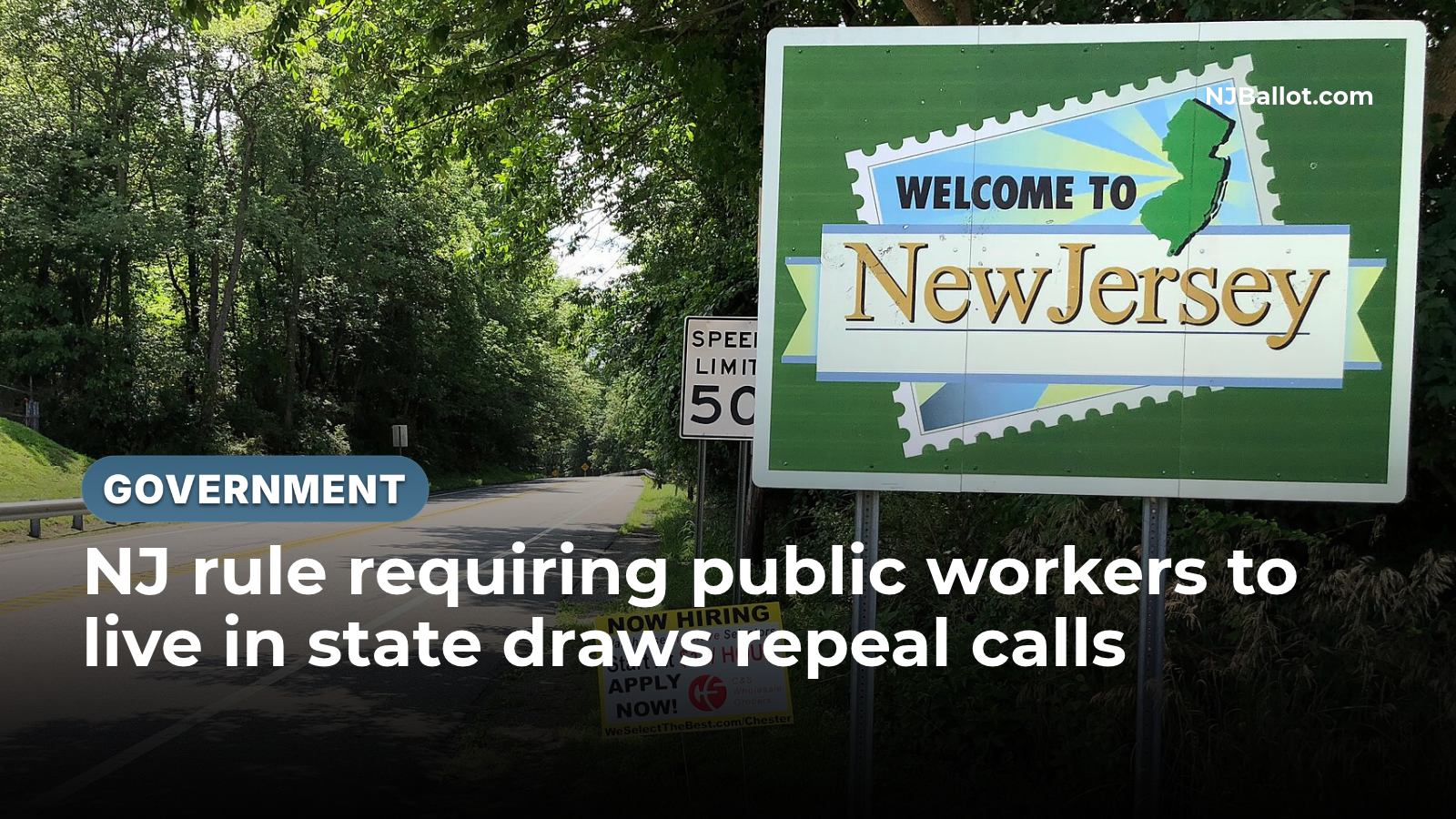

Since 2011, most new state, county, town and school employees have had one year to make New Jersey their main home. A five-member state committee decides who may live elsewhere.
Most people hired by New Jersey's state government, a county, a town or a school district have one year to make the state their main home or risk removal from the job, under a law that took effect in 2011.
A group of New York lawmakers that includes New York state Sen. James Skoufis (D, 42nd District) has asked New Jersey Gov. Mikie Sherrill and New Jersey's legislative leaders to repeal it. Their letter argues that qualified workers in nearby Orange and Rockland counties could help fill those jobs, Mid-Hudson News reported Nov. 23.
"We are locked out of every single public-sector job in northern New Jersey," Skoufis said in a Spectrum News report published Nov. 25. "Meanwhile, if a resident in Bergen County or elsewhere in New Jersey wants to be a teacher in Orange County or Rockland County, there is no problem with that."
Sherrill's office had not responded to Spectrum News about the letter when the outlet published its report.
The New Jersey Senate passed bills to ease the rule for school employees in January 2022, June 2023 and May 2024. Each one died without an Assembly vote when its two-year legislative session ended.
Meanwhile, a state task force on public school staffing recommended in February 2023 that New Jersey end the rule for school staff and other public workers alike. Bills to loosen or repeal it are back before the Legislature this session.
The rule reaches state, county, town and school jobs
The law covers state government, including its authorities, boards and commissions, as well as public colleges and universities, county and town governments and school districts, according to the statute. School districts include county vocational schools and educational services commissions.
Such workers must live in New Jersey, though not necessarily in the town or county where they work. County and municipal governments may have their own residency requirements beyond the state law, the state Department of Labor and Workforce Development notes.
Before 2011, the state's residency law covered only the governor, legislators, cabinet department heads and judges, according to the 2010 bill that widened it.
That bill had backers in both parties, among them then-Gov. Chris Christie, a Republican, and then-Senate President Stephen Sweeney, a Democrat. For anyone on a taxpayer-funded payroll, living in New Jersey was a "fair and reasonable expectation," the bill's prime sponsor, then-state Sen. Donald Norcross (D, 5th District), told The Philadelphia Inquirer in 2010.
Public employee unions objected to the first version of the bill, which gave new hires four months to move and workers already living out of state two and a half years. The New Jersey Education Association said that version would change the terms for workers after they had already been hired, spokeswoman Kathy Coulibaly told The Inquirer at the time.
"It just doesn't seem like good public policy without considering the reality of many people's lives," she said.
Before the Senate's first vote in May 2010, lawmakers amended the bill to give new hires a year instead and let workers already out of state keep their jobs without moving.
Christie returned the bill in February 2011 with recommended changes, which lawmakers accepted, and signed it May 17, 2011. His message commended the sponsors "for their efforts to increase employment opportunities for New Jersey residents, by ensuring that citizens throughout the State enjoy access to public positions in their communities."
The New Jersey Education Association still wants the rule gone. "We opposed that bill when it was passed 10 years ago and we support its repeal now," its spokesman Steven Baker told Patch in December 2021. The union backed the school-staff bill the Senate passed in June 2023.
The law sets three tests for a worker's "principal residence," and all three must point to New Jersey. They cover where the worker spends most nonworking time, the place that is "most clearly the center of the person's domestic life" and the address the worker uses as a legal and voting residence. Meeting one or two is not enough.
New hires get one year from their start date to meet that test. A worker who later falls short for any 365-day stretch no longer qualifies for the job, and any public official or New Jersey citizen can file a lawsuit asking a Superior Court judge to remove the worker.
Workers who want to move out need permission first
People who already held public jobs on Sept. 1, 2011, while living in another state did not have to move. They keep that protection as long as they stay in public service without a break of more than seven days, the law says. A leave of absence does not count as a break, under a state Civil Service Commission rule, but a separation from the job of more than seven days, through a layoff, resignation, retirement or firing, does.
A worker who already lives in New Jersey needs an exemption before moving out, according to 2011 guidance from the state Civil Service Commission that the state Department of Labor and Workforce Development still posts. A worker who moves without one can face removal, though an employer may first tell the worker to return, the guidance says.
The law itself exempts visiting professors and researchers at public colleges, as well as full-time state employees whose jobs require them to work mostly outside New Jersey. Public colleges can also exempt faculty and staff jobs that need special expertise, if they list those jobs in a yearly report explaining that the rule would make it hard to recruit against schools in other states.
A December 2018 law added NJ Transit engineers and mechanics, plus any other NJ Transit position that its board of directors certifies as a position of "critical need." Those jobs are exempt without going to the state committee that otherwise decides exemption requests.
A state committee rules on hardship and critical need
Other workers who want to live outside New Jersey can ask the Employee Residency Review Committee, a five-member state panel, for an exemption based on "critical need or hardship." The governor appoints three members, and the Senate president and Assembly speaker appoint one each, according to the law.
The committee has 30 days to act on a request. If it does not, the request fails, and the worker still has to live in New Jersey. Cabinet department heads and judges cannot apply at all.
An exemption covers only this law, the Labor Department says. Employers can still require in-person work. Other residency rules, such as one in a town ordinance or a job contract, still apply too.
Critical-need requests rest on a letter from the employer explaining why it needs this worker. The letter must be on agency letterhead, no more than 90 days old and signed in pen by a director, department head or other higher official at the employer, the committee's forms say. A typed, pasted-in or electronic signature does not count.
Hardship requests take "substantial documentation," the committee's checklist says. For a money-based claim, that means proof of income, a budget and evidence comparing housing in New Jersey with housing where the worker wants to live. A medical claim usually needs a letter from the worker's doctor or other provider, signed by hand, backing up the worker's account.
The committee holds its hearings by teleconference, where the body swears in each applicant. Its hearing flow chart lists the common outcomes as "granted, granted for a limited term, tabled for insufficient documentation, and denied." One hardship exemption granted in September, for example, runs only until Dec. 31, 2027.
At its most recent hearing, on Nov. 18, the committee took up requests from workers at public school districts, a state university, NJ Transit, state departments and a county sheriff's office, its posted results show.
Courts and lawmakers have weighed the rule
In February 2021, a state Superior Court judge sided with a Somerville High School teacher whom the Somerville Board of Education had gone to court to remove, New Jersey 101.5 reported at the time. The board's position was that the teacher moved to Pennsylvania in 2017 without first getting an exemption. The teacher kept the job.
The judge found the law's "critical need or hardship" standard unconstitutionally vague, Spectrum News reported. However the judge did not strike down the law, and said that any change to the law, or its repeal, is for the Legislature to decide, according to the same report.
The ruling settled only that teacher's case. The law still applies to everyone else.
The task force that recommended ending the rule was formed in November 2022, under an executive order from then-Gov. Phil Murphy aimed at filling teacher and support staff jobs.
"Especially for school districts that border other states, the residency requirement significantly restricts the recruiting pool for educators," the task force's February 2023 report said.
A bill the Senate passed in May 2024 would have given new school hires three years to move to New Jersey if the hiring district had first advertised the job to state residents for at least three months and tried in good faith to hire one.
After that bill died with the 2024-25 session, Senate Majority Leader M. Teresa Ruiz (D, 29th) and Sen. Shirley K. Turner (D, 15th) reintroduced it on Jan. 13, 2026, with Democratic and Republican co-sponsors. That bill sits in the Senate Education Committee while an identical bill is pending in the Assembly.
Two other bills introduced the same day are also in committee. One, in the Assembly, would give newly hired teachers two years, instead of one, to move to New Jersey if their district had advertised the job for at least six months and tried in good faith to hire a state resident.
The other, sponsored by Republicans in both houses, would repeal the rule for all public workers except the governor, legislators, cabinet department heads and judges.
Skoufis, the New York senator, says the rule hurts New Jersey public workers who would rather live in Orange or Rockland County and could cost New Jersey a pool of Hudson Valley workers, Spectrum News reported.
He said New York might consider a similar law aimed only at New Jersey, or a lawsuit. "The idea would be if a neighboring state has this type of law, then we have a similar type of law specific to that state," he said.
Unless the law exempts the job, living outside New Jersey takes the committee's approval. The committee meets next on Wednesday, Dec. 16.
Sources
Baldwin, Carly, Patch, "NJ Teachers May No Longer Be Required To Live In New Jersey" (Dec. 21, 2021)
Camera, John, Spectrum News, State of Politics, "N.Y. officials press N.J. governor to repeal public-worker residency rule" (Nov. 25, 2026)
Lu, Adrienne, The Philadelphia Inquirer, "N.J. bill mandates public employees live in state" (March 11, 2010)
Mid-Hudson News, "State lawmakers ask NJ governor to scrap 'New Jersey First Act'" (Nov. 23, 2026)
New Jersey Civil Service Commission, memorandum from Chair and Chief Executive Officer Robert M. Czech to all state human resources directors, "P.L. 2011, c. 70 (N.J.S.A. 52:14-7) – 'New Jersey First Act'" (Oct. 7, 2011)
New Jersey Civil Service Commission, "New Jersey Residency," adopted amendments, N.J.A.C. 4A:2-2.3 and 2.5 and 4A:4-2.11 (adopted Feb. 8, 2012)
New Jersey Department of Labor and Workforce Development, Employee Residency Review Committee, "Application for Exemption From the Provisions of N.J.S.A. 52:14-7a (NJ First Act)" (revised Sept. 11, 2025)
New Jersey Department of Labor and Workforce Development, Employee Residency Review Committee, "Checklist for NJ First Act Exemption Request" (accessed Nov. 26, 2026)
New Jersey Department of Labor and Workforce Development, Employee Residency Review Committee, "Hearing Process Flow Chart" (accessed Nov. 26, 2026)
New Jersey Department of Labor and Workforce Development, Employee Residency Review Committee, "Results for the Hearing of November 18, 2026" (accessed Nov. 26, 2026)
New Jersey Department of Labor and Workforce Development, Employee Residency Review Committee, "Results for the Hearing of September 16, 2026" (accessed Nov. 26, 2026)
New Jersey Department of Labor and Workforce Development, "New Jersey First Act" (accessed Nov. 26, 2026)
New Jersey Education Association, Legislative Action Center, "S 904: Eliminates requirement for State residency of public school employees for period of three years" (accessed Nov. 26, 2026)
New Jersey Legislature, Bill No. A146, "Eliminates requirement for State residency for public officers and employees with limited historic exceptions," sponsored by Assemblywoman Dawn Fantasia and Assemblyman Michael Inganamort, 222nd Legislature (Jan. 13, 2026); companion Bill No. S2512, sponsored by Senator Declan J. O'Scanlon Jr. and Senator Parker Space
New Jersey Legislature, Bill No. A2607, "Establishes exemption from State residency requirement for certain public school teachers for two years," sponsored by Assemblywoman Carmen Theresa Morales and Assemblyman Cody D. Miller, 222nd Legislature (Jan. 13, 2026)
New Jersey Legislature, Bill No. S1730, bill history and sponsors, 214th Legislature (accessed Nov. 26, 2026)
New Jersey Legislature, Bill No. S1730, conditional veto message of Gov. Chris Christie, "Senate Bill No. 1730 (First Reprint)," 214th Legislature (received in the Senate Feb. 7, 2011)
New Jersey Legislature, Bill No. S1730, "Requires all public officers and employees to reside in State," as introduced, sponsored by Senator Donald Norcross and Senator Kevin J. O'Toole, 214th Legislature (March 11, 2010)
New Jersey Legislature, Bill No. S2181, bill history and sponsors, 221st Legislature (accessed Nov. 26, 2026)
New Jersey Legislature, Bill No. S2181, "Eliminates requirement for State residency of public school employees for period of three years," first reprint, sponsored by Senator M. Teresa Ruiz and Senator Shirley K. Turner, 221st Legislature (May 13, 2024)
New Jersey Legislature, Bill No. S2205, "Eliminates requirement for State residency of public school employees for period of three years," sponsored by Senator M. Teresa Ruiz and Senator Shirley K. Turner, 222nd Legislature (Jan. 13, 2026); companion Bill No. A2525, sponsored by Assemblywoman Rosaura Bagolie
New Jersey Legislature, Bill No. S4203, "Eliminates requirement for State residency of public school employees for period of three years," bill history and sponsors, sponsored by Senator M. Teresa Ruiz and Senator Steven V. Oroho, 219th Legislature (accessed Nov. 26, 2026)
New Jersey Legislature, Bill No. S904, "Eliminates requirement for State residency of public school employees for period of three years," bill history and sponsors, sponsored by Senator M. Teresa Ruiz, Senator Steven V. Oroho and Senator Shirley K. Turner, 220th Legislature (accessed Nov. 26, 2026)
New Jersey Legislature, "Frequently Asked Questions" (accessed Oct. 31, 2026)
New Jersey Legislature, legislator roster, party, district and leadership posts (accessed Nov. 26, 2026)
New Jersey Legislature, New Jersey Statutes, New Jersey First Act, N.J.S.A. 52:14-7, "Residency requirements for State officers, employees; exceptions" (accessed Nov. 26, 2026)
New Jersey Legislature, P.L.2011, c.70, "An Act concerning residency requirements for public officers and employees and amending R.S.52:14-7" (May 17, 2011)
New Jersey Legislature, P.L.2018, c.162, "An Act concerning reforms of the New Jersey Transit Corporation, amending various parts of the statutory law and supplementing P.L.1979, c.150" (Dec. 20, 2018)
New Jersey Legislature, Senate Education Committee, "Statement to Senate, No. 2181," 221st Legislature (May 6, 2024)
New Jersey Legislature, Senate State Government, Wagering, Tourism & Historic Preservation Committee, "Statement to Senate Committee Substitute for Senate, No. 1730," 214th Legislature (May 13, 2010)
New York State Senate, "James Skoufis," senator page (accessed Nov. 26, 2026)
Task Force on Public School Staff Shortages in New Jersey, "Initial Recommendations from Members of the Task Force on Public School Staff Shortages in New Jersey," posted by the New Jersey Department of Education (February 2023)
Vogt, Erin, New Jersey 101.5, "NJ teacher, who lives in PA: Residency law is 'unconstitutional'" (March 23, 2021)
Photo: Famartin/Wikimedia Commons, CC BY-SA 4.0, modified