
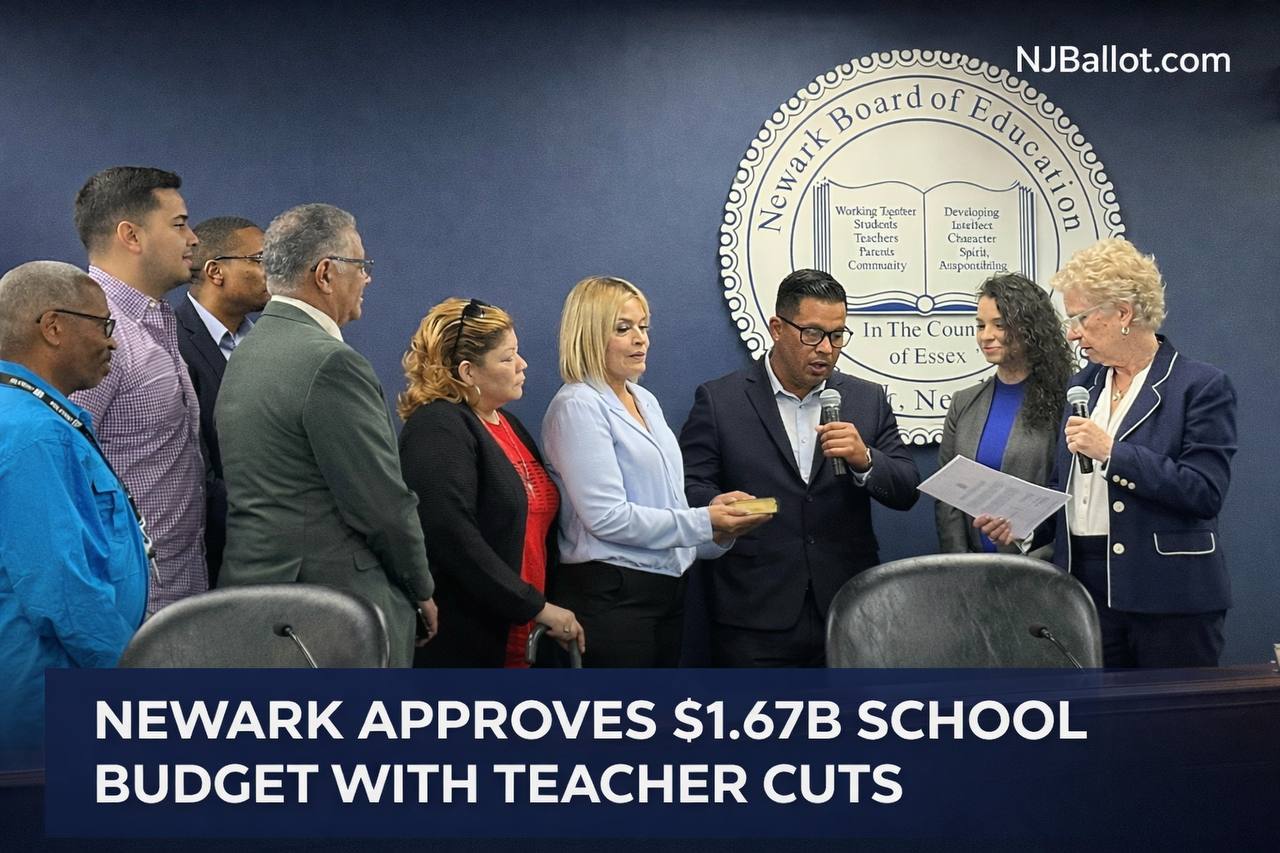

NEWARK—On March 28, Newark Public Schools approved a $1.677 billion budget that includes a $3.5 million capital reserve for a new high school wing and a $2.7 million elementary playground. It also eliminates 45 positions, 30 of them classroom teachers. This is not a contradiction. It is the predictable outcome of a funding architecture where capital obligations carry legal enforcement mechanisms that personnel contracts lack.
Budget Cycles Show Trend of Increasing Aid
This pattern has calcified over three budget cycles. When Governor Phil Murphy increased School Funding Reform Act (SFRA) allocations to record levels in 2024, Newark received additional state aid, but the district still cut positions because the formula failed to address charter displacement mechanics. Murphy’s FY2025 budget had also eliminated $20 million in stabilization aid that previously allowed school districts to paper over the structural gap between incoming revenue and outgoing charter pass-throughs. School aid has increased since the inauguration of Mikie Sherrill in January, at least on paper. Her FY2027 budget, submitted in February, provides record $12.4 billion statewide K-12 spending, including a $60.6 million increase in state funds for Newark.
The same week as Newark's vote, the Paterson Board of Education voted 7-2 to advance an $852 million preliminary budget that threatens up to 200 layoffs alongside an 8% property tax increase. Board members Kenneth Simmons and Commissioner Teague opposed the measure, but the budget advanced.
These concurrent crises are mechanically tied to a slow contraction in the financial sector that has begun to erode the municipal tax bases these budgets assume are stable. The Department of Labor's WARN filings show 409 high-salary positions eliminated in March alone: at Prudential (54 in Newark), JPMorgan Chase (134 in Jersey City), UBS (103 in Weehawken), and Fiserv (118 in Berkeley Heights). Since July 2025, the sector has shed 4,715 jobs statewide. Cumulatively, JPMorgan alone has reduced its New Jersey workforce by 374 positions since July 2025, though the bank maintains 12,500 remaining positions and characterizes the cuts as "regular business management."
The Covenant Constraint
The explanation for Newark's simultaneous revenue increase and workforce reduction lies in the binding hierarchy of budget obligations. Sherrill's proposed budget increases statewide K-12 spending to a record $12.4 billion, and includes $60.6 million more in education funding for Newark. Yet the district is cutting teachers anyway, because $433.39 million of its spending (some 26% of the total) flows to charter schools under enrollment-based formulas mandated by state law.
When a parent transfers a student from a traditional public school to a charter, the per-pupil allocation "follows the child." The district's fixed costs, including debt service on facilities, central administration, building maintenance and mandated reserve funds, do not.
Under the SFRA formula, fully funded for the first time in FY2025, per-pupil funding "follows the child" to charter schools at 90% of the district's calculated base cost. For Newark, that base cost was set at $14,972 for Newark in the 2025-26 school year. This figure, which represents the amount that districts require to educate the average student, serves as the calculation benchmark for charter pass-throughs. Factoring in costs of transportation, special education and other needs, Newark’s per-pupil charter school costs came to about $20,000 in the 2026 fiscal year. More recent enrollment data remains under privacy embargoes.
For Paterson, where charter enrollment climbed to 8,888 students, this formula drove pass-through obligations up $27.5 million, to a total of $188 million. That sum that accounts for the full per-pupil allocation, including 90% of base costs and any categorical aids for security and special education, not merely the base cost figure alone.
The full implementation of the SFRA eliminates the transitional aid that gave districts a buffer against this discrepancy. With charter costs rising and transitional aid gone, the result is mechanical: state aid functions as replacement revenue for charter obligations, while districts resolve the remaining gap by reducing variable costs, rather than fixed obligations.
But the distinction between "fixed" and "variable" costs is not merely fiscal, it is also legal. Newark's capital commitments, including the $3.57 million New Media High School reserve and $2.68 million Belmont-Runyon Elementary obligation, stem from current-year budget appropriations for capital improvements. By contrast, while the district's collective bargaining agreement with the Newark Teachers Union offers teachers some protection from firing, N.J.S.A 18A:28-9 permits districts to reduce the workforce "for reasons of economy."
Superintendent Roger León acknowledged this constraint hierarchy following the March 28 vote, saying, "We have to make difficult decisions." What he meant was that the district can legally fire 30 teachers, but it cannot legally pause the New Media High construction without triggering credit rating consequences and possible litigation. The capital investments are protected by long-term financing mechanisms. The teaching positions are protected only by bargaining provisions that dissolve under fiscal stress and give way to state law.
The Tax Base Compression
The 409 layoffs in the financial sector compress this system further. High-salary financial positions generate disproportionate property tax revenues, particularly in Essex County where commercial properties carry annual tax burdens that far outweigh residential ones.
JPMorgan Chase characterized its 134 Jersey City reductions as "regular business management" and noted that 700 positions remain open statewide. Prudential describes its 54 Newark cuts, part of 237 total headquarters reductions since July 2024, as strategic realignment with "evolving customer needs." But the effects on municipal budgets are the same regardless of corporate intent. When a $150,000 position is eliminated or relocated, the associated property tax liability vanishes with it. Newark's commercial property tax base faces long-term erosion from the March financial sector layoffs. The school budget's charter obligations, however, remain fixed by enrollment counts that do not fluctuate with the local tax base.
The Stay NJ property tax relief program, co-sponsored by Assembly Speaker Craig J. Coughlin (D-Middlesex) in 2024, faces this compression directly. Governor Sherrill's budget reduces Stay NJ benefits from $6,500 to $4,000 and lowers the income eligibility ceiling from $500,000 to $250,000. A Newark household with a working spouse and a teacher earning near the starting salary of about $70,000 faces a net fiscal swing from reduced state relief plus a $39.94 local school tax increase, while watching the district eliminate positions held by residents in similar income brackets.
The Intervention Horizon
The biggest risk for Newark is state receivership, and with it, a reversal of who controls these decisions. The concern is more than hypothetical. On March 27, the Supreme Court denied Lakewood Public Schools' appeal for additional aid, clearing the path for Education Commissioner Lily Laux to assume control. Lakewood faces $143 million in state loan debt and a $140 average tax hike after fixed costs consumed state aid beyond sustainable thresholds.
Newark currently has a significant portion of state aid committed to fixed costs like debt servicing, charter pass-throughs and administrative mandates. With charter enrollment growing and SFRA implementation removing transitional buffers, Newark risks eventually approaching statutory intervention thresholds for state monitor appointment. Under N.J.S.A. 18A:7A-55, a state monitor may be appointed when districts exhibit deficit balances, adverse audit opinions, material weaknesses in internal controls, or late audit submissions.
Here is the institutional irony: if Newark falls into receivership, the Commissioner would assume oversight authority to oversee fiscal management and expenditures, including budget reallocations and approvals of purchase orders. The state intervention designed to fix fiscal distress would actually invert the district's current constraint hierarchy, giving the monitor oversight of capital contracts that elected boards cannot easily modify, while potentially reversing personnel decisions.
The Republican Alternative
Republican budget critiques highlight the same structural pressures, but from a different angle. State Senator Declan O'Scanlon (R-Monmouth) argues that Sherrill's 6% cap on aid increases places artificial constraints on districts historically underfunded by the SFRA formula. However, the GOP alternative, the proposal by 2025 gubernatorial candidate Jack Ciattarelli to equalize per-pupil aid regardless of poverty concentration, would convert Newark's $60.6 million increase into a reduction of approximately 30% of current aid.
Those cuts would force the district to eliminate over 900 teaching positions based on average salary and benefit costs. Newark Mayor Ras Baraka characterized that plan as "taking [money] out of the pockets… of Black and Brown children." Both approaches highlight Newark’s structural bind, where the only choices were systematic constraint or drastic disruptions.
Conclusion
Newark's budget is not broken. Indeed, it is performing exactly as designed: increasing gross revenue while reducing instructional capacity to satisfy fixed obligations. The $60.6 million state aid increase and the 30 teacher layoffs are not conflicting headlines. They are the same fiscal event viewed from opposite ends of the accounting ledger. Revenue enters as education funding and exits as charter pass-throughs and capital amortization, leaving workforce reduction as the remaining variable adjustment mechanism.
The district just traded 30 teaching positions to maintain its bond rating. The trade worked---the district meets capital obligations, even if it fires the math teachers---but it only works until the fiscal distress triggers under N.J.S.A. 18A:7A-55 take effect. At that point, the constraint hierarchy inverts, and a state monitor will oversee which covenants get honored and which teachers get rehired.
Related Articles
• Wave of Layoffs Hits New Jersey: Major Employers Cut Thousands of Jobs in 2026
• NJ Governor Sherrill Submits $60.7B Budget With Record $4.2B Relief
• Cherry Hill Schools Face $14.5M Cuts as Tax Hike Looms Tonight
• Ras BarakaResponds to Viral Claims About Newark Mayor’s Office Budget
Sources
• Patch Newark, "$1.6 Billion Newark School Budget Has Tax Hike, Teacher Cuts" (March 22, 2026)
• TapInto Newark, "New Schools, Enrollment Shifts, Ambitious Capital Projects Shape Nearly $1.7 Billion Newark School Budget" (March 27, 2026)
• Office of the Governor, "ICYMI: Detailed Budget Book for Governor Sherrill's Proposed FY2027 Budget Plan Now Available Online" (March 24, 2026)
• Jessie Gómez, Chalkceat Newark, "Record school aid, tutoring, youth mental health: key education priorities in New Jersey governor 2027 budget" (March 10, 2026)
• Declan O'Scanlon, "State Budget Outrageously, Unfairly Totally Screws Many School Districts Out of Their Fair Share" (March 12, 2026)
• State of New Jersey, Department of Education, "Educational Adequacy Report 2026" NJDOE (2026)
• Joe Malinconico, Paterson press "Will Paterson School District Be Cutting 200 Jobs?" (March 26, 2026)
• David Hutter, NJBIZ, "Major Financial Firms Cut 409 Jobs in NJ in March" (March 31, 2026)
• Steve Strunsky, NJ.com, "Layoff Notices Top 800 for N.J. Workers at Several Major Companies This Month" (February 21, 2026)
• Amanda Wallace, NorthJersey.com, "Hundreds of employees expected to be laid off at these NJ banks," (March 30, 2026)
• New Jersey Department of Labor and Workforce Development, "2026 WARN Notices" (2026)
• Teach Newark, Newark Board of Education, "Salary and Benefits" (retrieved April 2, 2026)
• Jessie Gómez and Catherine Carrera, Chalkbeat Newark, "Newark Teachers Union New Contract Includes Higher Salary Extended Workday" (June 7, 2024)
• Justia, "2025 New Jersey Revised Statutes" Justia (2025)
• New Jersey Department of Education, "2024-25 Audit Program Cover Intro" (June 30, 2025)
• Stacey Barchenger, Asbury Park Press, "Lakewood Schools Proposed Budget Hikes Taxes by $140 Per Home" (March 27, 2026)
• John Reitmeyer, NJ Spotlight News, "NJ's School Funding Formula Once Again a GOP Target" (October 31, 2025)