
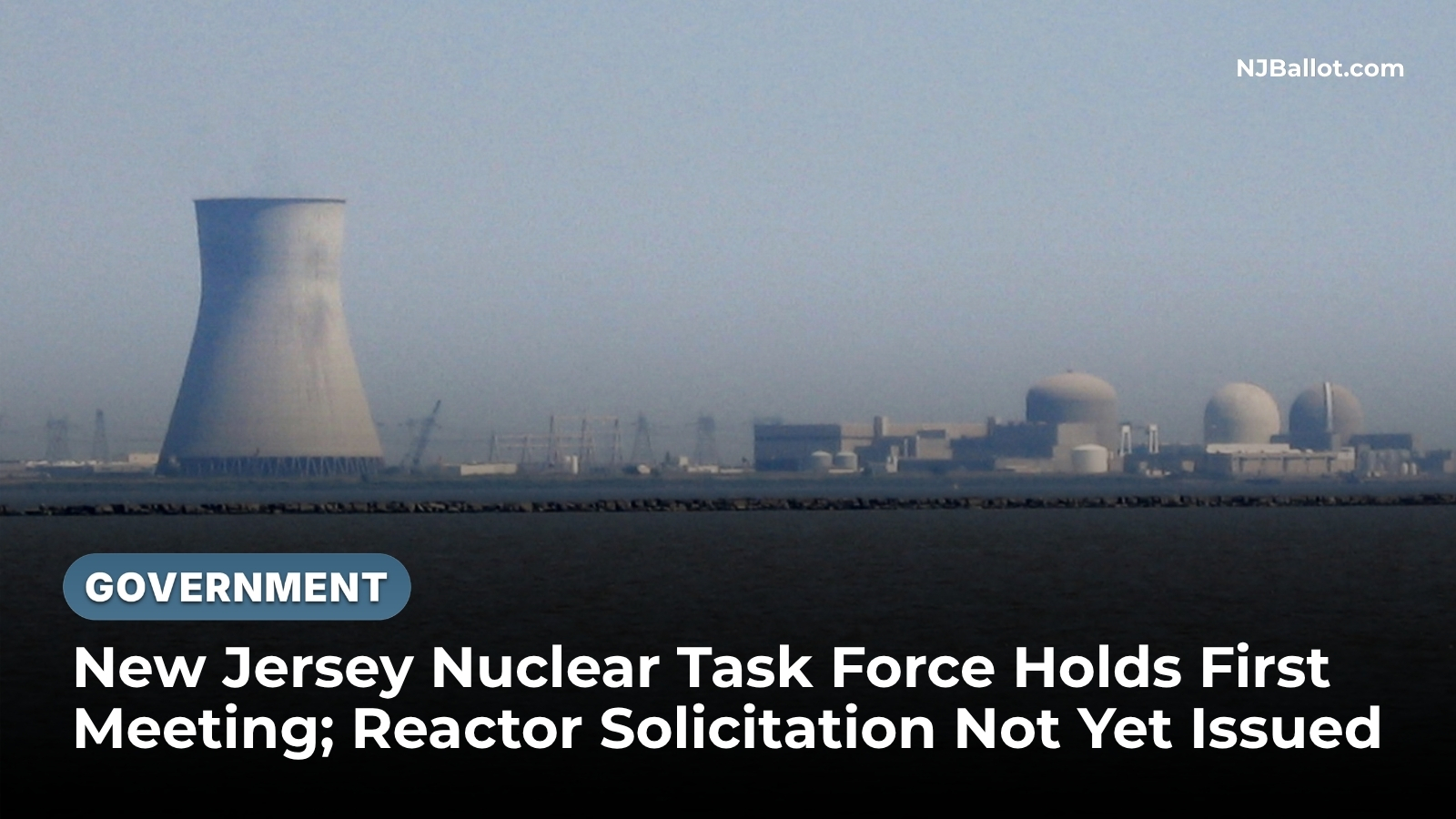

Thursday's meeting reviewed a draft charter and established five subcommittees. The state has until January 9, 2027 to issue its solicitation for new nuclear reactors; the process, the companies positioned to respond, the ratepayer safeguards, and the projected cost, explained.
New Jersey's new Nuclear Task Force convened for the first time on Thursday, the 81st day of the 180-day window to solicit bids for new nuclear reactors. The solicitation, due by January 9, 2027, had not been issued as of the meeting.
The group reviewed a draft charter and stood up five subcommittees covering regulatory and permitting; financing and deal structure; supply chain and technology; workforce growth and training; and public trust and confidence, the same five focus areas the administration set in April.
“We've assembled the best of the best on this Task Force, and we are going to take big swings today to secure New Jersey's energy future tomorrow,” Sherrill said Thursday in a statement announcing the meeting.
The administration also went live with Nuclear NJ, a public website carrying statements from legislative supporters, including Senate President Nicholas Scutari.
Thursday's meeting followed a sequence that spans 17 months and two governors. The New Jersey Board of Public Utilities under Governor Phil Murphy issued a request for information on prospective new nuclear generation in May 2025. Sherrill created the task force by executive order on January 20, her first day in office, signed a law in April ending a decades-long de facto moratorium on new reactor permits, and on July 13 signed the Power NJ Act, which passed both chambers without a dissenting vote and took effect immediately.
The board has 180 days from the law's July 13 effective date to issue that solicitation, formally a request for expressions of interest. Bidders then get 60 days after the request publishes to file proposals. Each filing must carry a Class IV cost estimate accurate to within roughly minus 30 or plus 50 percent, an estimate of the monthly-bill impact for a typical customer, and a commitment to a project labor agreement that pays prevailing wages on construction work.
The board has 90 days after a complete filing lands to provisionally qualify one or more projects; the qualification lapses if the two sides don't reach a stipulation in 12 months. Once a stipulation reaches its agenda, the board has 90 days to issue a final order that approves, modifies or rejects it. The board's final order can go only to a project entity that can “demonstrate financial integrity and sufficient access to capital, including a loan or loan guarantee from the United States Department of Energy or Department of Commerce.” The administration's own timeline projects the final order landing before July 8, 2028.
Jersey Central Power & Light (JCP&L), one of New Jersey's electric distribution utilities, told the board in a June 2025 filing that data-center growth, weak market signals and plant retirements have left the region facing what the utility called “a higher likelihood of outages during peak periods potentially starting in 2029.” The filing cited the regional power grid operator, PJM Interconnection, describing New Jersey as “an intensive net importer of power.”
Payments run through the Reliable Capacity Certificate: a certificate representing each megawatt-hour's environmental attributes. Every electric supplier selling power in New Jersey must buy the certificates in proportion to its sales, for terms of up to 40 years, and the money flows from suppliers to the project.
Nothing is paid until a plant delivers power to the grid. When the project sells electricity into PJM's markets, those earnings go back to customers; the statute gives the project 60 days to turn the money over and suppliers 90 more days to credit it to bills. The program is designed to support 1,100 megawatts or more of new capacity. But the 1,100 megawatts “shall constitute a program design parameter and shall not constitute a commitment by the State to procure any specific quantity of generation.”
Three companies start with the strongest hand in New Jersey
The most obvious bidder is Public Service Enterprise Group (PSEG), whose PSEG Nuclear subsidiary runs all of the state's operating nuclear plants: a 57 percent share of the Salem nuclear plant and all of the Hope Creek nuclear plant in Lower Alloways Creek Township. The two plants are Salem County's largest employer, with more than 1,600 workers. In 2016 the U.S. Nuclear Regulatory Commission issued PSEG an early site permit, an advance federal finding that the site is suitable for a new reactor, one of six such permits currently issued in the country.
PSEG used its August 4 second-quarter earnings call to describe the conditions any deal must meet. “We don't want to be in a high-risk market,” Chief Executive Officer Ralph LaRossa said on the August 4 second-quarter call. “These are 12 years, 12-year long projects,” he said, and “a successful framework for new nuclear will require an appropriate allocation of project risk.” The company is “looking for utility-like returns,” he added, “because we're looking for utility-like risk,” a regulated, predictable investment profile rather than open-ended construction exposure. PSEG is also in discussions with large power users about bilateral contracts tied to its existing nuclear plants. The same call disclosed that PSEG had proposed, in PJM's Reliability Backstop Procurement, dispatchable generation projects that could pair with large industrial users.
Holtec International, the Camden company now dismantling the retired Oyster Creek plant in Lacey Township, wants to build four small modular reactors on the site, a project the company estimates at 1,360 megawatts and roughly 4,000 construction jobs. On July 30, Holtec announced that the U.S. Nuclear Regulatory Commission had approved its plan for the rest of the dismantling, which the company says will free the site for redevelopment. The company is also leading the restart of the Palisades plant in Covert Township, Michigan, the first attempted restart of a retired U.S. reactor, backed by a $1.52 billion federal loan.
Constellation, the nation's largest nuclear operator and owner of 43 percent of Salem, filed in the docket on June 23, 2025. Its filing asked the state to clarify the radioactive-waste statute that has blocked new reactor permits, to support the federal tax credits new plants count on, to preserve federal loan programs and to fund early engineering and permitting work. The filing put construction costs in writing: roughly $4,000 to $10,000 per kilowatt of capacity depending on reactor design and project maturity, or about $4.4 billion to $11 billion for the program's 1,100-megawatt floor before overruns; other published estimates in the same figure run far higher. Constellation points to its Microsoft and Meta contracts in other states as the model for pairing reactors with data centers.
Every deal carries ratepayer protections and a reopen clause
A verified cost estimate anchors each deal, the baseline for assigning overruns to the developer. The state Division of Rate Counsel sees every filing and can petition the board to reconsider any order it issues. Each deal also faces a 30-day public comment window and a public hearing in the host municipality.
Section 6.e of the Power NJ Act lets a developer petition the board to reopen a signed deal and raise its approved construction costs. The board may grant the petition if the change was “reasonably unforeseeable” and necessary to keep the project alive, so long as it would impose no unreasonable costs on ratepayers.
Division of Rate Counsel Director Brian Lipman wrote to lawmakers during the final debate in June that the bill could add $7.80 to $22.43 a month to the average utility bill, the range tied to project delays: “This bill not only raises rates, but ultimately acts as a ratepayer subsidy of data centers.”
AARP's McDonald told a June hearing the bill was “a 40-year bill with no cost estimate, no cap on what ratepayers will have to pay, no guard rails to protect us against cost overruns,” and Environment NJ's O'Malley cited Rate Counsel's upper estimate of $22 a month. The New Jersey Business & Industry Association's Ray Cantor testified for the bill: “Nuclear power is not going to address our issues of affordability today. It's a longer-term play, but that's what we need to do. Plan for the future.”
In a May 2025 comment filed in the board's docket, Bill Wolfe, a former state Department of Environmental Protection policy analyst, wrote: “The entire modular nuclear program will go the way of the Hazardous Waste Facilities Siting Commission,” referring to the state's 1980s-era effort to site hazardous-waste facilities. He added that he hoped the program would die faster than “the garbage incinerator fad”.
Bidders' filings become public records in the board's docket, though developers can ask the board to shield financial details as confidential, so parts of the files may stay out of public view. Three formal chances for public input are written into the process: written comment on the draft deal, a public hearing in the host town, and a chance to be heard if a developer asks to reopen a deal. The first bidders' files, including the required monthly-bill projection, are due by spring at the latest.
Related Articles
Sherrill Signs Bill Ending 50-Year Nuclear Moratorium, Launches Task Force at Salem Plant
Sherrill Signs Power NJ Act as Rate Counsel Warns of 40-Year Ratepayer Lock-In
Sherrill Signs NJ Energy Bills in Woodstown, Claims $1B in Ratepayer Savings
Sherrill Unveils Four-Pillar Data Center Plan as Municipal Bans and Grid Pressure Mount
Sources
separation, each source on its own visual line:
• Constellation Energy Generation LLC, Response to NJBPU Request for Information, Docket No. QO25040202 (June 23, 2025)
• Jersey Central Power & Light Company, Comments, Docket No. QO25040202 (June 23, 2025)
• New Jersey Board of Public Utilities, Request for Information, Docket No. QO25040202 (May 21, 2025)
• New Jersey Legislature, Bill No. A4881/S4296, "Powering Opportunity, Workforce, and Energy Reliability for New Jersey Act" (approved July 13, 2026)
• Office of the Governor, "Governor Sherrill Signs Legislation Lifting 50 Year Nuclear Moratorium" (April 8, 2026)
• Office of the Governor, "Governor Sherrill Signs Legislation Launching Procurement Process for New Nuclear Energy & Setting Strong Safeguards to Protect Ratepayers from Costs" (July 13, 2026)
• Office of the Governor, "Governor Sherrill Convenes First Nuclear Task Force Meeting, Launches Nuclear Website" (October 1, 2026)
• U.S. Department of Energy, Loan Programs Office, Palisades project page (accessed October 2, 2026)
• U.S. Nuclear Regulatory Commission, "PSEG Power, LLC and PSEG Nuclear LLC; PSEG Site," 81 Federal Register (May 16, 2016)
• Bill Wolfe, Public Comment, Docket No. QO25040202 (May 20, 2025)
• Jersey Vindicator, "Nuclear Energy Bill Advances Despite Affordability Concerns" (June 23, 2026)
• Kamen Kraev, "NRC Approves Holtec's Oyster Creek Licence Termination Plan," NucNet (August 3, 2026)
• "PSEG (PEG) Q2 2026 Earnings Call Transcript," Motley Fool (August 11, 2026)
• New Jersey Globe, "OLS Seeks to Silence a Political Critic by Removing Him from Agenda Distribution List, Activist Claims" (February 23, 2023)
• New Jersey Monitor, "NJ Legislators Approve Bills on Data Centers, Voting Rights, and More" (July 1, 2026)
• Holtec International, "Oyster Creek's License Termination Plan Approved by the USNRC; Oyster Creek Project Planned to Feature Four SMR-300 Units" (July 30, 2026)
• Nuclear NJ, State of New Jersey public nuclear energy website (launched October 1, 2026)
• PSEG Corporation, Salem and Hope Creek Nuclear Generating Stations fact page (accessed October 2, 2026)
• The Brattle Group, "Brattle Economists Evaluate Impacts of the Salem and Hope Creek Nuclear Power Plants on New Jersey's Economy" (2020)
• Pillsbury, "PJM's Reliability Backstop Procurement Proposal—Fast-Track Capacity to Meet Rising Large-Load Demand," Gravel2Gavel (April 17, 2026)
Photo: "Salem and Hope Creek 2011" by NOAA Photo Library / Personnel of PEIRCE, CC BY 2.0, via Wikimedia Commons