
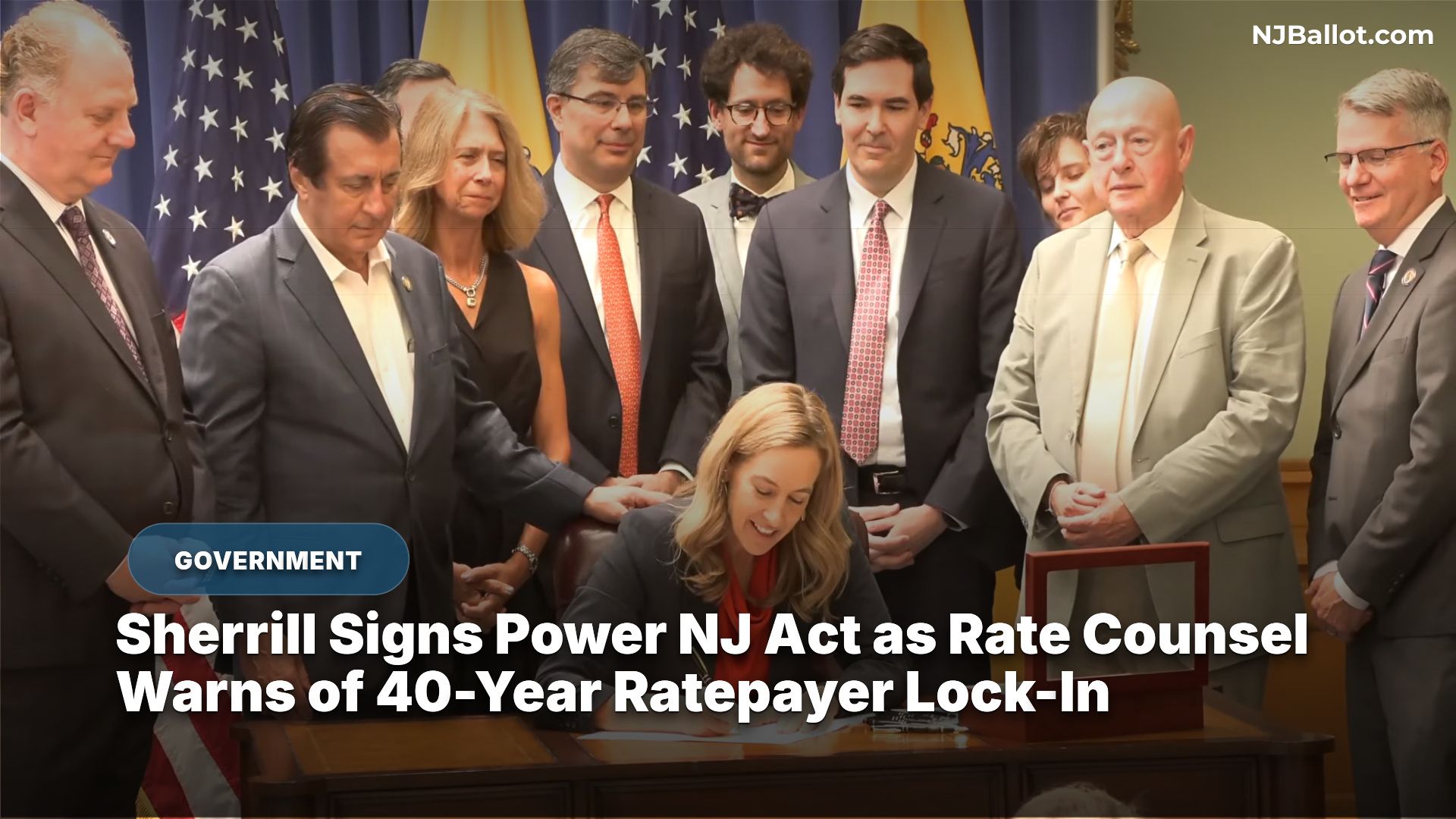

The Power NJ Act starts a competitive process for at least 1,100 MW of new nuclear generation. The administration claims $1 billion in annual savings from a report that did not model new nuclear generation.
Governor Mikie Sherrill signed the Power NJ Act on July 13 over the objection of the state's ratepayer advocate, who warned the bill would commit New Jersey families to 40 years of payments for nuclear generation. Brian O. Lipman, Director of the Division of Rate Counsel, had warned legislators in a May 27 letter that the measure "will require New Jersey ratepayers to pay for nuclear generation for the next 40 years" and "will place an unnecessary burden on ratepayers, provide little, if any, rate relief and will shift significant risk onto ratepayers."
New Jersey sits in PJM Interconnection, a regional grid serving 13 states where data center demand is adding $25.7 billion in capacity costs from 2026 through 2030, according to Synapse Energy Economics. The Sherrill administration points to those rising costs as justification for expanding generation. Rate Counsel argues the measure leaves ratepayers subsidizing data center demand rather than ensuring the facilities pay their fair share.
Law directs competitive process for new nuclear generation
The new law directs the Board of Public Utilities to open a competitive process for at least 1,100 MW of nuclear generation, with the Economic Development Authority joining later negotiations. The Governor's Office says this is part of an energy agenda that will save ratepayers $1 billion annually.
Ratepayers owe nothing until a facility is built and delivering power; utilities then purchase Reliable Capacity Credits at a fixed negotiated price. Before any plant operates, the board must determine that the project provides net benefit, reasonable costs and secured federal financing.
Lipman said ratepayers should not pay for data center demand they did not create. He said they are not the driving force behind the significant increase in demand and should not shoulder the costs or risks to build generation just to meet data center driven demand. He added: "This bill, rather than ensure that data centers pay their fair share, has New Jersey's ratepayers subsidizing data centers, both in and outside of New Jersey."
He also cautioned against the four-decade term. "No one knows what will happen over the next forty years," Lipman wrote, "and locking in a price now - at the height of demand may not be beneficial to ratepayers."
The only nuclear units built in the United States since 1990 offer a cautionary benchmark for New Jersey. Georgia Power's Vogtle Units 3 and 4 took roughly fifteen years to construct and cost more than $30 billion, more than double the original $14 billion estimate. The first unit entered service in 2023, the second in 2024.
The Governor's Office says its $1 billion annual savings claim draws on Synapse Energy Economics. The firm's November 2025 report modeled data center self-supply, PJM capacity reform, right-sizing utility profits and building electrification. Nuclear procurement was not among the modeled levers.
By 2030, a typical household could see annual savings of $467, and a moderately sized commercial customer could see $1,236. The four levers combined could cut statewide energy costs by $14.3 billion from 2026 through 2030. The authors cautioned that when multiple measures produced savings in the same year, the impacts could overlap, so they reported only the larger individual lever instead of adding the effects together.
Data centers drive regional costs, not local bills
The local bill impact is minimal, according to a Rutgers study, a finding that echoes Lipman's argument that the bigger issue is regional. Kiran Garimella, an assistant professor at the Rutgers School of Communication and Information, analyzed 22,834 ZIP codes across 24 states from 2014 through 2024. ZIP codes with data centers had monthly residential bills about $2.09 higher than ZIP codes without them — a small gap against the $164 average and a borderline result statistically.
When aggregated to the utility level, the effect was not statistically significant. Garimella cautioned: "For New Jersey, the main risk is probably not a single data center raising bills in the surrounding ZIP code. The bigger issue is regional."
Garimella pointed to the PJM capacity market as the real driver of ratepayer costs. The 2025/2026 auction cleared at $269.92 per megawatt-day for much of the region, up from $28.92 the year before. PJM attributed that spike to tighter supply, higher demand, market rule changes, and declining offered capacity, with analysts flagging data center load growth as one contributor. He cautioned that "that kind of regional capacity-market effect is not something a ZIP-level study is designed to isolate. But it can still matter for New Jersey households, because wholesale market costs eventually flow into retail bills."
Advocates warn of forty-year "blank check"
Crystal McDonald of AARP New Jersey cautioned legislators in June: "We're talking about a 40-year bill with no cost estimate, no cap on what ratepayers will have to pay, no guard rails to protect us against cost overruns. We can't sign a blank check to build a nuclear power plant when we're already struggling to pay the bill we have in front of us."
Doug O'Malley, State Director of Environment New Jersey, criticized the legislative pace: "No bill, I think, has moved quicker with a larger price tag and with a lack of a fiscal note."
The Board of Public Utilities must open expressions of interest by January 9, 2027. Proposals come due sixty days later, with provisional qualifications to follow by April 9, 2027. The Board of Public Utilities and the Economic Development Authority then have twelve months to negotiate stipulations, before a final board order must be issued by July 8, 2028. The contracts that the order authorizes will run for forty years.
Related Articles
• Sherrill Signs Bill Ending 50-Year Nuclear Moratorium, Launches Task Force at Salem Plant
• Sherrill Signs NJ Energy Bills in Woodstown, Claims $1B in Ratepayer Savings
• NJ Activates Summer Shutoff Protection as Grid Auctions Show Data Center Stress
• NJ committee votes 9-0 for data center reporting, but some metrics stay hidden
Sources
• New Jersey Department of the Public Advocate, Division of Rate Counsel, Brian O. Lipman, Director, Letter to Assembly Telecommunications and Utilities Committee regarding A4881 (May 27, 2026)
• New Jersey Governor's Office, "Governor Sherrill Signs Power NJ Act" (July 13, 2026)
• U.S. Energy Information Administration, "Georgia Power's Plant Vogtle Units 3 and 4" (July 7, 2026)
• Rutgers School of Communication and Information, Kiran Garimella, "Are Data Centers Raising Your Electric Bill? Mostly Not. Yet." (July 6, 2026)
• SJ Climate News, "New Jersey passes bill to expand nuclear energy" (June 2026)
• Synapse Energy Economics, "Policy Interventions to Address Rising Electricity Costs in New Jersey" (November 13, 2025)