
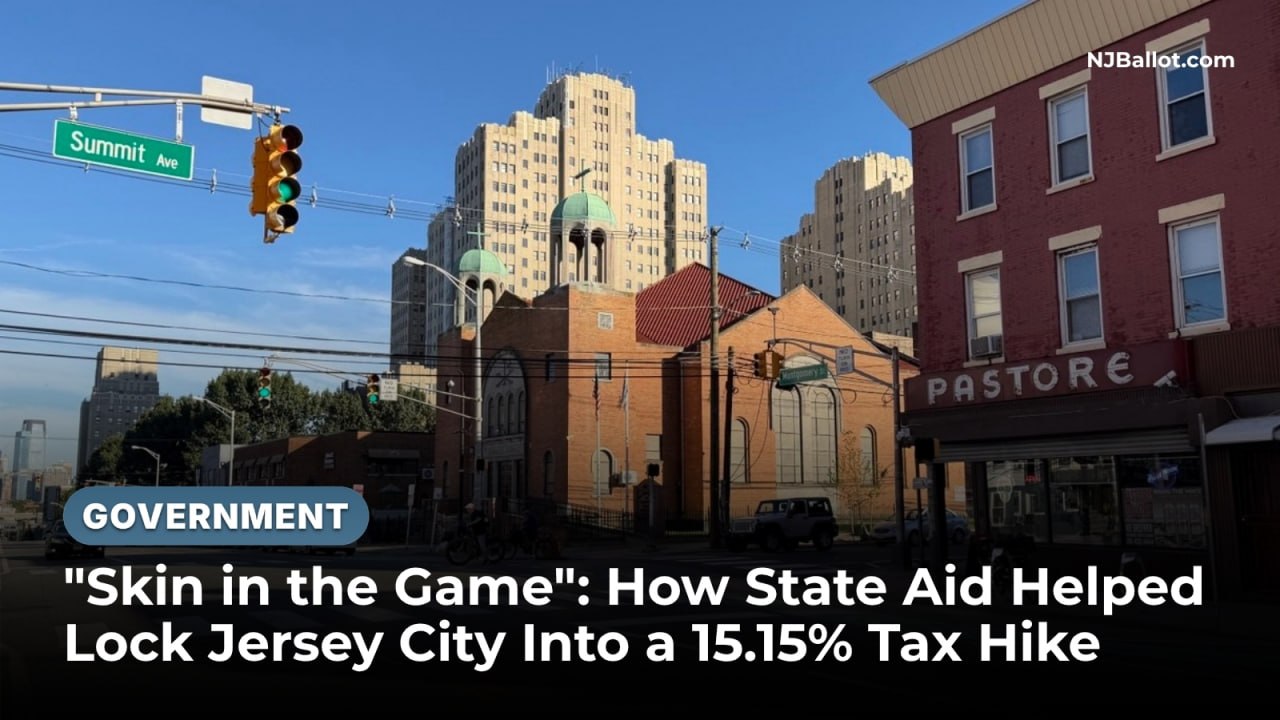

Jersey City homeowners are staring down a 15.15% municipal tax hike. The council approved it Aug. 26 after months of back-and-forth with Trenton. The state offered aid, but the price was steep: the city had to show it could bleed, too.
Ward F Councilman Frank Gilmore called that price skin in the game. In a Facebook Live video after the vote, Gilmore said state officials had floated tax increases of 15% or 20% during negotiations over a $105 million loan.
That tracks with what city finance officials told the council in July. The state Department of Community Affairs would sign off on a levy hike at 15% or 20%, they said. Stray from that number and the loan terms would get uglier — a shorter repayment window and a higher interest rate.
The council made it official Aug. 26. Nobody called it a win.
Nobody Called It a Win
The Municipal Council adopted an $886.4 million budget for 2026, locking in a 15.15% increase in the municipal property-tax rate. Resolution 26-536 records total appropriations and revenues of $886,416,892.79 and lists $458,568,888.35 to be raised through municipal taxation. The final vote was 8-0, with Councilman-at-Large Michael Griffin abstaining.
Griffin told the council he grew up in a community where 80% of residents live under the poverty line. He could not sign off on a tax hike he knew would push some of his neighbors toward foreclosure. He abstained. He was not the only one hurting.
"This is certainly not a victory today," said Ward C Councilman Thomas Zuppa Jr. "The pain of this tax increase will be felt in every corner of our city." Ward E Councilwoman Eleana Little added: "This is extremely painful and it cannot happen again." Former Councilwoman-at-Large Amy DeGise was blunter: "None of us are celebrating. None of us are taking a victory lap because it feels really bad when we are having eye contact with people and they are asking us what did you do?"
The 15.15% hike applies only to the municipal portion — the slice that pays for police, fire, trash pickup and road repair. It does not include the school tax, which the Jersey City Board of Education sets separately and which rose 17% this year, or the county tax, which Hudson County controls. A Jersey City homeowner's total bill is the sum of all three, and the municipal increase is just one layer of a larger stack.
The Human Cost
During the earlier debate, Greenville resident LaTrayer Sumter-Moreau told News 12 New Jersey her August quarterly tax bill had jumped $500. "It already hit me hard," she said. At the Aug. 26 meeting, Yvonne Balcer — who knows the downtown neighborhoods well — told the council her friends in Van Vorst Park and Paulus Hook were paying $40,000 a year. "So in my opinion, this budget did not cut a lot," she said. Peter Carter cut through the noise: "You guys got to understand something. You're not… We have homeless in Jersey City. With this 15 and 12% property tax, we're going to have more homeless people." Tina, who works with Ward F Councilman Frank Gilmore, said it was "depressing to see that so many people are so afraid of September of going into the winter and not having nowhere to go."
The anger was not limited to the council chamber. As Mayor James Solomon spoke at a rally criticizing corporate polluters, protesters pushed back — including with a box truck carrying an anti-tax message. At the subsequent council meeting, Steph, who runs the social media account @prevailingsentiment, said she paid for the truck. "I can pay to have that truck anywhere, any day of the week," she said. "We have a mayor more interested in photo ops than in doing the work."
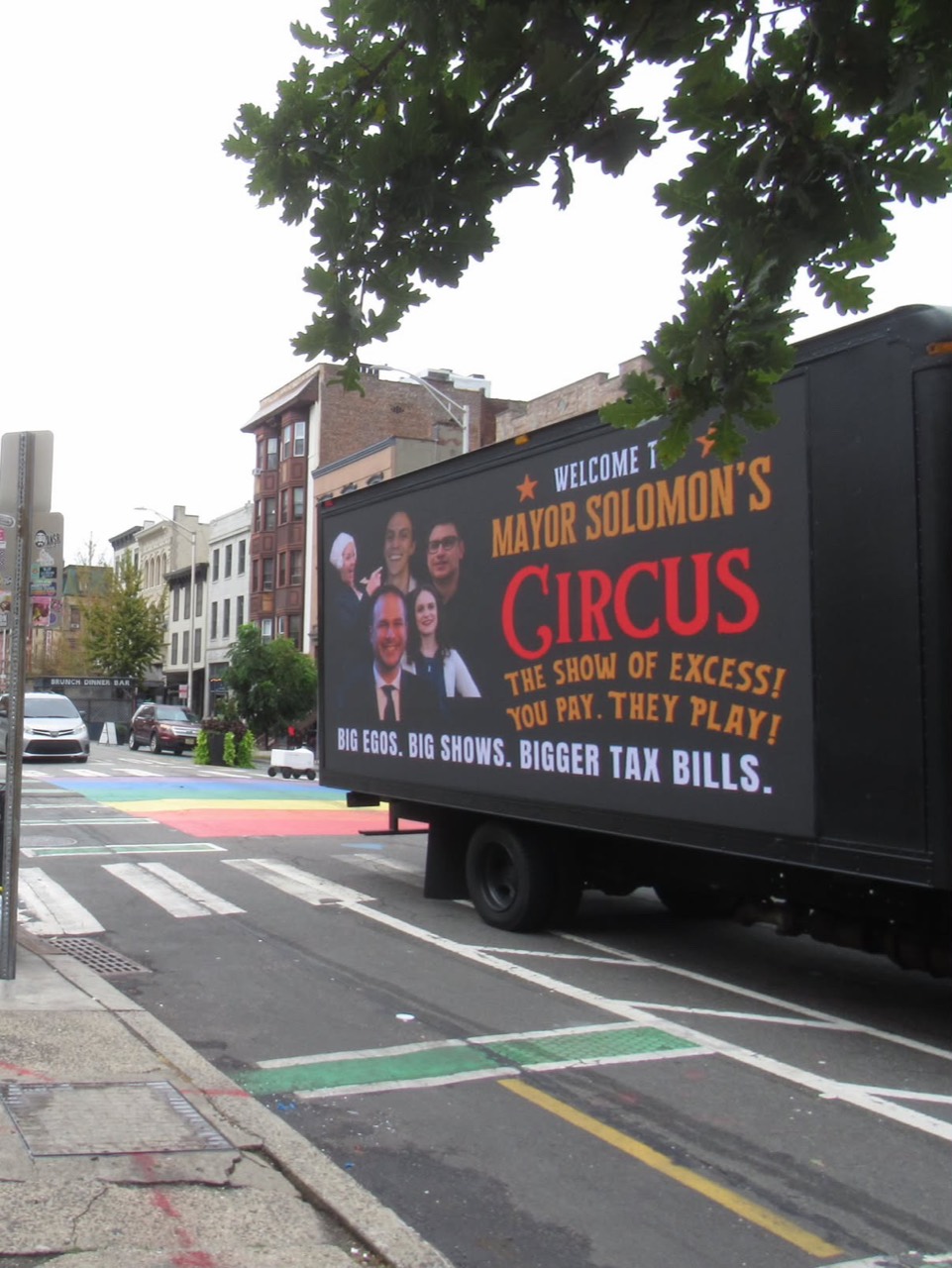
Steph said she organized the protest because Solomon, Assemblywoman Katie Brennan and two council members had participated in a Make Polluters Pay rally for state legislation that would fund climate resiliency projects statewide — none of it earmarked for Jersey City. The administration has argued that Jersey City, as a coastal city vulnerable to flooding, stands to benefit from any statewide resiliency fund. Steph disputed that framing, noting the city had not applied for available resiliency grants on its own. She told the council she had submitted an OPRA request to the state Department of Environmental Protection asking whether the city had applied for any grants since January 2026. The response she said she received: one grant, submitted by Sustainable Jersey City, not the city administration itself.
The administration has defended its position by noting that the $255 million gap was structural — the result of years of using one-time revenue for recurring costs, not a single-year spending spike. City officials have pointed to the $58 million in cuts they identified, including reduced police overtime, deferred non-essential hires and trimmed administrative costs, as evidence that the tax hike was paired with austerity. Councilwoman Danielle Brookes, who voted yes, told the council the budget "does not force austerity on our city workforce through mass layoffs" and restores funding for essential services that prior budgets had underfunded.
How We Got Here
The administration's proposed increase bounced around all summer. Solomon opened with 20%. After state support came through and the administration found more cuts, he brought it down to roughly 15%. The council formally advanced 15.5% in July before technical amendments shaved it to 15.15%.
The state aid package drove that progression. The city secured $120 million: a low-interest loan of $105 million and $15 million in direct aid. The council approved the loan agreement in July. City officials say that money, plus spending cuts, new tax revenue and growth in the tax base, formed the plan to close what they called a $255 million structural gap.
The 15% floor was not arbitrary. City officials told the council the figure was tied to two hard numbers: the debt service on the $105 million state loan, which added millions in annual repayment obligations, and the need to fund recurring costs that prior budgets had covered with temporary revenue. Health insurance alone was underfunded by tens of millions, according to the administration, and the city faced deferred charges from 2025 — bills pushed into future years rather than paid when they came due — that could no longer be carried forward. Without the 15% levy increase, officials said, the city would have fallen short of the state's solvency requirements and risked losing the loan entirely.
But Trenton was not offering a handout. The Division of Local Government Services had told the council 15% was the floor — the minimum hike the state would approve. Little confirmed it during the vote: "The state division of local government services has told us that 15% is the minimum tax increase they will approve this year." And the state kept squeezing. Days before the final vote, DCA examiners found a 2019 tax overpayment on the city's books that had to be appropriated in one year — adding roughly $3 million inside the cap. Finance Director Bill Viqueira told the council the issue had been "carried over" through multiple audits and "candidly should have been addressed in previous years." The administration drained reserve accounts to absorb it.
The amendments saved the average homeowner roughly $15 — from $612 to $597. They also moved $200,000 out of police overtime to reinstate a senior citizen transportation driver and added funding for mental health crisis response, park maintenance and tenant right-to-counsel services. The budget spared police and firefighters. But the city cut 31 employees. At the final meeting, Lavarro urged those workers to reapply.
The state set the floor. The city had to find the rest. Gilmore's post-vote account adds another perspective on how the city got here. He said he had warned during previous budget cycles that relying on one-time revenues and pandemic-era funds would eventually blow up. The specific sources that ran out in 2026 were a stack of temporary fixes. The largest was approximately $100 million in federal American Rescue Plan funds — roughly 70% of the city's allocation — which the prior administration used for a one-time property tax cut in 2021. The city also sold nearly 1,000 properties for at least $100 million total. It used $33 million in land-sale proceeds to plug the 2025 budget. The surplus that had exceeded $100 million in 2022 was drained to nearly zero. And the city frontloaded $50 million in water-authority franchise fees through the Municipal Utilities Authority, converting property taxes into future water and sewer debt for residents. The Solomon administration has said the prior administration relied on $667 million in one-shot revenue sources since 2019. Separately, Rutgers professor Marc Pfeiffer, who reviewed the city's finances, said those one-time sources grew to become 25% of the budget.
Even Gilmore, who said he had figured the hole at roughly $100 million, admitted he did not see $255 million coming.
What Comes Next
The revenue cliff explains how the city got here. It does not settle who is responsible. The bigger fight is over who left the hole. The Solomon administration said in July it would pay down $109 million in bills the prior administration had left unpaid. It also claimed to have cut the actual cost of running the city by more than $58 million. Former Mayor Steven Fulop has disputed both numbers. CBS New York reported that Fulop said he would have proposed a budget with no tax increase. The argument is not just about math. It is about who owns the mess.
The city's independent audit offers a separate record, though it does not settle the political fight. Released in August, it covered 2025 — the last year of the prior administration — and did not examine 2026. Auditors found 17 issues, two weaknesses in internal controls that auditors called material and $94,124,946 in deferred charges — bills the city had pushed into future years rather than paying when they came due. The audit also flagged emergency appropriations for recurring health-insurance costs. Those findings concern accounting practices. They do not prove the deferred charges equal the administration's claimed $255 million gap, nor do they resolve the Solomon-Fulop dispute.
New Jersey 101.5 reported that Assemblywoman Katie Brennan supported aid for Jersey City. Assemblywoman Dawn Fantasia and Assemblyman Paul Kanitra opposed using statewide funds for the city. Inside Jersey City, the outcome is now concrete: the state put up money, the city raised taxes and the council landed on 15.15%.
The council passed the budget. The fight continues. Council President Denise Ridley said the council will form a Finance Committee and start on the 2027 budget. She said she is working with the state on adjusting the loan terms. Lavarro, who voted yes, ended the blame game in his closing remarks. "The blame game ends with this budget," he said. "For months, we have heard whose fault this is. The last administration, the state, forces beyond our control. But this final budget and this 15.15% tax increase now belong to us, the people who passed them, the mayor and the city council. I include myself in that. I own my vote." He added: "That means putting in place the tools a well-run city uses, a fund balance policy [a rule governing how much cash the city keeps in reserve], a council finance committee, and ending the city's reliance on special emergency notes [short-term borrowing used to plug budget holes] that push our problems onto next year's taxpayers. That is how we make sure we are never back in this chamber on a night like this one again."
The 2027 budget will test whether the council can break the cycle. The questions are specific: Can recurring spending come down? Can the city stop relying on one-time revenue? How will the state loan shape future budgets? And can Jersey City avoid another year where outside aid and a double-digit tax hike are the only options on the table?
Related Articles
• Jersey City Council Rejects 15% Tax Hike as $254M Deficit Looms
• First Union Suit Under NJ Up-the-Chain Law Targets $2M Jersey City Wage Theft
• Jersey City Bank Fire: Three Fires, One Street, 14 Years of Failure
• Sherrill's $60.7B Budget Passes as GOP Calls Process a 'Disaster'
• NJEDA Pauses New Applications for $4.6B Aspire Tax Credit Program
Sources
• CBS New York, "Jersey City's $255 million budget deficit causes war of words between current and former mayors," CBS New York (date not specified in ledger)
• City of Jersey City, "Independent Audit of Jersey City's 2025 Finances Identifies 17 Material Weaknesses & Findings," City of Jersey City (August 14, 2026)
• City of Jersey City, "Jersey City Mayor James Solomon Releases Report on City's Fiscal Crisis," City of Jersey City (February 4, 2026)
• City of Jersey City, "Mayor Solomon Announces Revised 15% Tax Rate Increase," City of Jersey City (June 29, 2026)
• City of Jersey City, "Mayor Solomon Introduces 2026 Budget - Reduces City Spending By Over $58 Million, Responsibly Addresses Historic Fiscal Crisis," City of Jersey City (July 10, 2026)
• City of Jersey City, "Regular Meeting of Municipal Council - July 15, 2026 - Minutes," City of Jersey City (July 15, 2026)
• Daniel Ulloa, "Jersey City Council plans to set Q3 tax bills, make budget changes, after DCA meeting," Hudson County View (July 13, 2026)
• Daniel Ulloa, "Jersey City Council votes 8-0(1) to pass $886.4M budget with 15.15% tax increase," Hudson County View (August 27, 2026)
• Frank Gilmore, "Facebook Live video on Jersey City's 2026 budget," Facebook (August 27, 2026)
• Jersey City Municipal Council, "City Council Budget Hearing Public Safety," YouTube (August 6, 2026)
• Jersey City Municipal Council, "Jersey City Special Municipal Council Meeting," YouTube (August 26, 2026)
• Kevin W. Davis, Facebook post on Jersey City Council meeting (August 2026)
• Marc Pfeiffer (Rutgers professor), review of Jersey City finances
• Sergio Bichao, "Jersey City facing 20% tax increase. Should the rest of NJ bail them out?," New Jersey 101.5 (June 23, 2026)
• The Hudson County Chronicles, "Prevailing Sentiment #SheIsABossMovement," Facebook (August 2026)