
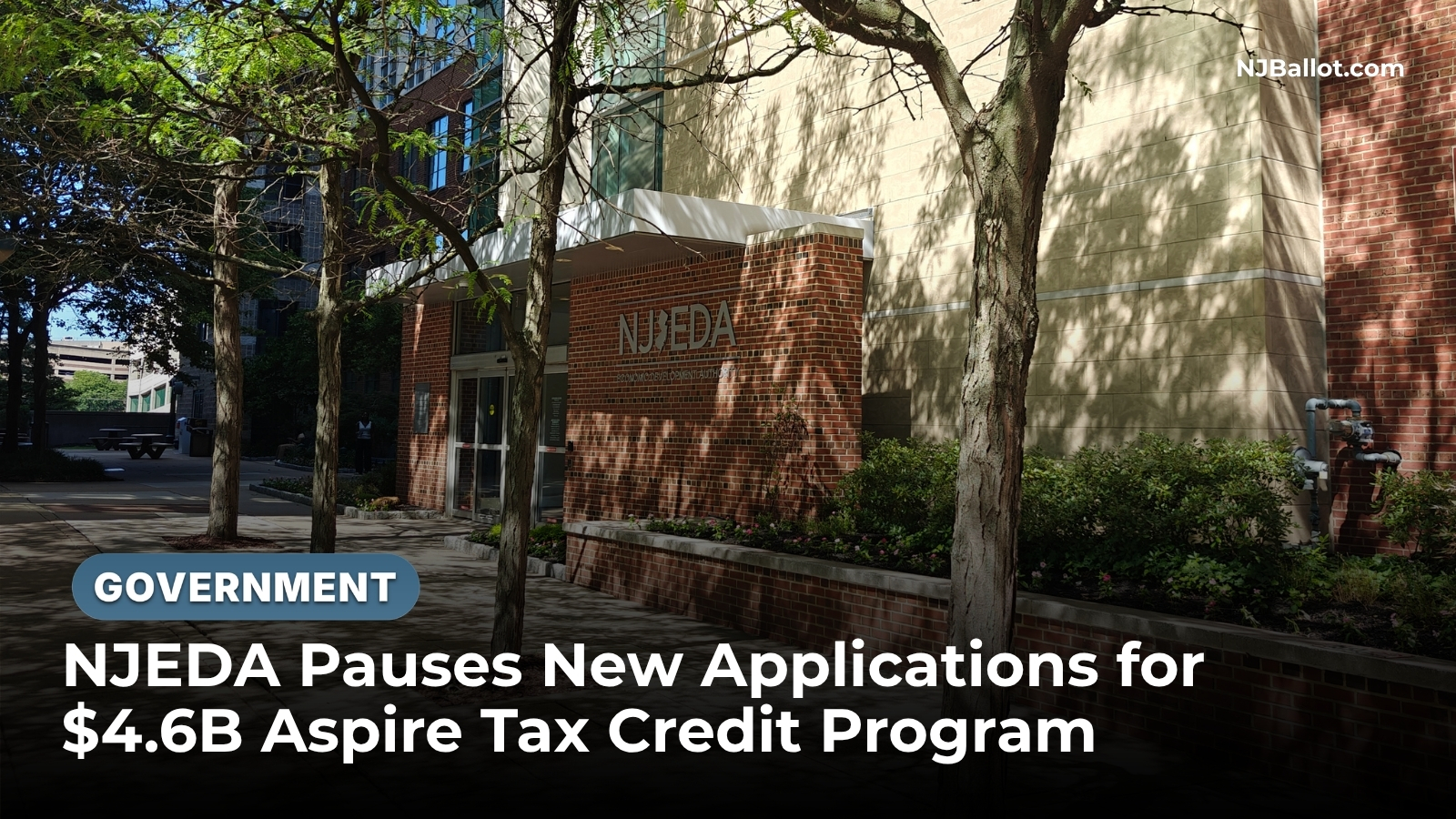

The authority's CEO says as much as half of each award pays consultants and fees, not construction. Developers with transformative applications exceeding $190 million will be refunded and must reapply under fall rules.
As much as half of Aspire tax credit awards goes to transaction costs rather than construction, according to New Jersey Economic Development Authority CEO Evan Weiss. On July 22, 2026, the agency stopped taking new applications for the $4.6 billion-plus program.
Since its 2021 launch under the Economic Recovery Act (ERA) of 2020, Aspire has backed more than 40 developments producing over 7,500 housing units. The program awards transferable tax credits. Developers sell them for cash to bridge the gap between project costs and available financing. The demand for those tax credits now exceeds supply.
"Through listening sessions, dozens of conversations, and our own data analysis it is clear that Aspire can be a difficult tool to use," Weiss said in a July 22 statement.
The transaction costs are not abstract. NJEDA rules explicitly exclude consultant fees, loan interest on permanent financing, escrows, reserves, pre-opening costs and commissions and fees to the developer from direct reimbursement. Developers must pay those costs from the same pool of money the tax credit generates. The authority also charges $500,000 per transformative project phase for approval, $300,000 for modifications, and $200,000 in annual servicing.
Credits sell for no less than 85 cents on the dollar. A $10 million award therefore produces roughly $8.5 million in cash. Residential projects using federal Low-Income Housing Tax Credits face a lower floor of 65 cents. Weiss said as much as half the total award can disappear into transaction costs — consultant fees, interest, reserves and authority charges — before a single footing is poured. What remains after that is what actually goes toward construction.
The annual ceiling is $1.1 billion, shared with the separate Emerge job attraction and retention program. Northern counties may absorb no more than $715 million of that pot in any given year; southern counties face a $385 million limit. After six years, unallocated credits roll forward irrespective of geography.
The statutory sunset is March 1, 2029. Developers must apply before that date or lose eligibility.
Most approved Aspire projects cluster in Hudson and Essex Counties
Of the more than 40 projects the program has supported, only a handful sit in Government Restricted Municipalities like Paterson, Camden and Trenton. The majority cluster in state-designated incentive zones like Jersey City, Newark and Hoboken, while a warehouse in Secaucus qualified under amended rules for contaminated sites. A $35.3 million senior housing project in Totowa, Passaic County, received approval on June 10, 2026; the authority's announcement did not specify its zone status.
Paterson's award covers up to 85 percent of costs, capped at $36.6 million, for 88 fully affordable housing units. Secaucus landed a $56.5 million award for a warehouse on the contaminated industrial site, which is not in a Government Restricted Municipality. The Meadowlands Logistics Center qualified under amended rules that require developers to spend at least $10 million cleaning the property.
Meanwhile "Charlie," a 27-story mixed-use tower in Hoboken, received $90 million in Aspire credits, and the Firemen's Insurance Company conversion in Newark drew approximately 81 million.
Chris Emigholz, chief government affairs officer for the New Jersey Business and Industry Association, urged the state to keep the pause brief. "In light of recent layoff and relocation announcements, we just want to make sure that any pause is as short as possible," he said. "We don't want to go too long without this critical tool, especially now."
State law guarantees developers an exit ramp. P.L.2025, c.113, enacted in 2025, mandates that the New Jersey Department of the Treasury Division of Taxation purchase unused Aspire credits at 85 percent of face value after a one-year holding period. If a developer sells back after the sixth year of eligibility the state claws back 50 percent of any profit exceeding the program's reasonable-return threshold.
The statute carries no annual fiscal cap for Aspire buybacks. That distinguishes Aspire from the film tax credit program, which the New Jersey Economic Development Authority limits by annual cap.
Weiss hits pause on program he helped create
Weiss helped craft the 2020 Economic Recovery Act, a $14 billion law, while advising former Governor Phil Murphy. Six months into Governor Mikie Sherrill's administration he is overseeing the program pause. A January gubernatorial transition report included a resident's complaint that the authority maintains "almost too many programs that are difficult to navigate." The report recommended a centralized business ombudsperson inside the Governor's Office.
Projects costing $10 million or more must secure a municipal letter of support and negotiate a Community Benefits Agreement with the host municipality and the authority. That requirement ties local governments to the application pipeline. When new applications freeze, so do new Community Benefits Agreement negotiations. Whether Government Restricted Municipalities can still advance affordable housing projects without new Community Benefits Agreement negotiations is now an open question. None had issued public statements on the pause that NJBallot could locate by July 24, 2026.
The transformative category allows up to $400 million per development. Film studios operate under different rules: they face no geographic restrictions on where they build. Netflix's Fort Monmouth campus is among the projects that have drawn Aspire support under that exemption.
By July 24, 2026, neither the Housing and Community Development Network of New Jersey nor the Fair Share Housing Center had addressed the pause publicly. Their last public filings focused on Aspire rule changes. The absence leaves the debate to developers and state officials.
Weiss promises autumn reboot with clearer standards
Weiss previewed the program's autumn reboot: "clearer standards, a stronger emphasis on fiscal discipline and project readiness." What those standards look like remains undefined. So does the full roster of active projects.
Non-transformative applications already in the queue will advance to board review in coming months. "Transformative projects seeking more than the $190 million remaining in the program's allocation will have their applications discontinued and application fees refunded," Weiss said. Those developers must reapply under whatever rules emerge this fall.
For now the state has stopped adding new entries to a ledger whose return on investment remains unclear. The credits still flow to approved projects. The machinery still grinds. Whether the fall reboot produces more housing or simply reallocates the same costs is a question the Sherrill administration will have to answer before March 1, 2029.
Related Articles
• After $114M Spent, NJ Housing Fund Gets $30M Back. Developers Call It Insufficient.
• U.S. Supreme Court Upholds NJ Affordable Housing Mandate, Denies Towns’ Emergency Bid
• NJEDA Pauses $500M AI Tax Credit Program Amid Municipal Ban Wave
Sources
• New Jersey Department of the Treasury Division of Taxation, Director's Tax Credit Purchase Program (accessed July 24, 2026)
• New Jersey Economic Development Authority, Aspire Program Application Portal (accessed July 24, 2026)
• New Jersey Economic Development Authority, Aspire Program FAQ (revised April 12, 2022)
• New Jersey Economic Development Authority, Aspire Program Overview Slides (January 2025)
• New Jersey Economic Development Authority, Board Book (February 25, 2026)
• New Jersey Economic Development Authority, Film Tax Credit FAQ (accessed July 24, 2026)
• New Jersey Economic Development Authority, N.J.A.C. 19:31-23.5, "Aspire Program Rules"
• New Jersey Economic Development Authority, "Approves Aspire Awards to Senior Housing Development in Totowa" (June 10, 2026)
• New Jersey Economic Development Authority, "Awards Aspire Tax Credits to Projects in Paterson and Secaucus" (November 6, 2025)
• New Jersey Economic Development Authority, "Notice of NJEDA Board Meeting" (July 15, 2026)
• New Jersey League of Municipalities, "NJEDA Adopts New Rules..." (September 11, 2025)
• New Jersey Office of the Governor, "Economic Development and Innovation Action Team Report" (January 14, 2026)
• New Jersey Office of the Governor, "Governor Sherrill Signs FY 2027 Appropriations Act" (June 30, 2026)
• P.L.2025, c.113, "Purchase of Unused Tax Credits" (2025)
• EisnerAmper, "Understanding the New Jersey Aspire Program 3.0 Update" (February 2, 2026)
• Insider NJ, "Dinice: Samsung's Departure..." (June 7, 2026)
• Jersey Digs, "New Jersey Pauses Aspire Tax Credits Program" (July 23, 2026)
• Joshua Burd, re-nj.com, "EDA pauses Aspire applications..." (July 23, 2026)
• Matthew Fazelpoor, NJBIZ, "NJEDA to pause Aspire tax credit applications" (July 22, 2026)
• Multi-Housing News, "Charlie" project (February 2025)
• NJB Magazine, "NJEDA Puts Temporary Pause on Aspire Program" (July 22, 2026)
• re-nj.com, Firemen's Insurance Building conversion (September 2025)
• Reuters, "Samsung Electronics America to reduce workforce by 739 jobs" (July 19, 2026)
• ROI-NJ, "NJEDA temporarily pausing Aspire Program applications" (July 22, 2026)
• Evan Weiss, New Jersey Economic Development Authority Chief Executive Officer, "Statement on Aspire Program" (July 22, 2026)
• Evan Weiss, New Jersey Economic Development Authority Chief Executive Officer, "Statement on FY27 Budget" (July 1, 2026)
• Fair Share Housing Center, comments on Aspire rule changes (October 28, 2022)
• Samsung Electronics America, Inc., Worker Adjustment and Retraining Notification, Englewood Cliffs, Bergen County (July 2026)
• WMBD Radio, "Samsung Electronics America to reduce workforce by 739 in New Jersey" (July 18, 2026)