
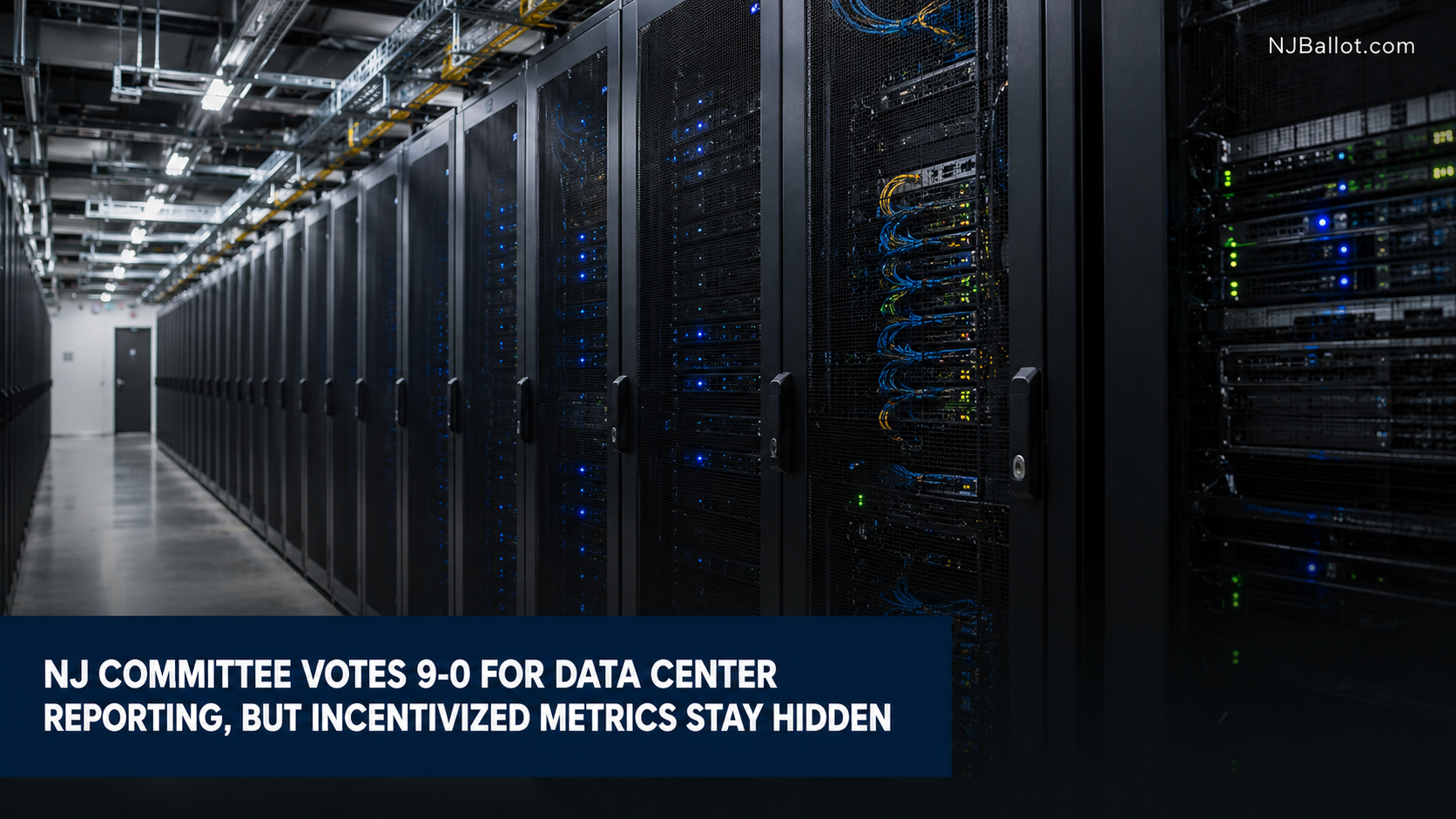

The transparency bill would force semi-annual reporting to the BPU. Facilities receiving state money could still lock performance data.
TRENTON, N.J. — Last summer your electric bill jumped nearly 20 percent, according to a new report from New Jersey Policy Perspective, which argues that data centers were the main driver of that spike. State lawmakers are now moving to force those facilities into the open—with a significant limitation written into the text
The catch is written directly into the bill.
What the Assembly passed, and what stays hidden
Assembly Bill A4096, which the Assembly Telecommunications and Utilities Committee released unanimously earlier this month, mandates that every data center in New Jersey submit semi-annual water and energy usage reports to the Board of Public Utilities. The bill passed the committee 9-0, with one absence. The Senate version, S3379, which the Assembly committee amended A4096 to match on June 4, cleared the upper chamber 34-2 in March.
But the legislation explicitly shields the most revealing metrics from public view.
Under the bill text, the BPU must publish basic facility information and energy and water consumption data within 30 days. The board "shall not publish any performance or sustainability information submitted pursuant to subsection c. of this section." That information "shall be confidential and shall not be subject to disclosure under P.L.1963, c.73 (C.47:1A-1 et seq.), or the common law right of access." The only exception: "such information as anonymized and aggregated from at least five facilities shall be included in the report."
What that means in practice: the BPU will publish raw water and power consumption for each facility, but the efficiency metrics that explain those figures stay secret for state-backed facilities. The BPU can publish anonymized averages only if at least five facilities submit data. If fewer than five participate, the public sees no performance data at all.
"New Jersey is a hub for innovation, but that growth cannot come at the expense of our residents' wallets or our environment," said Senate Majority Leader Teresa Ruiz (D, 29th District), a sponsor of the Senate bill alongside Raj Mukherji (D, 32nd) and five co-sponsors. "This bill is a commonsense measure to give policymakers the tools needed to protect consumers and manage our resources responsibly. By implementing clear oversight, we can support sustainable growth without compromising the reliability of our power grid or the affordability of utility bills for New Jersey families."
The Assembly bill’s sponsors are Michael Venezia (D-34th), Shama Haider (D-37th) and Rosy Bagolie (D-27th), with Katie Brennan (D-32nd) as co-sponsor.
What the bill makes every data center hand over
The reporting requirement applies to all data centers. The bill defines a data center as "any facility whose primary services are the storage, management, and processing of digital data" that houses computer systems, servers, network equipment, telecommunications, environmental controls, fire protection systems and security systems. There is no megawatt floor, no square footage minimum, no employee threshold. The obligation extends to every facility meeting that definition. The confidentiality lock applies to performance metrics submitted under the bill, though only incentivized facilities are required to submit them. Most small operations would have only their basic data published.
Facilities that have been operating for at least a year must file within three months. Newer facilities get six months. Reports are due semi-annually for three years, after which the BPU must determine whether to continue permanently through formal rulemaking. Owners must also notify the BPU 60 days in advance of any substantial change that would alter reported information.
The legislation requires data centers to report total energy use in kilowatt hours, including every fuel and power source used for cooling. Facilities must name their electric utility and report details on every on-site power supply: permit numbers, capacity, tier level, fuel type and total permitted emissions. The bill also requires water use in cubic meters, not gallons, broken down by source, whether drinking or reclaimed, with percentage allocations. The committee amended the bill on June 4 to add peak daily water input and requirements for facilities drawing from public water systems.
Facilities receiving state financial incentives must also submit "performance calculations, including energy reuse factor, power usage effectiveness, renewable energy factor, and water usage effectiveness." The Next New Jersey initiative, which offers up to $500 million in tax credits for AI facility development, is one such program. These are the metrics that remain confidential under the bill's statutory language.
Data centers that do not receive state incentives may submit performance and sustainability metrics at their discretion. The bill does not mandate them. The BPU must coordinate with the Department of Environmental Protection in implementing the law.
The scale of water consumption
Kathryn Fisher, campaign manager for the New Jersey League of Conservation Voters, told the committee during testimony that "one large facility consumes energy equivalent to 80,000 homes and uses 5 million gallons of water daily." A recent NJPP report puts the figure at 100,000 households for a typical large AI campus. The NJPP report also found "a medium-sized data center can consume more than 100 million gallons of water per year."
Anjuli Ramos-Busot, New Jersey Sierra Club chapter director, testified at the June 4 committee hearing that the DataOne facility has provided no information about its current and future water and energy usages.
"No one has any idea of how much water this enormous facility is actually going to consume," Ramos-Busot said. "Not the DEP, the BPU, not the members of the communities. We don't even know if the Town Council actually knows this information."
Rutgers Gleaner cited early estimates putting the Vineland DataOne facility's consumption at 1.1 million gallons annually. The DataOne CEO told WHYY the facility could use up to 20 million gallons per year. The Vineland water department estimated 1.1 billion gallons annually, a thousand times the Rutgers Gleaner figure. The company adds a fourth figure: it says the facility will generate its own water from atmospheric condensation using waste heat, even as the CEO admits to using "a little bit of water if it's extremely hot."
DataOne's basic water consumption would be public under the bill, but the efficiency metrics that would show how intensively it uses water would remain confidential if the facility receives state incentives.
The political fight behind the legislation
The Vineland chaos has become a focal point in the push for state-level transparency. The bill addresses the transparency pillar of Governor Mikie Sherrill's Comprehensive Plan announced May 27, which also proposed fair-share grid payments, statewide community benefit standards and local trade job creation. The plan is advisory only.
This is the second attempt. In October 2025, then-Governor Phil Murphy conditionally vetoed a 2025 bill that would have delayed implementation until 2027. Senator Ruiz opposed that delay, arguing that irreversible impacts could land before the study finished.
The New Jersey Business and Industry Association opposed the 2025 predecessor bill. Deputy Chief Government Affairs Officer Ray Cantor called the reporting requirements redundant and unnecessary. He noted that facilities using over 100,000 gallons daily already need DEP permits, and that buildings over 25,000 square feet already benchmark energy use under the Clean Energy Act. He warned that forcing data centers to disclose utility consumption could discourage developers from locating in New Jersey.
Industry advocates counter that data centers generate jobs and tax revenue, and that New Jersey's Next New Jersey program offers up to $500 million in tax credits for AI facility development.
The cost-shifting debate and the tariff bill
Brian Lipman, director of the New Jersey Division of Rate Counsel, took a more cautious approach to the cost-shifting question. In February he argued large data centers should bear their own grid upgrade costs instead of passing them to residential customers. He cautioned that changing existing rate structures could increase residential costs. "If we pull them out of that and allocate them somewhere else, there is a possibility that residential customers could see an increase," he said.
In April he told Politico that grid strain is a regional problem across PJM states. "It's not a New Jersey problem, it's not a New Jersey solution," he said.
Assembly Bill A796, the related tariff bill, is further along than the transparency measure. It passed the Assembly 55-18 on March 23, 2026, and awaits a Senate floor vote. That bill targets only facilities using 100 megawatts or more. The transparency bill covers all data centers regardless of size.
Local governments are already drawing hard lines. Last month, Millville rejected what would have been the state's largest data center proposal, then banned all planned projects in the city over energy affordability fears.
The bill now goes to the Assembly floor. If it passes, your electric bill will not drop. But you might finally learn why it rose.
Related Articles
• Sherrill Unveils Four-Pillar Data Center Plan as Municipal Bans and Grid Pressure Mount
• Millville Bans Data Centers as Municipal Backlash Spreads Across Six NJ Towns
Sources
• FastDemocracy, A-796 roll call data (March 23, 2026)
• NJ Division of Rate Counsel, testimony on Assembly Bill A-796 (February 2026)
• NJ Legislature, Assembly Telecommunications and Utilities Committee, A-4096 committee statement (June 4, 2026)
• NJ Legislature, Bill No. A-4096 (February 19, 2026)
• NJ Legislature, Bill No. S-3379 (March 23, 2026)
• P.L. 2024, c. 49, Next New Jersey Program (July 25, 2024)
• Business Insider, "New Jersey city at center of AI data center boom votes to ban them" (May 20, 2026)
• CBS Philadelphia, "At town hall on proposed data center in South Jersey, residents voice concerns: 'We don't know this guy'" (January 21, 2026)
• Courier-Post, "Data center of 2.6M square feet blocked by Millville ban" (May 20, 2026)
• Inside Climate News, "How Much Water and Energy do Data Centers Consume? A New Jersey Bill Demands Answers" (November 18, 2025)
• News12, "Millville Bans Data Centers Killing Largest Proposed Facility in New Jersey History" (May 20, 2026)
• NJ Monitor, "Committees approve bill aimed at power usage of data centers" (February 13, 2026)
• NJ Monitor, "Governor seeks changes to data center bill, wants study on impact" (October 21, 2025)
• NJ Monitor, "Gov. Sherrill seeks limits on data center construction" (May 27, 2026)
• NJ Spotlight News, "'Left in the dark': Pushback builds against Vineland data center" (March 30, 2026)
• NJ Spotlight News, "Lawmakers back transparency on data center water, electricity use" (June 10, 2026)
• Politico, "Data center boom poses early challenge for New Jersey's affordability agenda" (April 4, 2026)
• ROI-NJ, "Millville bans data centers, rejecting largest proposed facility in N.J." (May 20, 2026)
• South Jersey Climate News, "How a data center project in Vineland is sowing distrust in the community" (March 10, 2026)
• TechPolicy.Press, "Big Tech Will Not Save Us From the Climate Crisis" (May 8, 2026)
• WHYY, "Vineland residents push back against AI data center" (March 25, 2026)
• New Jersey Senate Democrats, "Ruiz, Mukherji Bill Holding Data Centers Accountable for Water and Energy Use Passes Senate" (March 2026)
• LegiScan, A-4096 legislative data (2026)
• New Jersey Policy Perspective, "Fool's Gold: The Hidden Costs of AI Data Centers" (March 31, 2026)
• Pinelands Alliance, "A Town Hall Too Late – Vineland Data Center" (February 11, 2026)
• Rutgers Gleaner, "What Does the New Data Center Approved in Vineland Mean for South Jersey and Rutgers-Camden?" (February 8, 2026)
• Saul Ewing, "New Jersey's 'First in the Nation' Comprehensive Plan to Regulate Data Centers" (June 1, 2026