
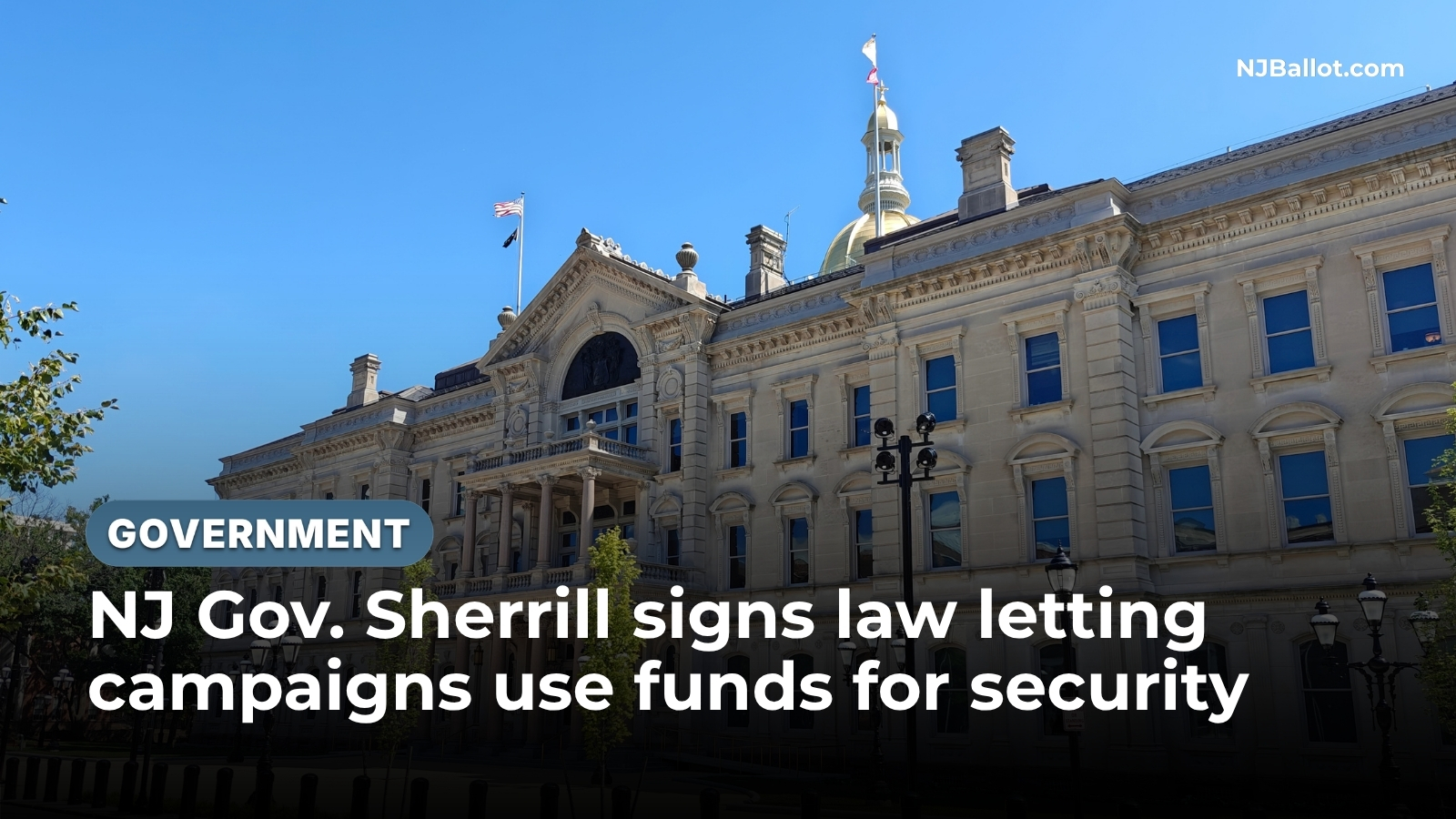

The new law lets New Jersey candidates, officeholders, committees and leadership funds pay for locks, alarms, guards and cybersecurity against threats tied to their status, effective immediately. Sherrill also signed the New Jersey History Day Act and a Green Acres funding measure the same day.
Gov. Mikie Sherrill signed legislation on Tuesday authorizing New Jersey candidates and officeholders to use campaign funds to pay for security measures tied to holding or seeking office, the governor's office announced. The law formalizes a practice the state Election Law Enforcement Commission (ELEC) had long permitted and began moving in 2025 to standardize. It took effect immediately and was one of three bills Sherrill signed that day.
The legislative record lists the law, S-3386/A-5258, as P.2026, c.99. Sen. Paul Sarlo (D, 36th District), Sen. Carmen Amato (R, 9th) and Assemblyman Robert Karabinchak (D, 18th) sponsored the measure.
The new law applies to candidates, candidate committees, joint candidates committees and legislative leadership committees. Coverage extends to the candidate or officeholder, their staff and family members living in the same household.
Security measures under the law range from door locks and alarm systems to cybersecurity services. It authorizes spending for the "reasonable costs" of such measures, which must address "ongoing dangers or threats that would not otherwise exist were it not for the individual's status or duties."
Spending falls into four permitted categories: non-structural devices such as locks, alarms, motion detectors and cameras; structural devices such as wiring, lighting, gates, doors and fencing, provided they serve security only and do not improve the property or increase its value; bona fide security personnel and services from providers compliant with the Security Officer Registration Act; and cybersecurity software, devices and services. Every expenditure must reflect "fair market value."
The funds cannot go toward firearms, ammunition or payments to family members or to entities they own or operate. Home improvements outside the authorized categories are also barred.
The statute treats receipts, invoices and contracts for the spending as public records, available through the state's Open Public Records Act. Campaigns must keep the documents under ELEC’s record-retention rules, which require committees to retain such records for at least four years after the election or transaction they relate to, whichever is later. The requirement covers purchases of devices and services as well as contracts with security providers.
One exception applies: the law shields from public disclosure any plan, design or schematic that reveals the type or location of installed measures.
Devices and services bought with campaign funds remain campaign assets. The law requires campaigns to dissolve those assets, disposing of devices and ending services, when a campaign closes or an officeholder leaves office. It permits campaigns to sell devices for cost or other reasonable value; the Senate Budget committee's June 24 amendments made that sale discretionary, changing "shall" to "may," so a sale is not required.
The bill cleared the Senate in June and the Assembly in September
The sponsors introduced the measure on Feb. 9, 2026, and it went to the Senate State Government, Wagering, Tourism and Historic Preservation Committee. That panel amended the bill on May 21 and advanced it to the Senate Budget and Appropriations Committee, which Sarlo chairs, on a 13-0 vote. The Budget committee adopted its own amendments on June 24, according to the committee statement, and reported the bill to the floor. The full Senate passed the bill 40-0 on June 30.
The Assembly substituted the Senate bill for its own version, A-5258, on Sept. 24 and passed it 51-12, with nine members abstaining and eight not voting; all 12 no votes came from Republican members, according to the roll call. Sherrill signed the measure on Oct. 27.
ELEC had already permitted such spending
The Election Law Enforcement Commission, which collects the state's campaign filings and enforces its campaign-finance laws, had already permitted using campaign funds for security and moved in August 2025 to put that practice into regulation.
In an advisory issued on Aug. 28, 2025, the commission wrote: "Historically, the Commission has permitted such campaign expenses, but in response to acts of violence targeting candidates and officeholders across the country, the Commission now seeks to explicitly standardize this use of campaign funds." The advisory stated at the time that the proposal, if adopted, would likely take effect in December 2025 or January 2026. The statute now directs the commission to promulgate rules under the Administrative Procedure Act.
The Federal Election Commission codified a parallel rule in September 2024 allowing candidates and officeholders to use campaign funds for security tied to their status or duties. The federal commission approved the rule on Sept. 19, 2024, and published it days later; it amended Part 113 of the federal campaign-finance regulations and took effect on Jan. 1, 2025.
New Jersey is now one of 17 states where candidates can spend campaign contributions on security, the Philadelphia Inquirer reported, citing the National Conference of State Legislatures. The group's own tally lists 16 states with statutes authorizing the practice, among them Alabama, California, Illinois, New Hampshire and Wisconsin.
Sherrill signed two other bills the same day
Sherrill also signed the History Day Act, S-4307/A-5251, sponsored by Sens. Patrick Diegnan (D, 18th) and James Beach (D, 6th). The bill's findings note that while current law requires the teaching of New Jersey history, "there is no designated Statewide observance to highlight and celebrate such history." The new law designates Dec. 18 as New Jersey History Day and requires the governor to proclaim the observance each year.
School districts may skip the observance or mark it for one day or one week, with the Department of Education issuing planning guidelines. The Historical Commission, consulting with the department, will develop and distribute resource materials, promote statewide participation and, within available funds, award grants to support observance programs. The findings also envision cultural institutions joining in, noting such collaborations "can also raise awareness of, and support for, these institutions."
The third bill, S-4495/A-5321, supplements the Garden State Preservation Trust Act. Sen. John McKeon (D, 27th), Sen. Douglas Steinhardt (R, 23rd), Assemblywoman Alixon Collazos-Gill (D, 27th) and Assemblywoman Marisa Sweeney (D, 25th) sponsored the measure. It bars the state Department of Environmental Protection from requiring matching funds from qualifying tax-exempt nonprofits that seek Green Acres program funding to develop, repair or improve property on state-owned land. Under the law, grants from the Preserve New Jersey Green Acres Fund may cover a project's full cost.
In an X post marking the signing, Assembly Democrats said the law "will make it easier for nonprofits to secure funding for needed repairs and improvements."
Green Acres is the state's open-space preservation program, created in 1961 to meet recreation and conservation needs, according to the state Department of Environmental Protection. The department reports protecting more than 725,000 acres of open space and parkland and funding 1,256 local and nonprofit park development and stewardship projects. Statewide preserved open space totals nearly 1.67 million acres. Funding for the program comes from bonds, and voters have approved every Green Acres bond referendum put before them, authorizing $3.3 billion to the program's goals.
Related Articles
Sherrill's Housing Plan Looks to State Land for Up to 42,800 Homes, But the Land List Isn't Public
Sherrill Signs Bill Ending 50-Year Nuclear Moratorium, Launches Task Force at Salem Plant
Sherrill Signs Power NJ Act as Rate Counsel Warns of 40-Year Ratepayer Lock-In
Sources
• Biryukov, Nikita, "Governor signs bill allowing security spending with campaign funds," New Jersey Monitor (October 27, 2026)
• FastDemocracy, "NJ S3386 status, votes and notes" (October 29, 2026)
• Federal Election Commission, "Use of Campaign Funds for Candidate and Officeholder Security," Federal Register (September 25, 2024)
• LegiScan, "NJ S3386 | 2026-2027 | Regular Session" (October 29, 2026)
• National Conference of State Legislatures, "Using Campaign Funds for Candidate Security" (October 29, 2026)
• New Jersey Assembly Democrats, "A5321 signed into law" (October 27, 2026)
• New Jersey Department of Environmental Protection, "Green Acres Program" (October 29, 2026)
• New Jersey Election Law Enforcement Commission, "Press Advisory: Campaign Funds for Candidate and Officeholder Security" (August 28, 2025)
• New Jersey Election Law Enforcement Commission, campaign record-retention regulations, N.J.A.C. 19:25-7.3 and 19:25-15.42 (October 29, 2026)
• Office of the Governor, "Governor Sherrill Signs Legislation" (October 27, 2026)
• Philadelphia Inquirer, The, "N.J. passes bill to allow campaigns to use funds for security" (September 24, 2026)
• Philadelphia Inquirer, The, "Amid rising political violence, N.J. candidates may now use campaign donations to beef up security" (October 27, 2026)
• Senate Budget and Appropriations Committee, Statement to Senate No. 3386 (June 24, 2026)
• Senate State Government, Wagering, Tourism and Historic Preservation Committee, Statement to Senate No. 4307 (June 11, 2026)
• New Jersey Senate No. 3386/Assembly No. 5258, "An Act concerning the use of campaign funds for security expenses" (October 27, 2026)
• New Jersey Senate No. 4307/Assembly No. 5251, "New Jersey History Day Act" (May 18, 2026)
• New Jersey Senate No. 4495/Assembly No. 5321, "An Act concerning development, capital repair, or improvement by certain nonprofit organizations of property on State-owned land" (June 22, 2026)
Photo: NJBallot