
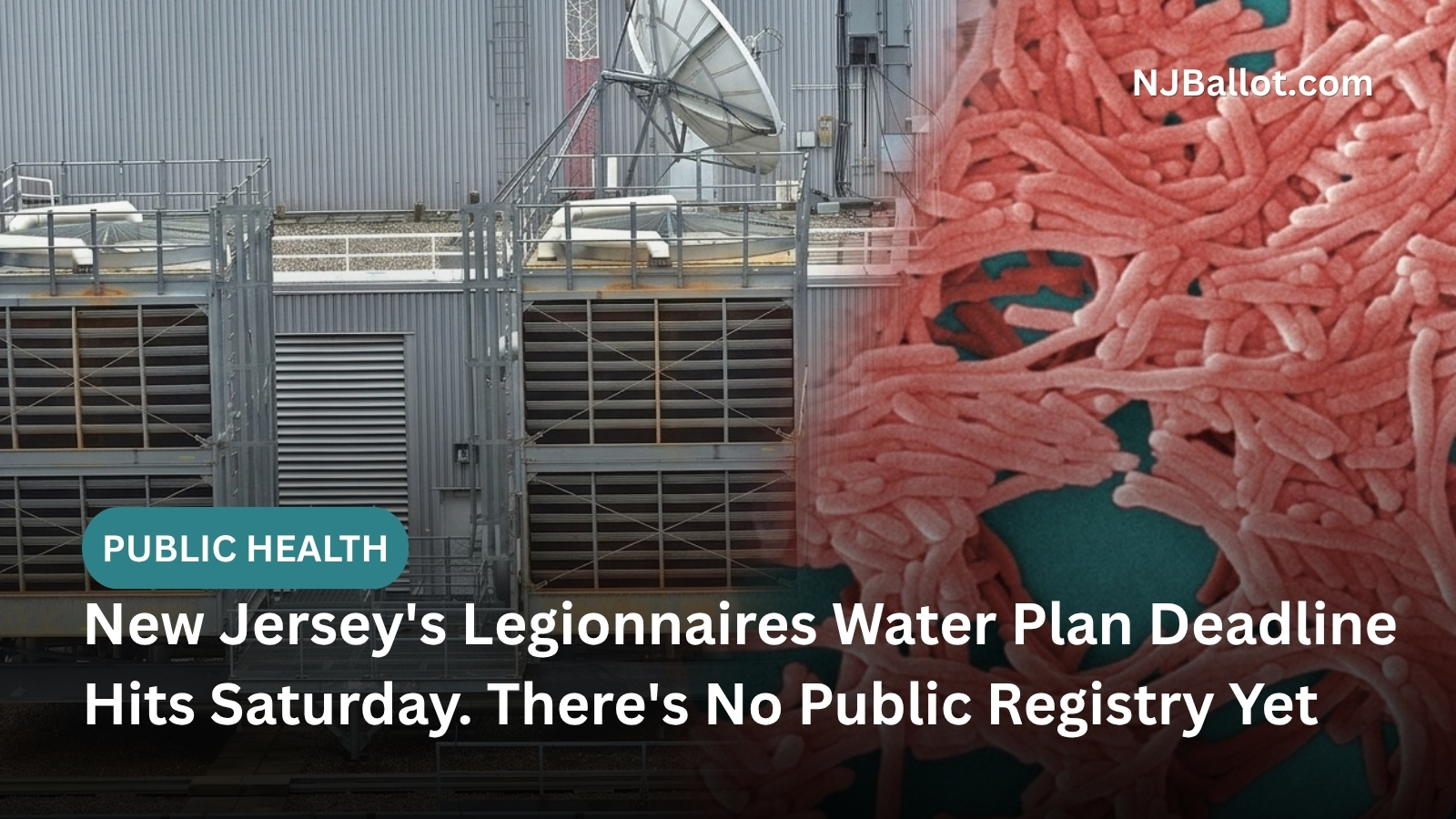

Every covered building in New Jersey must have a written Legionella control plan by Saturday and be running it by December 12. There's no public list of who complied — residents can ask the building's operator, or look for the posted notice once the program is running.
By the end of Saturday, every covered building in New Jersey must have written a plan for controlling Legionella in its water system. By December 12, every covered building must be running that plan. The law gives residents a way to ask whether a building did the work. It does not give them a way to know on their own.
Legionnaires' disease is a severe lung infection caused by Legionella bacteria, which occur naturally in fresh water and become a hazard in human-made systems such as premise plumbing and cooling towers. People are infected by inhaling contaminated droplets from showers, hot tubs, sinks and fountains. State health officials say the disease remains rare for healthy people who are exposed, but it kills about one in ten people infected and poses the gravest risk to people over 50, smokers and those with weakened immune systems.
New Jersey recorded 246 cases in 2021, 235 in 2022, 269 in 2023 and 224 in 2024, according to state data. The state Department of Health receives roughly 250 to 350 reports a year, and a 2022 study in a Centers for Disease Control and Prevention journal found that fewer than 10 percent of reported cases are tied to outbreaks. The rest are sporadic infections tied to plumbing inside individual buildings.
The law is P.L. 2024, Chapter 66, which then-Governor Phil Murphy signed on September 12, 2024.
It covers hospitals, nursing homes and assisted living facilities, along with any building linked to a prior outbreak. It reaches every building that houses an aerosol device — a cooling tower or evaporative condenser, whirlpool, spa, pool, indoor ornamental fountain, mister, atomizer, air wash or humidifier — and demands a program for the device itself. And it pulls in building types that have never operated under a water regulation, provided they heat potable water through a centralized system: correctional facilities; hotels and motels with 25 or more units for short-term guests; subsidized senior and disability housing of 25 or more units; and residential high-rises of six or more floors.
Each building's program must follow the American Society of Heating, Refrigerating and Air-Conditioning Engineers standard for water management, which builds compliance around scheduled monitoring of temperatures and disinfectant levels rather than routine laboratory testing. Periodic sampling for the bacteria is mandatory only for hospitals and long-term care buildings that are outbreak-associated or flagged by the Centers for Disease Control and Prevention; a building that chooses to sample on its own must follow state health department testing procedures. During an investigation, the health department or a local health officer can order the operator of a suspected-source building to test and mitigate, and the operator must report the results of testing performed as part of that investigation. Operators must keep the program and five years of records at the building and produce them on request to the state departments of health, environmental protection or community affairs. Those departments are not required to review a program except during an investigation of an actual case. Penalties attach to specific failures: not implementing or demonstrating the program, not reporting a positive test, not testing or mitigating as ordered, not giving the notice owed to people potentially exposed during an investigation. They run from $2,000 for a first violation to $5,000 for subsequent violations and $10,000 where serious injury or death results.
Trenton Water Works partly under state oversight because of the bacteria
Trenton Water Works serves more than 200,000 people in Trenton and portions of Ewing, Hamilton, Hopewell and Lawrence. In 2020 the state sued the city and the utility over lead service lines, an uncovered reservoir and Safe Drinking Water Act violations. Nine Legionnaires' disease cases, at least three of them fatal, struck Hamilton in summer 2021, as reported at the time. By October 2022, the health department had logged five Hamilton cases, including one death, since December 2021.
In July 2022, state officials began testing homes in Hamilton, and that fall the state tested 30 homes recruited across the wider service area. Legionella turned up in more than half, including in the cold water entering some homes. In October 2022, then-commissioner Shawn LaTourette of the state Department of Environmental Protection placed the utility under direct state operational oversight through a Unilateral Administrative Order, citing "significant concerns with TWW's operations and management," among them what the department described as "intermittent failures to fully maintain treatment processes, monitor water quality" and invest in aging infrastructure. The state health department said the order followed those findings. Under the order, the utility announced a low-velocity flushing program "to help address Legionella in its water system."
State health department releases reported seven more cases and two deaths in Trenton, Ewing, Lawrence and Hamilton between that October and March 2023. In late 2025, Ewing, Hamilton, Lawrence and Hopewell joined the state's lawsuit. On January 27, 2025, the environmental department released two reports that put the system at what LaTourette called "extremely high risk of systemic failure." "DEP cannot provide stability support forever," he told reporters then. "We have hundreds of water systems to monitor."
The 2022 order covered the system that serves the five towns. The deadline arriving Saturday covers the plumbing inside buildings across the state, the layer where the state's own research places most infections.
The DEP's rulemaking deadline arrives Saturday
The FY2026 budget funded the law's machinery: $500,000 for a health department response team and $750,000 for a database. Both items appear in the current budget: the $500,000 response team is in the FY2027 appropriations act, and the Legislature's analysis of the environmental department's budget shows the database funded at $785,000, the original $750,000 carried forward from FY2026 plus $35,000 in new funding, to develop, implement and maintain a tracking system whose statutory job is monitoring how public water systems manage the bacteria, not whether individual buildings complied.
The statute gave the health department 12 months to publish guidance; it did, posting a program template on its Legionellosis page. It gave the environmental department 24 months to adopt rules on public water systems; the 24-month clock runs out Saturday. The department published best management practices on September 12, 2025, and its own website says further guidance "are forthcoming with rulemaking." No Legionella proposal appears on the department's current rulemaking listing.
Senator M. Teresa Ruiz (D, 29th District) has said the bill grew out of the 2015 New York City outbreak she called "devastating" and the "equally disturbing" cases that surfaced afterward in Newark.
Trade groups fought it anyway. The New Jersey Business and Industry Association, American Water and the New Jersey Utilities Association all testified against the measure in May 2024, warning the requirements would burden water providers; Ruiz countered that most water providers were already doing what the bill demanded.
Gwen Hanlon of Morristown testified for the seventh time in nearly as many years when she appeared before the Senate Health, Human Services and Senior Citizens Committee in May 2024. Her husband Kevin contracted the infection at a Manhattan office building while recovering from lung cancer and died in 2017 at 47. "My family still has no answers," she told the committee. She also told them: "It blows my mind that in the state of New Jersey I cannot get a plastic bag, but our water will kill you," a reference to the state's 2022 ban on plastic carryout bags.
On Saturday, the only verification available to a resident is an operator's answer. The law requires each covered building to hold its written program and five years of records on site, but it assigns no one a duty to show them. The posted notice and the state agencies' power to demand records arrive with implementation on December 12, and agency review, by statute, begins only when someone gets sick. That design matters most in the buildings where the law's risk concentrates: the nursing homes, senior housing and hospitals that anchor its coverage. Three items remain open, each with a date or a deadline attached: the environmental department must still propose its rules; the health department owes the Governor an annual report, the first due September 12, 2025; the tracking system remains in development. The next milestone arrives December 12, when every covered building must be running its program.
Related Articles
Avian Flu Outbreak in New Jersey: What Residents Need to Know
Cyclospora Lettuce Recall Reached New Jersey Walmarts as Outbreak Tops 11,000 Cases
Sources
• Centers for Disease Control and Prevention, Emerging Infectious Diseases, Gleason et al., statewide legionellosis surveillance study (2022).
• Hamilton Township Division of Health, Legionella investigation updates page (accessed September 11, 2026).
• New Jersey Department of Environmental Protection, "Best Management Practices for the Control of Legionella in Public Community Water Systems" (September 12, 2025).
• New Jersey Department of Environmental Protection, Notice of Rule Proposals listing (accessed September 11, 2026).
• New Jersey Department of Environmental Protection, "Trenton Water Works" (accessed September 11, 2026).
• New Jersey Department of Health, "Health Officials Investigate Cases of Legionnaires' Disease in Hamilton Township" (August 29, 2022).
• New Jersey Department of Health, press release on regional water sampling results (October 15, 2022).
• New Jersey Department of Health, "Water Management Program Template" (accessed September 11, 2026).
• New Jersey Legislature, P.L. 2024, Chapter 66, "An Act concerning Legionnaires' disease" (September 12, 2024).
• New Jersey Legislature, S2027, FY2027 Appropriations Act (June 28, 2026).
• New Jersey Legislature, Office of Legislative Services, "Department of Environmental Protection, FY2027 Budget Analysis" (April 2026).
• New Jersey Monitor, "State warns of looming 'systemic failure' of Trenton's water utility" (January 27, 2025).
• New Jersey State Health Assessment Data, "Legionellosis Incidence by Year, New Jersey, 2006–2024" (accessed September 11, 2026).
• NJ Spotlight News, Jon Hurdle, "Legislation would overhaul how state protects water systems against Legionnaires' disease" (July 22, 2024).
• NJ Spotlight News, "Legionnaires': NJ officials report 4 new cases" (August 30, 2022).
• State of New Jersey, Department of the Treasury, "FY2026 Budget In Brief," Public Health and Environmental Protection sections (2025).