
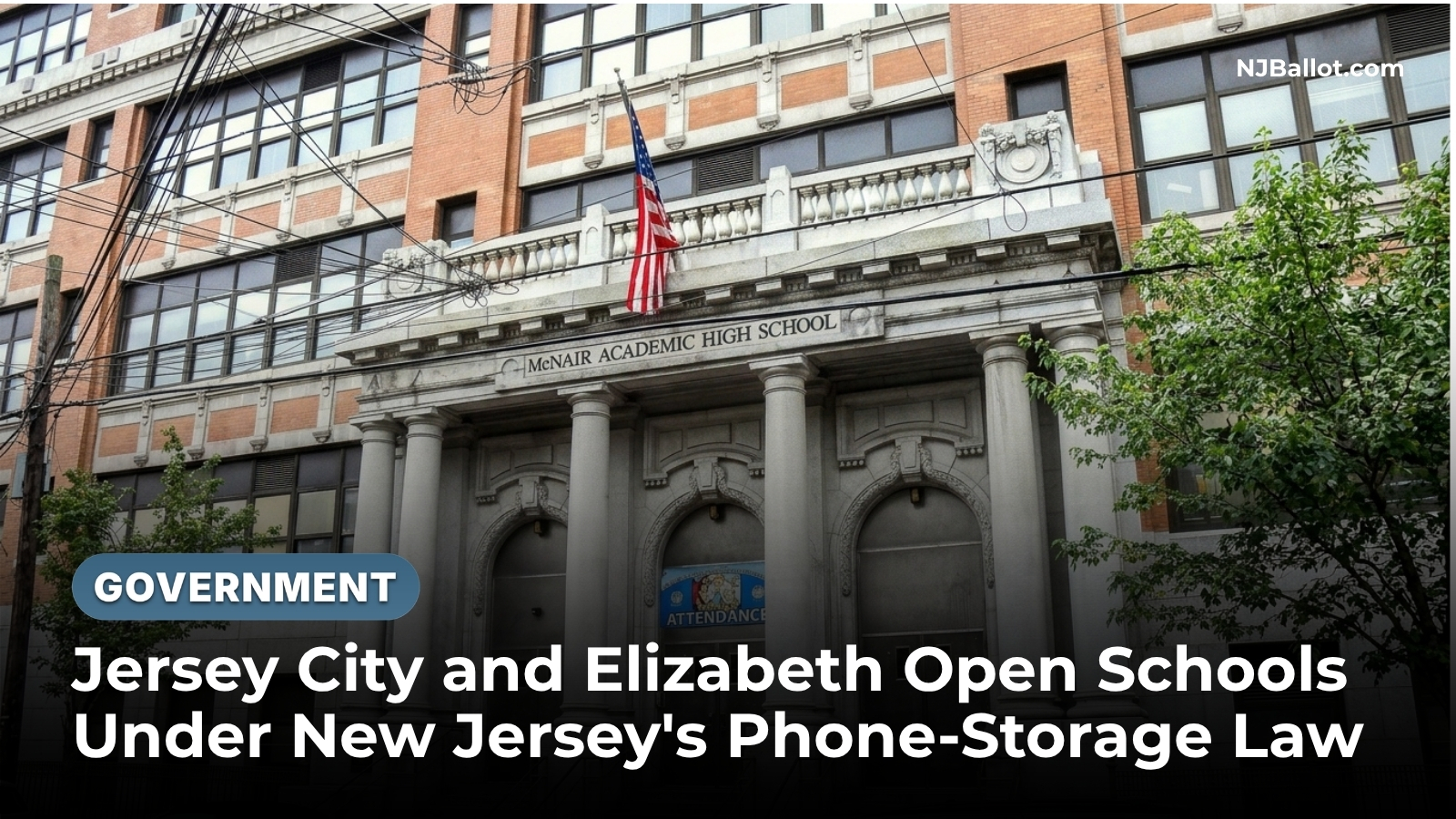

More than 50,000 students in Jersey City and Elizabeth return Thursday as the last big-city districts under the state's bell-to-bell phone-storage law. Trenton funded early adopters before the law existed.
Jersey City and Elizabeth open school this morning as the last of New Jersey's big-city districts to come under a state law requiring public and charter school students to keep their phones stored from the first bell to the last.
More than 50,000 public school students return today in the two districts. In Jersey City, the change is a single detail: students could use their phones at lunch last year; today, the devices remain put away under what the New Jersey Department of Education calls "bell-to-bell."
Districts started classes on various dates from late August to this week, so the rule took hold in stages. North Hunterdon-Voorhees, one of the earliest starts, has worked under it since August 27. Cherry Hill opened September 2, and the district is already weighing a broader technology policy that includes artificial intelligence, per NJ Spotlight News. Paterson and Newark opened September 8. Elizabeth, which enrolls about 27,740 students, and Jersey City come last, this morning.
The law goes further than Jersey City did
The law requires the state's public school districts, as well as charter schools, to keep students' internet-enabled devices stored from arrival until dismissal. The Department of Education issued tentative guidance to school districts while the bill was pending, then updated it after the signing, as the law required. The guidance points to locked pouches, school lockers or bins, in-class storage stations and student storage in a backpack, locker or other bag. Districts may add to the guidelines and set their own penalties.
The guidelines direct districts to spell out device expectations for lockdowns, evacuations and natural disasters. Students with special-education plans such as IEPs and 504s, health monitoring needs or translation requirements keep device access, as do students who act as routine caregivers for family members.
The Jersey City Board of Education had already voted unanimously in September 2025 to bar personal communication devices during class, effective October 1, reaching all 39 schools and roughly 26,000 students. The district tested the policy at two schools beginning in 2024, one using lockable pouches made by Yondr, a San Francisco company whose pouches keep phones sealed until tapped on a base unit.
Superintendent Norma Fernandez told NJ Spotlight News the district has seen students socializing more, fewer suspensions and fewer students expressing suicidal ideation since the policy took effect. "I applaud Governor Murphy for this statewide ban because now it provides the school districts with the tools necessary to say, 'This is the state law, this is our board policy and this is what's best for your child,'" Fernandez said before the signing. The district has published no data on the policy's effects.
The bill took a year to become law
State Senator Paul Moriarty (D, 4th District) and Assemblywoman Rosy Bagolie (D, 27th District) introduced the bill, S-3695/A-4882, in the 2024-25 session. Governor Phil Murphy called for phones out of schools in his January 2025 State of the State address, and argued in his February budget address that "getting cell phones out of schools helps educators, it helps parents, and most of all, it helps our kids." He signed the bill into law on January 8, 2026, shortly before leaving office, at Ramsey High School in Bergen County, where students had attended classes under a pouch program since January 2025. The law took effect with the 2026-27 school year.
The New Jersey Education Association lobbied for the law and says it won two changes: education stakeholders helped draft the guidelines, and the state imposed no one-size-fits-all mandate. The New Jersey School Boards Association also lobbied, and won early changes of its own: the bill reached the Assembly as a model-policy mandate, and the law instead requires the Department of Education to develop guidelines in consultation with education groups. The version the Assembly Education Committee approved in March would have barred non-academic phone use during classroom instruction; the final law covers the whole school day. The school boards association says the final law answered its local-flexibility concerns by letting principals and chief school administrators authorize device use in certain circumstances.
In Newark, where classes started September 8, Newark Teachers Union vice president Joicki Floyd saw the mandate up close last year: Malcolm X Shabazz High School piloted the ban with lockable pouches after spring break, and students were "definitely more engaged, more focused, and then we were able to see where they lacked in certain skills, so that we would be able to … accommodate what they did not know or what they needed to learn," she told Chalkbeat in August. Floyd added that at Shabazz, consequences ran from a $5 warning fine to $20 to cover a replacement pouch, and a student or two figured out how to open the pouches or stole them.
After using Yondr pouches for the pilot, Newark Public Schools adopted a districtwide policy it calls "off and away." The district's possession agreement requires devices "kept off" and "concealed at all times during the school day," with confiscation and revoked carrying privileges for violations. ABC7 reported students may carry phones in a pocket, bag or locker, with any device seen or heard subject to confiscation.
The state funded bell-to-bell before it was law
The Department of Education ran the Phone-Free Schools Grant Program from July 2025 through June 2026, providing money for storage equipment and staff training to districts that committed to bell-to-bell rules for grades 6-12 months before the law required them. The program carried a $3 million appropriation, and the Department of Education sent roughly $980,000 to 86 districts including 15 charters, out of roughly 600 operating districts statewide. Awards scaled with enrollment and ran from $1,000 to Newark's $176,625.
Newark, the largest recipient, put state money into hardware, its board approving up to $99,000 for Yondr pouches in June, per Chalkbeat. The published roster names every district and dollar amount, and Jersey City is not on the recipient list. Hudson County's awards went to Guttenberg, Harrison, Weehawken, Union City and several charters. Jersey City's class-time policy, with its lunch allowance, did not meet the program's bell-to-bell requirement, and the district ran its program without the state money.
Governor Mikie Sherrill, who endorsed the mandate as governor-elect, took office in January and unveiled her first proposed budget in March. It carried $625,000 "to help support the state's first cellphone-free school year." The line items under that description fund an office created by Executive Order No. 6 on her first day in office to coordinate state efforts on children's online safety and generate policy proposals, $125,000 in the New Jersey Department of Health, plus $500,000 toward a research center on social media at a New Jersey university.
Students are opposed, parents split
A Rutgers-Eagleton survey of 923 parents and 202 teenagers found only 10 percent of teens favored a full-day ban. Parents were split, about 40 percent favoring all-day storage and a similar share wanting limits on class time only.
Hunterdon Central Regional High School posted its plan on Facebook on August 6, three weeks before classes started: devices collected in a box at the classroom door, away through unit lunch and passing time. Parents raised worries in the comments, and the district replied that they could email their students at their school email addresses.
New Jersey families raised practical concerns through the summer about ride coordination, schedule changes and reaching children in emergencies. Newark parents and teachers voiced emergency-contact worries to Chalkbeat. The Department of Education discourages parents from reaching their children on personal devices during the school day and leaves contact plans to individual schools.
Royanda Phillips, whose daughter started at University High School in Newark on Tuesday, told Chalkbeat in August she agrees phones can distract in class but worries about reaching her daughter during the school day. "So I get it on both ends, but as a parent, I just feel like if I need to contact my child directly, I'll have to call the office," Phillips said. "And then it's like, 'OK hold on, let me see what class she's in, let me try to see where she is in the building …,'" Phillips said.
In Jersey City, the first day under the statewide rule ends at 3 p.m.
Related Articles
New Jersey Creates School Civil Rights Unit to Replace Federal Enforcement
N.J. Schools Open With Closures and Cuts as Health Benefits Commission Deadlocks Again
Sources
- ABC7 New York, "Newark students return to classrooms with phones required to be 'off and away'" (September 8, 2026)
- Chalkbeat Newark, "Back-to-school: 6 things to watch in Newark Public Schools this year" (August 20, 2026)
- Chalkbeat Newark, "Newark piloted the state's cellphone ban with positive results. Here are lingering concerns." (August 10, 2026)
- Chalkbeat Newark, "Record school aid, tutoring, youth mental health: key education priorities in New Jersey governor 2027 budget" (March 10, 2026)
- GovTech, "New Jersey Pays Schools to Restrict or Ban Cellphones," carrying the New Jersey Department of Education award list (December 18, 2025)
- Hunterdon Central Regional High School, Facebook, post describing bell-to-bell device policy (August 6, 2026)
- Jersey City Board of Education, 2026-27 school year calendar (2026)
- Jersey City Ed, "Jersey City Schools Enforce Districtwide Classroom Cell Phone Ban" (September 30, 2025)
- New Jersey Department of Education, Frequently Asked Questions: Student Use of Internet-Enabled Devices (July 2026)
- New Jersey Department of Education, "Guidance for Schools on Student Use of Internet-Enabled Devices," revised January 2026
- New Jersey Department of Education, Phone-Free Schools Grant Program portal and October 1, 2025 broadcast memo (2025-2026)
- New Jersey Education Association, "New law requires limits on cellphones at school" (March 2026)
- New Jersey School Boards Association, "Cell Phone Use Restrictions are Coming: What You Need to Know as a Board Member" (March 14, 2025)
- New Jersey School Boards Association, "Governor Murphy Signs Cell Phone Ban into Law" (January 13, 2026)
- New Jersey School Boards Association, "NJDOE Announces Availability of Phone-Free Schools Grant" (October 8, 2025)
- New Jersey School Boards Association, "School Cellphone Ban Legislation Heads to Governor's Desk" (December 23, 2025)
- Newark Public Schools, Board of Education, "Agreement for Possession of Personal Internet-Enabled Devices," File Code 5142 (undated)
- NJ Advance Media, "Jersey City schools ban cellphones in class starting Oct. 1" (September 19, 2025)
- NJ Advance Media, report on New Jersey school district start dates (August 24, 2026)
- NJ Advance Media, tally of the state's largest school districts (August 2026)
- NJ Spotlight News, "Students expected to benefit from cell phone ban" (January 8, 2026)
- NJ Spotlight News/70and73, report on Cherry Hill phone policy (August 6, 2026)
- Rutgers School of Communication and Information and Rutgers-Eagleton Center, "2025 Social Media Impact Survey" (October 30, 2025)
- State of New Jersey, Office of the Governor, FY2026 Budget Address (February 25, 2025)
- State of New Jersey, Office of the Governor, "Governor Mikie Sherrill Issues Six Executive Orders on Day One," Executive Order No. 6 (January 20, 2026)
- U.S. News & World Report, Jersey City Public Schools district profile (2026)