
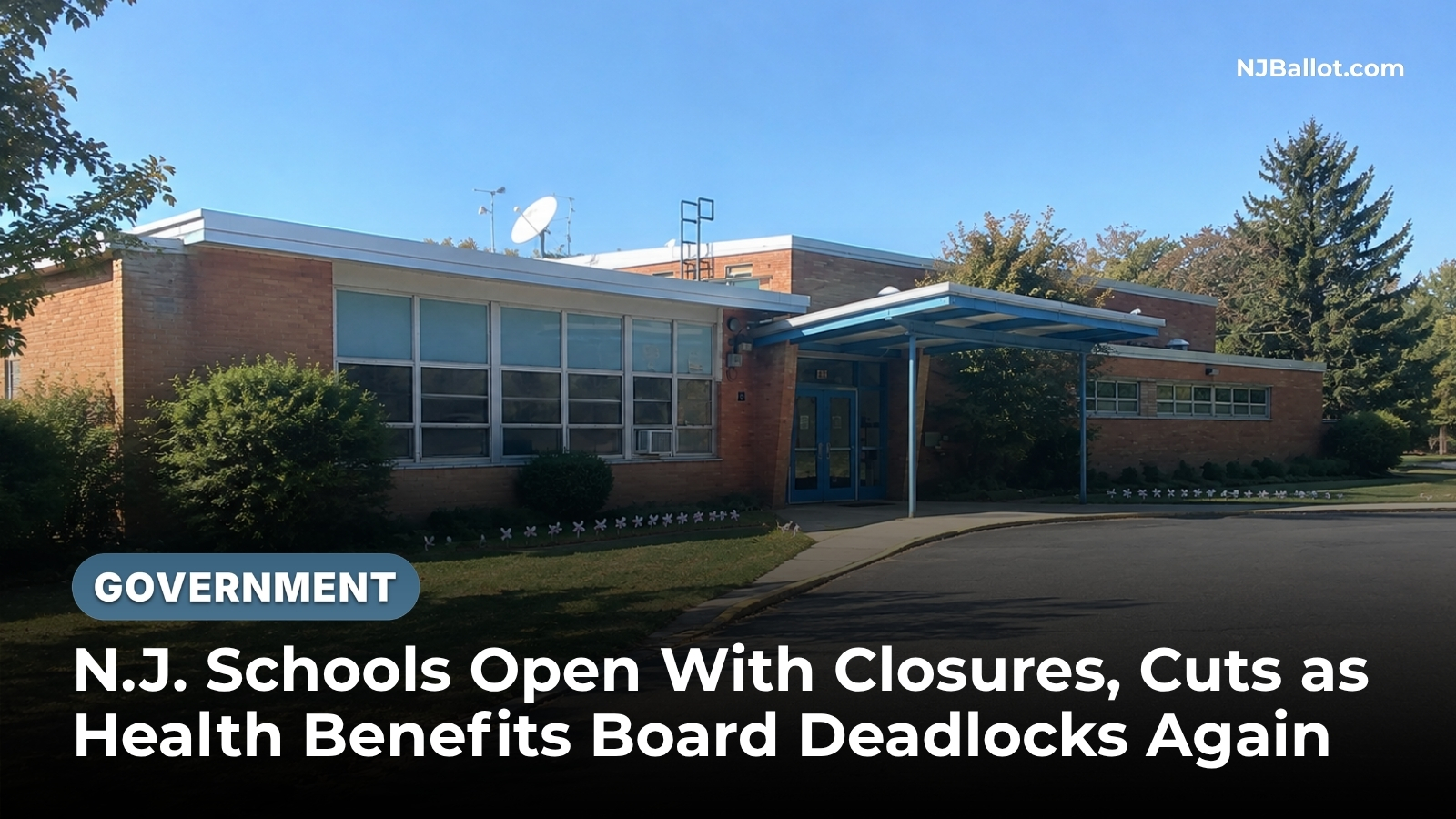

State aid hit a record $12.4 billion, but districts still closed schools, cut jobs and raised taxes while the commission that sets school employees' health premiums deadlocked again on a 34 percent hike.
Roughly 200 children in West Milford walked into unfamiliar school buildings on Thursday morning, the first day of classes in a Passaic County district that no longer operates Paradise Knoll Elementary School.
The school board voted 5-3 this spring to close the building, a 1955 structure that housed about 200 students in classrooms built for 370, and district officials expect the move to save $2.9 million over five years. It is the second elementary school West Milford has shuttered in three years.
Hours later, eight commissioners in Trenton deadlocked for the second time in two weeks over a proposed 34 percent increase in school employees' health premiums and went home without scheduling another vote. Across New Jersey, school boards opened the 2026-27 year having closed buildings, eliminated positions and raised tax levies while state school aid climbed to a record $12.4 billion. Projected figures from the governor's office show about 400 of the state's 600 districts receiving more aid than last year and 167 receiving less.
West Milford gained state aid this year: 6 percent, the maximum adjustment allowed. Jefferson Township and Toms River gained too. Cherry Hill lost the maximum permitted, 3 percent. Every one of the four districts still opened the year with fewer employees, emptier buildings or higher taxes.
Jefferson's aid grew $308,438, and Superintendent Jeanne Howe says the annual cap kept roughly $1.2 million more from reaching the district even though the state's formula called for it. In Camden County, Cherry Hill cut roughly 70 jobs against a $29 million shortfall; health costs alone jumped $10 million. Toms River is self-insured and still absorbed a 13.3 percent increase in medical costs alongside a 4.9 percent school tax levy increase.
Formula redistributes aid faster than districts can shed costs
The formula, dating to 2008, calculates aid from enrollment, property wealth and district income, and the 2018 law called S2 began shifting money toward districts it judged underfunded and away from districts it judged overfunded. Jefferson Township has lost nearly $45 million in cumulative aid under S2 while its enrollment fell 29 percent, a pairing the township council recorded in a May 20 resolution.
Last year's statewide count landed at about 1.4 million students, the smallest number since 2001-02 and a drop of 23,732 from the prior year. Districts with large Hispanic populations absorbed the sharpest declines: Paterson lost 8 percent of its students, West New York 6 percent, New Brunswick 6 percent. Those losses mean less state aid, which forces cuts even in districts the state considers fully funded.
In West Milford, Superintendent Brian Kitchin told PIX11 that state aid fell $9 million over ten years, leaving property taxes to underwrite 87 percent of the school budget. District records show health costs climbed 21 percent and utility costs 50 percent over the same stretch.
Education Commissioner Lily Laux told lawmakers in April the formula's implementation "needs another look," and Governor Mikie Sherrill's budget message promises to modernize it.
Health benefits consume every dollar districts cannot control
Its active reserve finished 2025 at negative $42 million and will close 2026 at a projected negative $56 million, actuaries told the commission, which borrowed $70 million from the retiree side of the plan to pay this year's claims.
District premiums rose 6.3 percent in 2024, 14 percent in 2025 and 31.9 percent this year, figures compiled by the New Jersey School Boards Association show, and the plan's actuary recommended 34.4 percent for 2027; the commission has now deadlocked on that proposal twice.
The New Jersey Association of School Business Officials calculated the four-year bill at $1.06 billion in new costs between 2019-20 and 2023-24: employer spending up 34.4 percent, employee contributions up 8.1 percent.
NJEA President Steve Beatty holds one of three union seats on the commission, and he told the members at their August 19 meeting why labor would not accept the proposal on faith. "We're unions. We negotiate contracts, and we know just simply agreeing to what we know is a wrong thing and hoping they'll change it is a fool's errand," he said. The union's elected officers widened the argument the next day, saying the choices before the panel "simply shift costs rather than control them," and they point to Horizon Blue Cross Blue Shield's $100 million settlement with the state over its administration of the plans, a November agreement in which the insurer denied wrongdoing. The union argues that settlement proves administrative failures, not just medical inflation, drove the plan's costs.
Even commissioners blocking the increase concede the books are real. "You have to follow the law," said Daniel Holub, a union appointee, though his challenge to the administration ran the other way: "But was there anything in the law that prevents this division from sitting down with stakeholders having a comprehensive conversation about what we might be able to do to solve this problem?"
Retiree premiums for January include an 11.3 percent increase for early retirees and 6.2 percent for those on Medicare, both approved by the commission in July. Treasury officials say only legislative changes to Chapter 44, the 2020 law that froze plan design through the end of 2027, can lower active-employee costs before then.
The actuary's projections show membership falling 9 percent in 2027 after declines of 18 percent and 8 percent, as districts leave for private carriers and take healthier risk pools with them.
Every New Jersey school board adopts its budget in the spring, weeks before the Legislature settles the aid figures in June and months before autumn brings the health rates that blow up the budget's assumptions. Deborah Cornavaca of the New Jersey Education Association described the trap in February testimony. "Public schools are forced to do their budget based on estimated state budget numbers that are not finalized until after the school budget is finalized," she said. "That is a recipe for errors."
State law caps school tax levies at 2 percent a year and folds in pension and health expenses no local board negotiates, so the exceptions now carry the system. Cherry Hill reached 7.4 percent this year through a health-cost waiver and banked authority. Hillsborough won state approval to raise 9.9 percent for the 2025-26 year under a one-time program, one of three districts to draw the maximum $1 million in incentive aid.
For districts the formula deems below their local fair share, the Education Law Center calculated in 2024, climbing out at 2 percent annually would take an average of 24 years in low-income districts and four in wealthy ones.
Land restrictions block revenue while state aid drops
Jefferson's council blames another constraint in its resolution: the Highlands Act limits development on land the state marked for preservation, 88 percent of the township's acreage, the document states, choking the ratable growth the formula expects local budgets to generate.
Republican bills sponsored in the Assembly by Alex Sauickie (R, 12th District), Aura Dunn (R, 25th) and Marisa Sweeney (R, 25th) and in the Senate by Anthony Bucco (R, 25th) and Michael Tiver (R, 8th) would pay qualifying districts $250 for every preserved acre, up to $2.5 million for midsize systems and $5 million for large ones, and the Senate Education Committee aired the proposal at a June hearing. Sauickie put the case bluntly there: "The state cannot tell a municipality it cannot develop its land and then expect it to replace lost school aid through growth-generated property taxes. Those two policies are fundamentally incompatible."
Commissioners split first on whether to allow public comment, Politico reported, then split again on the rates themselves and adjourned without naming a date; the next regular meeting falls on Sept. 28. Open enrollment begins in October, and whatever number eventually emerges takes effect in January.
In June, Senators Vin Gopal (D, 11th District) and Joseph Vitale (D, 19th) introduced a bill creating a statewide health benefits trust that would pool risk across districts; it waits in the Senate State Government Committee with no hearing scheduled. The NJEA endorses the concept, while the school boards association has warned against compelling districts to join.
On Wednesday, Governor Mikie Sherrill and 17 public-employee unions announced an agreement that waives an increase in state workers' contribution rates; their separate plan has its own commission and its own actuary, which recommended a 17 percent increase. The deal convenes a cost-reform working group by Oct. 1. The school employees' plan has no working group, no waiver and no deal — and no vote scheduled before open enrollment begins.
Paradise Knoll Elementary stood empty on the first day of school. Its students will spend the year in other buildings, and the largest uncontrollable cost in their district's budget now rests with a commission that has deadlocked twice and set no date to try again.
Related Articles
NJ Schools in Free Fall: Layoffs, Closures, Tax Hikes Hit 10+ Districts
NJ State Worker Health Premiums Drop in July, But 15.1% Hike Looms for 2027
New Jersey Creates School Civil Rights Unit to Replace Federal Enforcement
Sources
Cherry Hill Public Schools, Budget Clarity Hub (April 7, 2026)
Courier-Post, "NJ school health insurance premiums" (July 17, 2026)
Education Law Center, "A Roadmap to Improving New Jersey Tax Caps" (October 2024)
Friedman, Matt, Politico, "Ride the death spiral," New Jersey Playbook (Sept. 3, 2026)
Friedman, Matt, Politico, X posts from the School Employees Health Benefits Commission meeting (Sept. 3, 2026)
Inquirer, Cherry Hill health cost increase (April 10, 2026)
Jefferson Township Council, Resolution on Highlands Act school funding impact (May 20, 2026)
New Jersey Association of School Business Officials, "Structural and Financial Challenges in School Health Benefits" (October 2025); statement (Nov. 14, 2025)
New Jersey Attorney General's Office, Horizon Blue Cross Blue Shield settlement announcement (Nov. 14, 2025)
New Jersey Department of the Treasury, School Employees Health Benefits Commission meeting calendar and member roster (accessed Sept. 3, 2026)
New Jersey Governor's Office, "Governor Sherrill and 17 State Employee Unions Reach Agreement to Launch Comprehensive State Health Benefits Program Reform Effort" (Sept. 2, 2026)
New Jersey Governor's Office, Sherrill budget message on school funding formula (March 10, 2026)
New Jersey Legislature, Bill No. A4860, "Fairness for School Districts in Development Restricted Areas Act" (May 2026); companion Bill No. S4118
New Jersey Legislature, Bill No. S4438, "Public School Employees' Health Benefits Trust Act" (June 8, 2026)
New Jersey Monitor, budget-testimony coverage (Feb. 20, 2026); Laux testimony (April 15, 2026); SEHBP finances (July 15 and July 27, 2026); enrollment decline (July 20, 2026); commission deadlock (Aug. 19, 2026)
NJ.com, Cherry Hill health cost increase (March 24, 2026)
NJ.com, Jefferson aid history (Feb. 6, 2026); Jefferson cap figures (April 2, 2026); Paradise Knoll enrollment (April 15, 2026); commission deadlock (Aug. 20, 2026)
NJ Spotlight News, state aid figures (March 13, 2026); funding-formula tensions (July 9, 2026); Hillsborough incentive aid (Aug. 27, 2025); commission coverage (Aug. 20, 2026)
NorthJersey.com, Paradise Knoll closure plan (April 9, 2026)
Patch, Cherry Hill aid figures (March 24, 2026); Toms River budget approval (April 30, 2026); Hillsborough budget (May 3, 2026)
PIX11 News, West Milford closure report (April 2026)
TAPinto Jefferson, central office sale status (July 7, 2026)
West Milford Messenger, Paradise Knoll capacity and utility costs (April 13, 2026)
West Milford Messenger, Paradise Knoll vote (May 5, 2026); Senate Education hearing (June 2, 2026)
WRNJ, Jefferson resolution coverage (May 2026)
Yahoo News, Beatty remarks at SEHBC meeting (Aug. 19, 2026)
Yahoo News, SEHBP actuary presentation (July 15, 2026)