
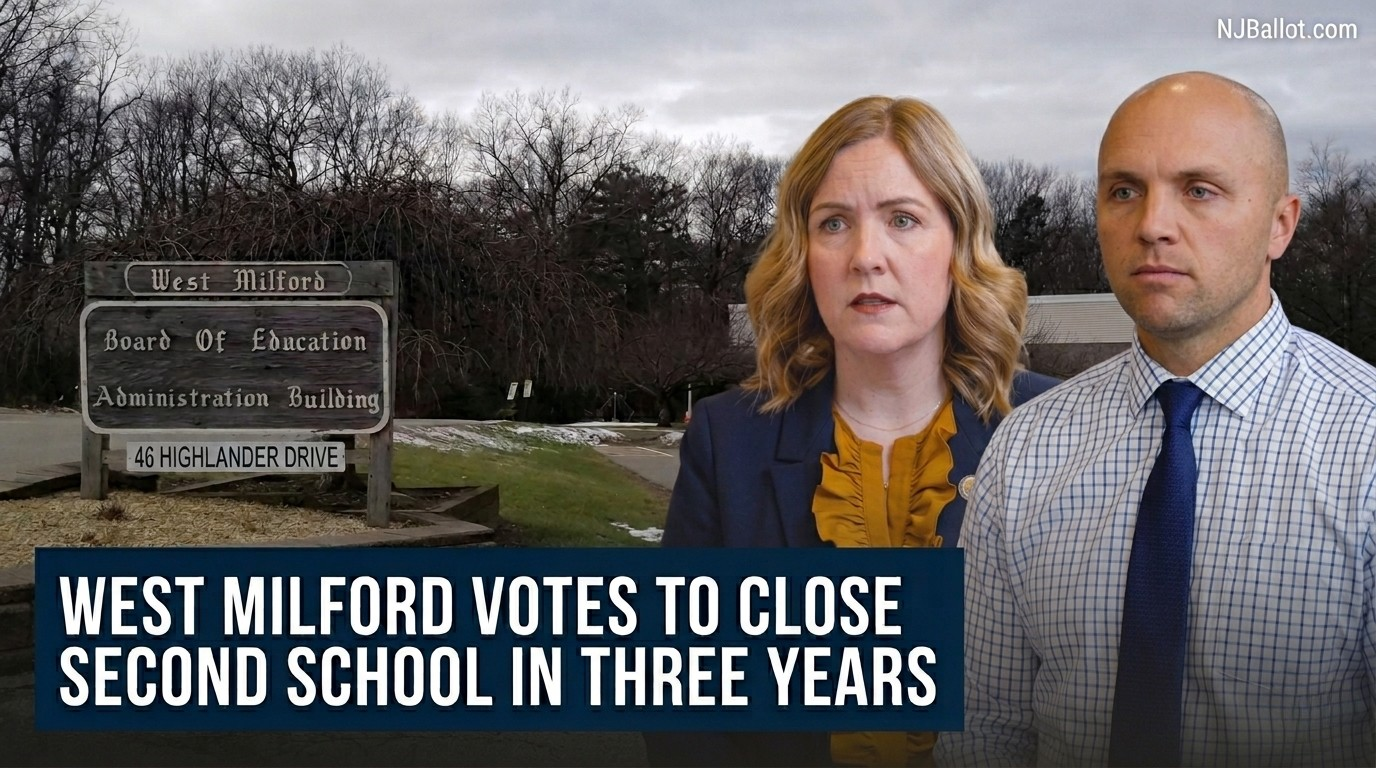

WEST MILFORD—The school board voted 6-1 to close Paradise Knoll Elementary School, a 1955 building on Paradise Road in the hilly Oak Ridge section where 211 kids go to class.
It was the second elementary school that West Milford has shut in three years. The first, Westbrook, closed in 2023 and became the Highlander Academy for special education programs. Now Paradise Knoll would follow. The district will scatter its students across four remaining schools while it tries to close an $8.6 million hole in an $83.6 million budget.
The hole predates this budget. Since 2015, the district has lost $8.74 million in annual state aid. That is a 60 percent reduction. During that span the district has increased the local tax levy by $8.9 million, according to Kitchin's letter. Next year's preliminary budget draws nearly 87 percent of its revenue from those local taxes. State and federal aid combined account for just over 8 percent.
"We are hardworking people here," said Jessica Brandt, a parent with two children at Paradise Knoll. "We are working hard to make this money for our families, and it is not going to our children."
Budget Cuts and Operating Costs
District administrators say shuttering Paradise Knoll will save millions annually. The building is the oldest in the elementary inventory, and its utility bills make it the costliest per student to operate. Closing it removes the district's most expensive elementary building to heat and light.
Maria Tahan, the Paradise Knoll PTA president, warned that large class sizes without aides can degrade instruction. "We know that children need more attention and care, and if you fill a classroom with 28 students without an aide, that's putting a big burden on the teachers, and the students' quality of education does decrease as a result of that," Tahan said.
Board member Stephanie Marquard said the priority was protecting students and staff. "For me, the priority is making sure we are doing right by our students, supporting our staff, and putting this district in the strongest position possible moving forward," Marquard said.
Highlands Preservation Act Limits Options
Superintendent Brian Kitchin laid out the structural problem in a March open letter to Governor Mikie Sherrill, Education Commissioner Lily Laux and legislative leaders.
West Milford receives roughly $1,842 in state aid per pupil. The statewide average is $8,811. Some districts collect $15,000 to $20,000 per student.
"Unlike other districts, West Milford cannot respond to funding losses by expanding ratables, because 100 percent of our municipality lies within the Highlands Preservation Area—a constraint imposed by state policy for the benefit of the region," Kitchin wrote.
The Highlands Act passed in 2004. It restricts development across parts of seven counties to protect drinking water for roughly half the state. The law severely limits commercial and residential construction, which caps property values and prevents the tax base from growing fast enough to offset aid losses. Kitchin noted that West Milford is the only K-12 district in New Jersey located entirely within the preservation area.
Buses run routes that would cross entire towns elsewhere. Kitchin wrote that the district spans 88 square miles of northern Passaic County, and its Transportation Department operates 157 routes generating over 1,100 daily trips. Transportation costs exceeded $6.7 million in the most recent audited year.
The district projects that health benefit costs for employees will hit $22.78 million in 2026-27, up 18 percent or $3.6 million from the current year. That increase alone exceeds the district's entire state aid bump for next year. Next year's aid increase covers less than one-tenth of the health benefits jump.
State Aid Increase Falls Short of District Needs
The fiscal year 2027 state aid package, released on March 12, brought West Milford a 6 percent increase from $5.49 million to $5.82 million. District officials said that represents a decline of roughly 57 to 58 percent from 2018-19 levels, when the district received about $14 million.
Education Commissioner Lily Laux told the Assembly Budget Committee on April 15 that the Sherrill administration built the FY27 budget with a 3 percent cap on aid decreases and a 6 percent cap on increases. Those caps prevent the dramatic swings that characterized the school aid reallocation under S2. That 2018 law required over-aided districts to align with the School Funding Reform Act (SFRA) formula over six years.
The S2 school funding law provided transitional funding for six years to districts, to help them align with the SFRA formula. Fiscal year 2025 marked the conclusion of that transition. Lawmakers introduced the 3 percent decrease cap and 6 percent increase cap in fiscal year 2026 as post-transition stability measures, and those caps remain in effect for the current fiscal year 2027. Those caps limit how fast West Milford can recover lost aid, regardless of how much the legislature appropriates.
At the April 15 hearing, Assemblyman Mike Inganamort, a Morris County Republican who sits on the Budget Committee, cited West Milford as an example of the formula's strain. "In West Milford, the state aid has been cut in half—80 percent of the school tax burden is on property taxpayers," Inganamort said. He also criticized urban districts like Newark that receive higher amounts of state aid.
Assembly Budget Chair Eliana Pintor Marin, a Newark Democrat, pushed back, arguing that Republican focus on high-aid urban districts diverted attention from statewide formula problems.
Ringwood and Bloomingdale Also Lose Equalization Aid
West Milford receives zero Equalization Aid, the core SFRA funding stream meant to close the gap between local wealth and educational need.
It is not alone. Also in Passaic County, Ringwood similarly receives no Equalization Aid. Ringwood's FY27 aid totals about $2 million, up 6 percent, but the district has lost 26.5 percent of its state aid since 2018-19 and reports zero banked cap remaining.
Bloomingdale, another Passaic County district with no Equalization Aid, saw its equalization support drop to zero in FY26.
All three districts share the same formula classification: the SFRA calculated their Local Fair Share as sufficient to cover the Adequacy Budget without state equalization support. For West Milford, that calculation ignores the Highlands Act's ratable restrictions.
West Milford Proposes Tax Levy to Fill the Gap
West Milford is proposing a 5.92 percent increase in the local tax levy for 2026-27. The district has exceeded the standard 2 percent cap, indicating that the district will use banked caps, health-benefit adjustment authorities, or some other statutory flexibility. District filings do not specify the exact mechanism.
Even with the increase, the district faces an $8.6 million deficit. District officials say they will redraw attendance boundaries and adjust staffing levels over the summer.
Kitchin's letter closed with an invitation for state officials to review the district's books in person.
Come September, Paradise Knoll's 211 students will board buses for four remaining elementary schools. The 1955 building on Paradise Road has no announced future.
Meanwhile, West Milford taxpayers—including parents like Jessica Brandt—will keep covering nearly 87 cents of every dollar the district spends.
"It feels like it's being taken," she said.
Related Articles
• Some NJ Districts Face Major Aid Losses Under Record School Budget
• Ridgewood Students Rally to Save Coach as Budget Cuts Force Layoffs Across New Jersey
• Jersey City School Board Approves 17% Tax Levy Amid $74M Aid Loss
• Cherry Hill Schools Face $14.5M Cuts as Tax Hike Looms Tonight
• N.J. School District to Close after Voters Reject Tax Hike
Sources
• New Jersey Department of Education, "Fiscal Year 2027 K-12 State School Aid District Details" (March 12, 2026)
• New Jersey Department of Education, "Fiscal Year 2026 K-12 State School Aid District Details" (March 2025)
• West Milford Township Public Schools, "2025-26 Municipal User-Friendly Budget" (n.d.)
• West Milford Township Public Schools, "Preliminary 2026-27 Budget" (March 24, 2026)
• West Milford Township Public Schools, "Annual Comprehensive Financial Report 2023" (n.d.)
• West Milford Township Public Schools Board of Education, "Agenda for Special Meeting" (April 7, 2026)
• Kitchin, Brian et al., "Open Letter to Governor Mikie Sherrill, Commissioner Lily Laux and Members of the New Jersey Legislature" (March 2026)
• Passaic County Board of Taxation, "Table of Equalized Valuations" (2025)
• West Milford Messenger, "Paradise Knoll Elementary School to Close" (April 11, 2026)
• West Milford Messenger, "West Milford BOE May Close Paradise Knoll School Amid Budget Pressures" (April 10, 2026)
• PIX11 News, "Second Elementary School in 3 Years Closing in West Milford" (April 9, 2026)
• DiFilippo, Dana, New Jersey Monitor, "NJ's School Funding Formula Needs to Change, Education Chief Says" (April 16, 2026)
• Zimmer, David M., NorthJersey.com, "West Milford May Close Another School as Taxes Rise Again" (April 9, 2026)
• Symons, Michael, Central Jersey, "NJ Schools Face Shortfalls Despite Record Budget" (April 17, 2026)
• West Milford Township Public Schools, "Transportation" (accessed April 2026)
• National Center for Education Statistics, "Paradise Knoll Elementary School Profile" (2024-25)
• Ringwood Public Schools, "2026-2027 Tentative Preliminary District Budget Presentation" (March 18, 2026)
• Bloomingdale School District, "2025-26 User Friendly Budget Summary" (October 1, 2025)
• New Jersey Legislature, P.L.2018, c.67 (July 24, 2018)