
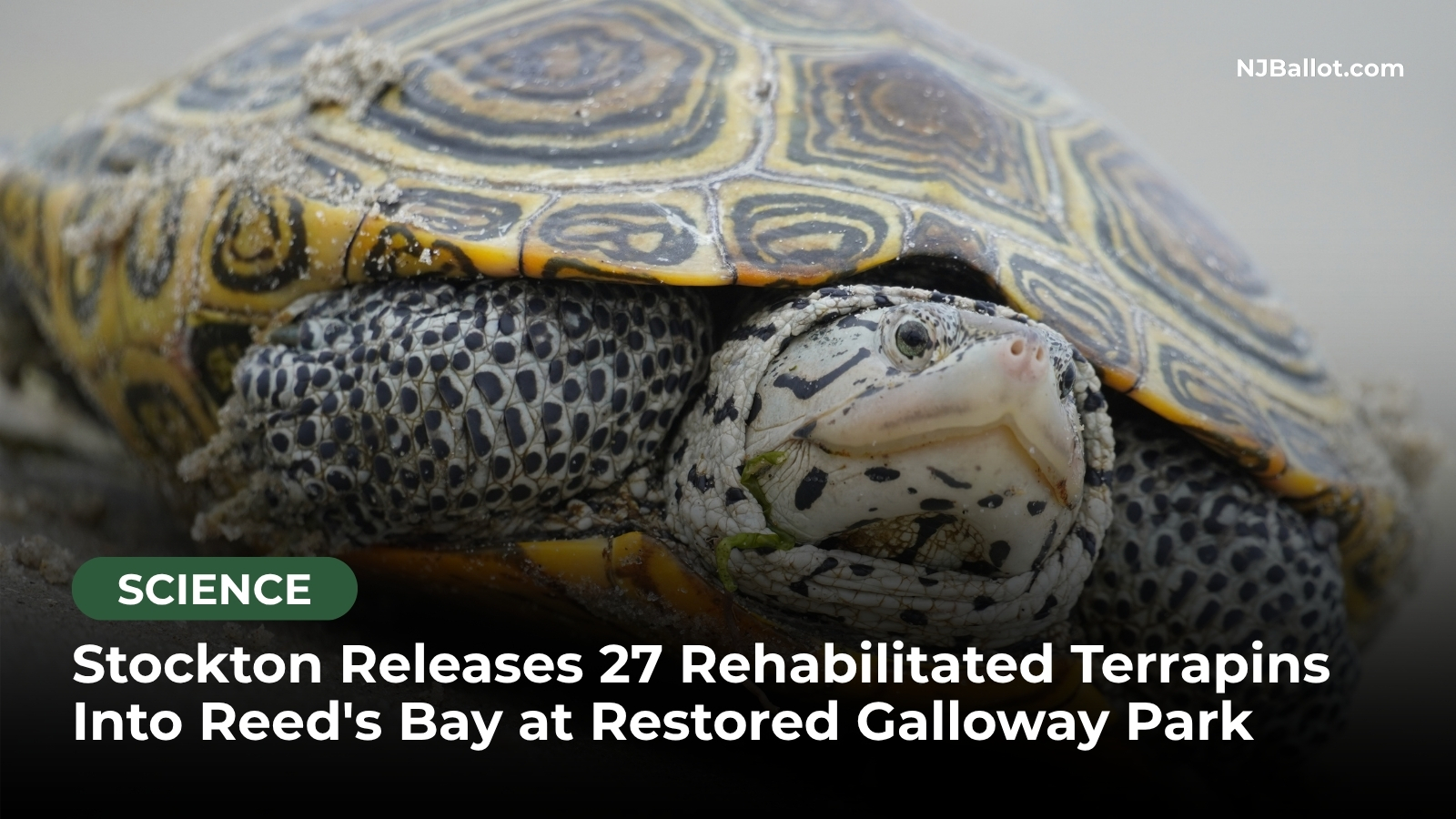

Twenty-seven healed terrapins went back into Reed's Bay behind Veterans Memorial Park on September 23, the latest release from the Stockton University program that has rehabilitated the road-struck species since 1989.
John Rokita, Melissa Laurino and Lester Block spent months getting 27 northern diamondback terrapins ready, and on September 23 the Stockton University alumni and staff carried the animals down the bank at Glenn by the Bay and set them loose in Reed's Bay.
The three look after the terrapins in the School of Natural Sciences vivarium, and students help with the daily work. Some of the turtles spent the winter in a campus lab, growing to the size of wild three- and four-year-olds. Others were adults recovering from shell repairs; staff kept them only long enough to heal. The community members who had found the animals and brought them in joined the release, according to the university's account.
The release site sits behind Veterans Memorial Park on South New York Road, on a township-owned parcel of roughly 72 acres that the Glenn family refused to develop. The family pushed the land into the state Green Acres Program, the Atlantic County parks system held it, and Galloway Township runs it today. Tim Glenn was there, and after the turtles went in he and Steve Fiedler of Galloway Go Green led a walk through what the property has become: pollinator gardens, educational signage and a mile-long loop trail, plus a stand of woods the family calls Annie's Woods, after Anne-Marie Glenn.
Female terrapins leave the marsh every summer to lay eggs, and the trip often takes them across pavement. Cars crush some outright; staff recover eggs from the dead females through a procedure called an eggedectomy and incubate them. Hatchlings also turn up in storm drains; some of this year's released hatchlings, Laurino said in her post, were "rescued from storm drains in the early spring."
The Stockton program doing this work dates to 1989, when professor Roger Wood started it after years of watching females die on the roads. It rehabilitates between 500 and 1,000 terrapins a year, according to a 2024 Stockton news feature. Rokita, a 1978 alumnus who has worked at Stockton since 1980, is assistant supervisor of the university's vivarium; a June 2025 feature on the program put his partnership with it at 34 years. "It's like a triage system. You have to go with what you think needs your attention first and then you go from there," Rokita said.
Staff incubate eggs at 30 degrees Celsius, a temperature that produces all-female clutches. A few degrees cooler and the clutches would hatch all male; Rokita told NJ 101.5 the point is to replace at least part of the females killed on the roads each year. The eggs take 10 months to a year to hatch and grow strong enough for the wild, and hatchlings carry a microchip when they go free. Staff do the work under state permits, and Stockton runs it in partnership with the Wetlands Institute in Stone Harbor, Cape May County, where a kindergarten release tradition goes back to 1991.
Rokita described one repaired female at an October 2020 release at Glenn by the Bay, pointing to the epoxy patches on her upper shell: "But she's eating. She's solid as a rock. She's good to go."
New Jersey's list of species of special concern includes the northern diamondback terrapin. The state Department of Environmental Protection closed the 2016 commercial harvest season with an administrative order that January, three years after a single harvester took 3,522 terrapins from two southern New Jersey locations and sold them to a Maryland aquaculture facility that later exported more than 14,000 offspring to Asia. That July, then-Governor Chris Christie signed the law designating the terrapin a nongame species, ending the harvest for good.
The trade never fully died: in 2019 a raid on a Bucks County man's home turned up thousands of hatchlings from New Jersey marshes with a black-market value of $550,000; he drew a six-month term. The federal government is now weighing the question: the U.S. Fish and Wildlife Service published a 90-day Endangered Species Act finding in the Federal Register on July 14, 2026, and opened a 12-month status review. The agency has not listed the species.
The park itself took years of physical work. Galloway officials cut the ribbon in October 2024 on a grant-funded project led by Fiedler's group that pulled more than 200 tons of invasive plants off the land and replanted native species. PSEG funded the work through Sustainable Jersey. Fiedler credited partners including the National Park Service, the U.S. Fish and Wildlife Service, the Xerces Society, the Glenn Family Foundation and Cub Scout Pack 12, and Galloway Mayor Anthony Coppola gave opening remarks. On March 22 this year, the New Jersey Watershed Ambassadors program had an invasive-removal workday on the calendar at the park.
Two days before the release, state Environmental Protection Commissioner Ed Potosnak opened New Jersey's Climate Week in Trenton by adding three regional teams to the Resilient NJ program, which pairs municipal groups with planners and engineers to map flood and heat risks. "Floodwaters, extreme heat and wildfires do not stop at municipal boundaries. These shared climate hazards require regional action, informed by the latest climate science, to protect public health and safety," Potosnak said.
Derelict crab traps drown terrapins elsewhere on the Jersey coast. Project Terrapin, a Barnegat Bay-area education program, reports handing out more than 35,000 bycatch-reduction devices across Ocean, Atlantic and Cape May counties through 2025, and Veolia North America funded a derelict-pot recovery project in the bay.
Laurino's post closed with advice for anyone driving near the marsh: "Small actions like slowing down, paying attention for crossing turtles, and checking your local storm drain, can go a long way in protecting our Northern diamondback terrapin." Residents can log sightings through the state Department of Environmental Protection's Wildlife Tracker app.
Releases at this site go back years: September 14, 2018, when Rokita was joined by Laurino and Lester Block, the same two colleagues named in this year's account; the fall of 2019, when just over two dozen went in; an October 2020 release that staff called the last of that season; early October 2024; and late August 2025. September water still holds summer warmth, giving the animals time to settle in before they cool down and bury themselves in the mud for winter. "They'll slow their respiration down to where they barely just survive in hibernation," Rokita said. "In one of those miracles of nature, they'll be raring to go next spring."
Related Articles
Sherrill Signs Bill Ending 50-Year Nuclear Moratorium, Launches Task Force at Salem Plant
NJ Secures $2.5B PFAS Settlement, Largest Single-State Environmental Deal
NJ DEP Unveils $130M Historic Sites Package as 250th Anniversary Nears
Sources
• Chris Christie, Governor of New Jersey, signing statement on A-2949, the northern diamondback terrapin nongame legislation (July 15, 2016)
• Glenn Insurance, Inc., Facebook, post on the August 26, 2025 terrapin release at Glenn by the Bay (August 26, 2025)
• Melissa Laurino, Instagram, post on the Atlantic County terrapin release (September 25, 2026)
• NJ 101.5, "Last of the NJ diamondback terrapins have been released for the year" (October 6, 2020)
• New Jersey Department of Environmental Protection, "Christie Administration Proposes Rule to Close All Harvesting of Diamondback Terrapins" (16/P042) (May 16, 2016)
• New Jersey Department of Environmental Protection, "DEP Issues Administrative Order Closing Diamondback Terrapin Season to Ease Harvesting Pressures on Species" (16/P004) (January 26, 2016)
• New Jersey Department of Environmental Protection, Endangered, Threatened and Special Concern Species list (accessed September 26, 2026)
• New Jersey Department of Environmental Protection, "Kicking Off Climate Week, DEP Highlights Three Regional Teams Making Communities More Resilient to Flooding and Other Climate Impacts" (26/P042) (September 21, 2026)
• New Jersey Department of Environmental Protection, "Reporting Rare Wildlife Sightings" / NJ Wildlife Tracker application (accessed September 26, 2026)
• New Jersey Legislature, A-2949 (P.L. 2016, c.17), 2016-2017 session (approved July 15, 2016)
• New Jersey Watershed Ambassadors Program, Facebook, "Glenn by the Bay Invasive Plant Removal" workday announcement (March 2026)
• Ocean County Vocational Technical School, "Veolia North America Awards MATES 20,000 in Partnership on a Derelict Crab Pot Recovery Project to Help Preserve the Barnegat Bay" (December 20, 2022)
• Patch, "NJ Kindergarteners Release Terrapins With Wetlands Institute" (June 2026)
• Philadelphia Inquirer, "Their moms were roadkill, but these South Jersey hatchling terrapins get new chance at life" (October 5, 2020)
• Project Terrapin, "Terrapin Excluder Devices (TEDs / BRDs)" program page (accessed September 26, 2026)
• Tammy Thornton, Shore Local Newsmagazine, "Glenn by the Bay at Veterans Memorial Park holds ribbon-cutting ceremony" (October 17, 2024)
• Stockton University, Facebook and Instagram, 2026 terrapin release posts (September 25, 2026)
• Stockton University News, "Picture Stockton… Giving Second Chances" (November 1, 2019)
• Stockton University News, "Rescue Project Gives Terrapins New Life" (June 6, 2024)
• Stockton University News, "Stockton Releases Rehabbed Terrapins Back into the Wild" (September 18, 2018)
• Stockton University News, "Stockton Terrapin Conservation Reaches Next Generation" (June 11, 2025)
• The Wetlands Institute, terrapin conservation program page (accessed September 26, 2026)
• U.S. Fish and Wildlife Service, "US Fish and Wildlife Service Completes 90-Day Finding for Diamondback Terrapin" (July 2026)
Hero photo: Lydia Hansen/USFWS (public domain)