

The law makes it an antitrust violation for landlords to use pricing software fed by competitors' nonpublic data. It takes effect July 1, 2027, and follows local bans in Jersey City and Hoboken.
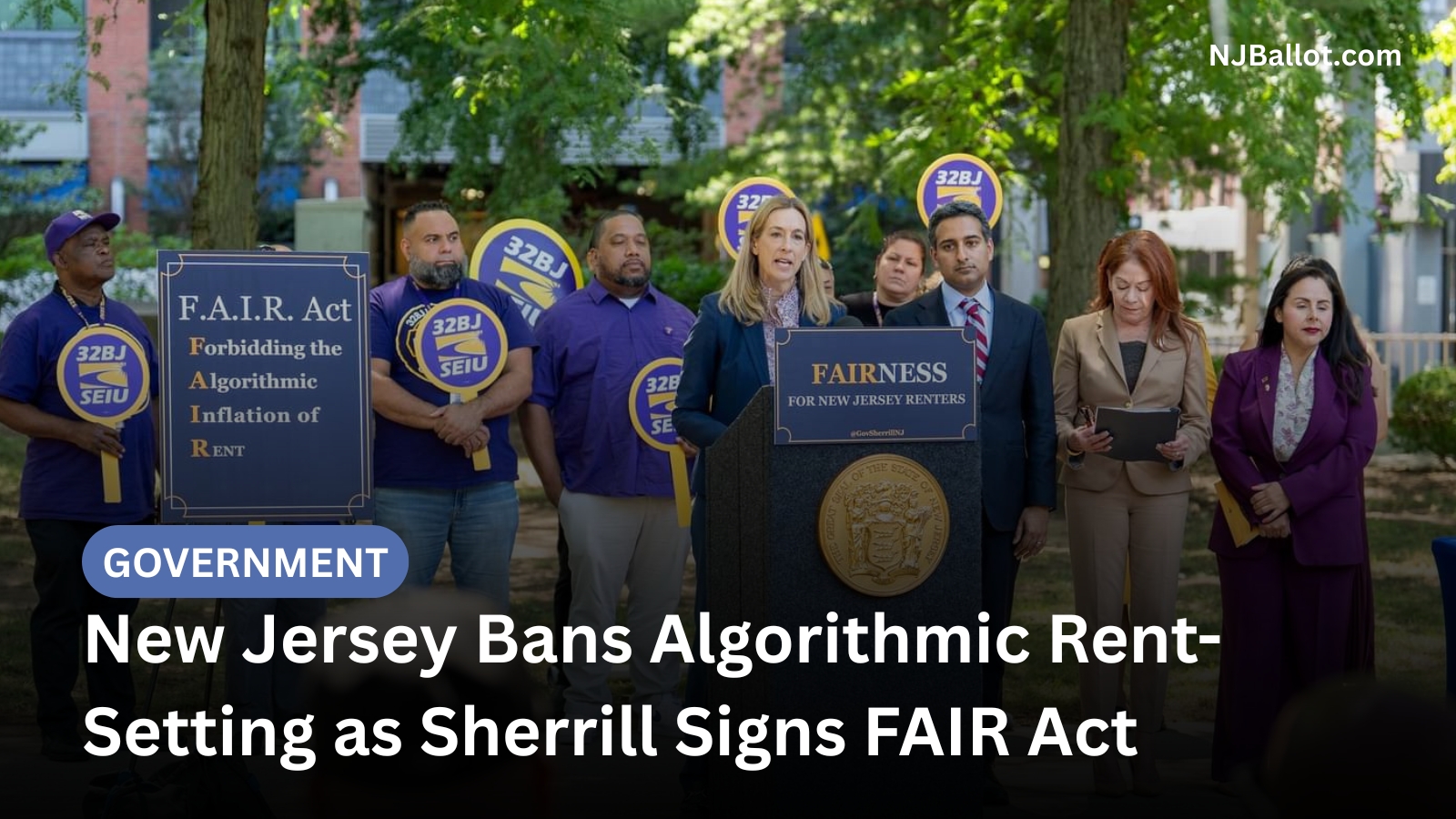
Governor Mikie Sherrill on Monday signed the Forbidding the Algorithmic Inflation of Rent (FAIR) Act, making it a violation of the New Jersey Antitrust Act for a landlord to buy pricing services fed by other landlords' nonpublic data. Her office said in a statement that New Jersey is just the fourth state to explicitly regulate rent setting algorithms.
The bill cleared the legislature June 30, when the Assembly passed it 57-22 and the Senate 33-4. Sherrill signed it on July 20 at Military Park in Newark.
Sherrill framed the law as a strike on collusion. "The problem is that these tools put competing landlords on the same team against renters," she said at the signing.
Law bars algorithmic rent coordination
Designated A3497 in the Assembly and S451 in the Senate, the law bars a rental property owner, or any agent, representative or subcontractor, from receiving, contracting for or subscribing to a rent coordinator. A coordinator is anyone operating a service that collects nonpublic pricing data from two or more owners and runs it through an algorithm to set or recommend rents, lease terms or occupancy levels. It also bans the coordinators themselves from brokering tacit or express agreements among owners that restrict competition.
The law carves out its own exceptions. A spreadsheet that runs without artificial intelligence and needs a human to do the math is not an algorithmic device. Neither is a database that merely queries its own unprocessed data. Free public rent estimates, open brokerage listing services that stick to listing and government affordability controls are all outside the law's reach. So are research, statistical analysis and testing, provided the information never feeds a price recommendation for a current or future lease. Nothing in the act sets rents, orders them down or forbids any owner from pricing alone.
Enforcement runs through the New Jersey Office of the Attorney General. The office must take complaints about violations on the website of the Department of Law and Public Safety. Existing Antitrust Act penalties apply. Under N.J.S.A. 56:9-10(c), a court may assess a civil penalty of not more than the greater of $100,000 or $500 for each day a violation continues. The statute also makes any knowing violation a crime under N.J.S.A. 56:9-11. Under N.J.S.A. 56:9-12, anyone injured may sue and recover the greater of $1,000 or three times their damages, plus attorneys' fees and costs.
Jersey City banned the practice in May 2025 and Hoboken followed that July. The state statute bars municipalities from enacting conflicting ordinances going forward. What that means for the existing local bans is an open question.
The law takes effect July 1, 2027, just under a year after signing. The Legislature wrote that delay into the statute itself.
Assemblywoman Yvonne Lopez (D, 19th District), who chairs the Assembly Housing Committee, carried the bill with Assembly members Margie Donlon (D, 11th), Chigozie Onyema (D, 28th) and Katie Brennan (D, 32nd). In the Senate, Brian Stack (D, 33rd) and Majority Leader M. Teresa Ruiz (D, 29th) sponsored its counterpart. Three Assembly committees shaped the bill before it reached the floor: Housing on March 9 (5-2), Appropriations on June 8 (10-4) and State and Local Government on June 23 (5-2).
For Brennan, a first-term assemblywoman from Hudson County, the FAIR Act marks her first bill to become law. She ran in 2025 on a housing plan that put a ban on rent-setting algorithms near the top.
"I'm proud to have this be the first housing bill I've sponsored to be signed into law," Brennan posted on her Facebook page. "It won't be the last!"
In a statement included with the Governor's press release, Senator Stack took aim at the software's corporate users: "These are not your neighborhood landlord—they are large corporations making money hand over fist and forcing people out of their communities."
A federal antitrust case was already under way
The bill became law while a federal lawsuit was already pending. In April 2025, then-Attorney General Matthew Platkin sued ten of the state's largest landlords and RealPage, a Texas-based software company that provides revenue management products to landlords.
Platkin alleged a hub-and-spoke conspiracy that covered apartments by the tens of thousands statewide and affected hundreds of thousands of tenants. The complaint cited user groups, landlords recruiting one another and "secret shops" that checked whether landlords followed the software's prices.
The complaint names as defendants AION, AvalonBay, Bozzuto, Cammeby's, Greystar, Kamson, LeFrak and its affiliate Realty Operations Group, Morgan Properties, Russo Development and its affiliate Russo Property Management, and Veris Residential.
Defendants have called the suit baseless, arguing the landlords merely licensed revenue management software.
Judge Madeline Cox Arleo issued a mixed ruling on March 31, 2026, unsealed in May, that kept RealPage and most of the landlords in the case while dismissing some state claims. Her opinion found the complaint plausibly alleged that all but one landlord had largely delegated their pricing authority to RealPage.
The state, represented by the Attorney General's office with Cohen Milstein as outside counsel, is seeking an injunction, a monitor paid for by the defendants, civil penalties, damages and disgorgement.
"We are proud to be leading the fight in court against algorithmic collusion," Attorney General Jennifer Davenport, who succeeded Platkin in January, said Monday.
The federal Justice Department settled its own case against RealPage in November 2025 with no penalties and no admission of wrongdoing, extracting product restrictions instead: a ban on using competitors' nonpublic data at runtime, a 12-month aging requirement on training data and a court-appointed monitor.
In the private multidistrict litigation in Tennessee, 27 defendants reached 26 settlements for $141.8 million with preliminary approval granted November 21, 2025. A second batch filed in May 2026, worth $218 million and covering 14 settlements, awaits approval, bringing the total to roughly $360 million. New Jersey joined Maryland, Kentucky and Washington, D.C. in formally objecting to the first batch of settlements.
A December 2024 White House Council of Economic Advisers analysis found algorithmic pricing cost renters in buildings that used the software an average of $70 per month. An estimate of the total cost to renters across the country came to $3.8 billion in 2023 alone, a figure the authors called a likely lower bound. RealPage's software at the time accounted for at least 10 percent of rental units nationwide and roughly one in four multifamily rentals.
New Jersey follows three other states
Sherrill's signing followed California, which broadened its general antitrust law in October 2025; New York, which enacted a housing-specific ban that December; and Connecticut, which did so in January 2026. Colorado's legislature had passed a similar housing bill that its governor vetoed in May.
The New Jersey Apartment Association has not publicly opposed the legislation's concept but has warned about its execution. "We just need to be careful that the language of the bill does not create additional litigation costs or an environment that disincentivizes companies from entering the New Jersey market," the association's David Brogan said in March.
The Tennessee multidistrict case still awaits a judge's approval of its $218 million second settlement batch, and New Jersey's lawsuit against RealPage and the ten landlords continues in federal court in Newark.
The law takes effect July 1, 2027, nearly a year after signing. Renters whose landlords price through the software will keep paying its rents until then.
Related Articles
• U.S. Supreme Court Upholds NJ Affordable Housing Mandate, Denies Towns' Emergency Bid
• Sherrill Signs NJ Energy Bills in Woodstown, Claims $1B in Ratepayer Savings
• DOJ Sues NJ Gov. Mikie Sherrill Over ICE Executive Order 12
Sources
• Arleo, Madeline Cox, United States District Judge, Platkin v. RealPage, D.N.J. 2:25-cv-03057, Opinion (March 31, 2026; unsealed May 14, 2026).
• Assemblywoman Katie Brennan (D, 32nd District), "Big News! New Jersey just became the fourth…," Facebook post (July 20, 2026)
• Assemblywoman Yvonne Lopez (D, 19th District), Chair, Assembly Housing Committee, statement (March 9, 2026).
• Baker McKenzie, "Connecticut Becomes Third State to Adopt Algorithmic Pricing Legislation" (January 15, 2026).
• Brogan, David H., Executive Director and CEO, New Jersey Apartment Association, statement to Homes.com News (March 17, 2026).
• Cohen Milstein Sellers & Toll PLLC, "NJ AG Sues RealPage, Landlords, Claiming Rent Price 'Cartel'" (April 23, 2025).
• Cohen Milstein Sellers & Toll PLLC, "RealPage And Most Landlords Must Face NJ's Antitrust Claims" (May 16, 2026).
• Davenport, Jennifer, New Jersey Attorney General, statement (July 20, 2026).
• Economic Security Project Action, "Governor Signs Landmark Legislation to Ban Algorithmic Price Fixing" (October 7, 2025).
• Fisher Phillips, "Senate Votes to Drop State AI Law Pause, Opening Door for More Workplace Regulation" (July 1, 2025).
• Fisher Phillips, "Congress Again Drops Bid to Block State AI Laws" (December 5, 2025).
• Governing, "Several Cities Block AI-Powered Rent Gouging" (June 10, 2025).
• Hausfeld LLP, "RealPage Federal Antitrust Class Action" (settlement page, accessed 2026).
• Homes.com News, "New Jersey Weighs Restrictions on Algorithmic Rent Pricing" (March 17, 2026).
• Homes.com News, "New Jersey Governor Signs Law Banning Rent-Setting Algorithms" (July 22, 2026).
• Hudson County View, "Assembly Panel Advances Bill to Ban RealPage, as Jersey City & Hoboken Already Did" (March 10, 2026).
• Hudson County View, "Hoboken Council to Follow Jersey City's Lead to Ban Rent-Setting Algorithms" (June 2, 2025).
• Hudson County View, "Sherrill Signs the FAIR Act to Protect Renters from Algorithmic Rent Setting" (July 20, 2026).
• Jersey Vindicator, "Legislature Sends FAIR Act to Gov. Sherrill, Advancing Ban on Algorithmic Rent-Setting Software" (July 1, 2026).
• Jersey Vindicator, "New Jersey Bans AI-Powered Rent-Setting Software Used by Landlords" (July 20, 2026).
• Morristown Minute, "New Jersey Bans Algorithmic Rent Coordination, Effective July 2027" (July 21, 2026).
• Multifamily Dive, "New Jersey RealPage Antitrust Lawsuit Narrowed" (April 7, 2026).
• Multifamily Dive, "Apartment Owners to Pay $218M in Second Batch of RealPage Settlements" (May 20, 2026).
• Multifamily Dive, "New Jersey Mulls Algorithmic Rent Pricing Ban" (March 24, 2026).
• New Jersey Legislature, Assembly Bill A3497 [1R] ACS, P.L.2026, c.43 (enacted June 30, 2026).
• New Jersey Office of the Attorney General, "AG Platkin Files Antitrust Lawsuit Against Software Company RealPage and 10 NJ Landlords for Alleged Collusion in Statewide Rent Raising Scheme" (April 23, 2025).
• New Jersey Office of the Governor, "Governor Sherrill Signs the Forbidding the Algorithmic Inflation of Rent (FAIR) Act Into Law to Protect Renters from Algorithmic Rent Setting" (July 20, 2026).
• Paul, Weiss, Rifkind, Wharton & Garrison LLP, "Practical Takeaways From the DOJ's Algorithmic Pricing Settlement" (December 2, 2025).
• Private Equity Stakeholder Project, "Thoma Bravo's RealPage Banned in New York and California" (December 17, 2025).
• Ruiz, M. Teresa, Senate Majority Leader (D, 29th District), statement (July 20, 2026).
• Stack, Brian, Senator (D, 33rd District), statement (July 20, 2026).
• United States District Court, District of New Jersey, Platkin v. RealPage, D.N.J. 2:25-cv-03057, Complaint (April 23, 2025).
• White House Council of Economic Advisers, "The Cost of Anticompetitive Pricing Algorithms in Rental Housing" (December 17, 2024).