
The measure cleared a Senate committee Oct. 8. Supporters say rates that customers can see coming would be easier to budget for and would help pay to keep up aging pipes and wires. The state's advocate for utility customers says it would bring yearly rate increases and weaker oversight.
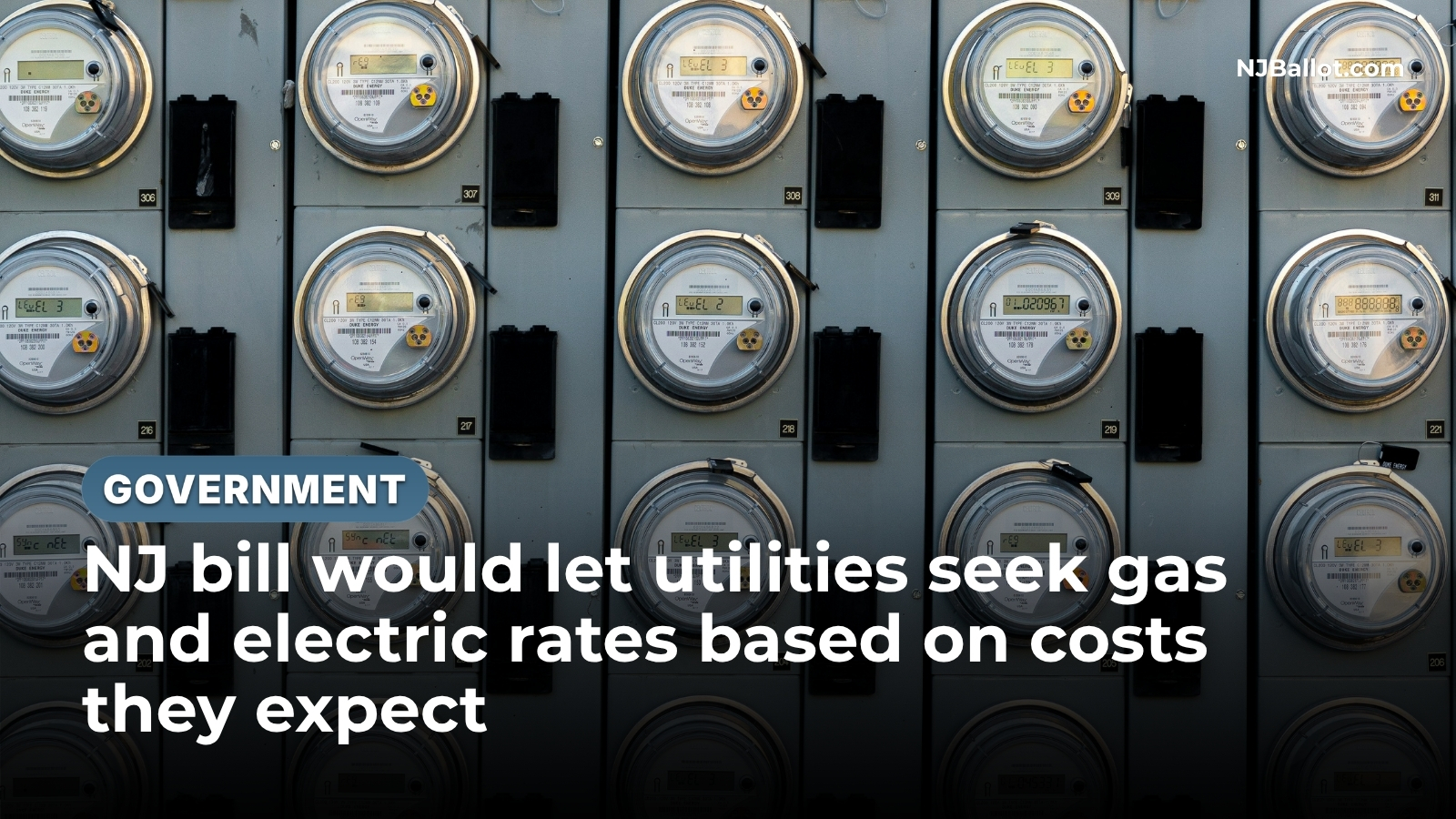
A bill in the New Jersey Senate would let gas and electric utilities ask state regulators to base customers' rates on what the companies expect to spend, not mainly on costs they have already paid. Utilities could also seek rate plans that run three years or more.
The bill, S4052, is titled the Public Utility Rate Stabilization Act. It cleared the Senate Economic Growth Committee on Oct. 8 with three votes in favor and two abstentions. Sens. John Burzichelli (D, 3rd District) and Paul Sarlo (D, 36th) are its prime sponsors. The Assembly version, A3608, is sponsored by Assembly Majority Leader Louis Greenwald (D, 6th) and Assemblyman Robert Karabinchak (D, 18th).
Supporters, among them a former board member and two business groups, said rates known in advance would help businesses and other customers budget. Those rates would also give utilities reliable money for older pipes and wires and for new projects, they said.
Brian Lipman, director of the New Jersey Division of Rate Counsel, the state office that represents utility customers, opposes the bill. "Implementation of this bill will guarantee annual rate increases, reduced regulatory oversight, and will almost certainly exacerbate our affordability crisis," he wrote in an Oct. 7 letter to lawmakers.
The committee vote comes while the New Jersey Board of Public Utilities, the state agency that approves utility rates, studies at Gov. Mikie Sherrill's direction whether some of the same approaches would lower customers' costs. Its consultant has written that one of them, multi-year rate plans, would need a new law.
The bill would let utilities seek rates based on what they expect to spend
Rate cases, the formal reviews in which the board weighs a utility's request for new rates, come every few years in New Jersey, the board's consultant wrote in July.
When a utility's costs rise between cases, the report said, the company generally covers them until its next case. That keeps the increases off customers' bills for a while and gives the company a reason to hold spending down. Regulators already let utilities add some costs between cases through separate surcharges, it added.
The proposed bill would let a utility build a rate case on its own forecast instead of mainly on past spending. The forecast would cover costs, investments and revenue for a 12-month period starting within a year of the filing.
It would also let utilities ask the board for other ways to set rates, including formulas, rates tied to performance and plans that return some corporate earnings to customers. One is a multi-year rate plan, in which the board sets rates for at least 36 months and can allow changes along the way, for inflation or new investment, without a new rate case.
Each plan would get a public hearing, and the board would have nine months to approve, change or deny it.
Nothing in the bill limits how far rates could climb. It leaves that decision to the BPU, which would have 180 days to write the tests a plan must pass. Those tests may include whether a plan provides "just and reasonable rates," the standard regulators apply to utility rates today, as well as whether it is fair to both customers and shareholders.
Backers say forecast-based and multi-year rates are easier to plan around and help pay for pipes and wires
Public Service Electric and Gas Co., known as PSE&G, made its argument to the board in May, in comments on the state's study rather than on the legislation.
The company wrote that multi-year rate plans "keep customer bills smooth and predictable, can be designed to avoid sharp spikes, and help residential and business customers better plan for their energy costs."
Bob Gordon, a former state senator and board member, testified for the bill on behalf of the New Jersey Energy Policy Coalition. "At the end of the day, New Jersey will need to build new infrastructure and new power plants," Gordon said. "These approaches allow regulators to consider expected costs, evaluate plans over several years, or use an approved formula to adjust rates."
The New Jersey Business & Industry Association, a statewide employer group, and the Chamber of Commerce Southern New Jersey, which speaks for businesses in the southern part of the state, backed the bill as well.
Andrew McNally is a senior director at South Jersey Industries, the company that owns South Jersey Gas and Elizabethtown Gas. He told senators the bill could help with delivery rates but not with the price of the energy itself, which has jumped.
"You can help to stabilize rates through this distribution method. That's not solving the supply side problem. That's a different problem," McNally said.
Critics want limits or a delay, and two senators want increases kept in check
At the hearing, Lipman, the Rate Counsel director, called the measure "not an affordability bill." He compared it to a homeowner handing a contractor the whole price of a renovation up front.
Lipman said utilities often misjudge construction costs, and that customers could end up overpaying when a forecast runs high. A cap on total rate growth over a fixed number of years was one safeguard he asked the committee to add.
Consumer and environmental groups also oppose the bill. Dena Mottola Jaborska of New Jersey Citizen Action said her group and AARP New Jersey are among them. In an email to lawmakers, she asked them to hold off until the board finishes the study the governor ordered. Acting now, she wrote, puts them "ahead of the public process." The study's final report is expected in early 2027.
Sen. Nilsa Cruz-Pérez (D, 5th), who chairs the committee and co-sponsors the Senate bill, voted for it Oct. 8, as did Sen. Kristin Corrado (R, 40th) and Sen. Joseph Pennacchio (R, 26th). Sen. Shirley Turner (D, 15th), the committee's vice chair, and Sen. Britnee Timberlake (D, 34th) abstained, legislative records show.
Pennacchio, who voted to advance the bill, said rate increases should stay hard for utilities to win. "I can understand a certain predictability that the utility company wants, but I don't want increases to also be predictable. They should not be predictable. They should be very, very hard to get," he said.
Timberlake, who abstained, doubted whether the measure would make power more affordable. Regulators can say no to rate requests now, she noted, and they often say yes. "I'm not going to be in support of anything unless it actually cuts the ratepayer's bill," she said.
The state's consultant and Maryland's regulators found risks but left room for the plans
Gov. Sherrill called for the study in an executive order she signed Jan. 20, amid her inauguration. The order directs the board to review how utilities make money and whether that information helps bring down customers' costs. Energy+Environmental Economics, the board's consultant, delivered its first report in July.
Local distribution, the lines and equipment a utility runs to bring power to homes, makes up about a quarter of a typical home electric bill, the firm's report said. It is the part New Jersey regulators control most directly. Most of what remains pays for the power itself and for long-distance transmission, costs driven mostly by regional power markets and federal regulators rather than by the state.
"A multi-year rate plan can reward cost control between rate cases, but it carries high implementation and bill-increase risk and is best pursued with a strong understanding of baselines and carefully designed guardrails," the firm wrote.
Maryland has already tried multi-year plans like the kind the bill would allow. Its Public Service Commission, which sets utility rates there, created them on its own in 2020, and Baltimore Gas and Electric, Pepco and Delmarva Power each got one. Lawmakers there later limited the plans by statute. New Jersey's bill runs the other way: lawmakers would authorize the plans first, for any gas or electric utility that asks, and the board would write the rules.
On Oct. 1, a week before the New Jersey committee vote, the Maryland commission ended its trial run of the plans. Its order found the program's goals "largely unachieved," adding that the plans made rates no more predictable or stable than the traditional method, which sets rates on a past year of costs.
Even so, the commission wrote that "a properly constructed multi-year rate plan could produce just and reasonable rates" and told a work group to deliver a plan for a redesigned version by June 30, 2027.
At the Oct. 8 hearing in Trenton, Sen. Turner asked McNally, the South Jersey Industries executive, about Maryland's experience. He answered that Maryland plans to return with a better version of a multi-year plan and that other states already use these methods. New Jersey, he said, would not be a "guinea pig." Hawaii, Illinois and Massachusetts are among the states with multi-year plans, according to the consultant's report.
The bill goes next to the Senate Budget and Appropriations Committee. The Assembly version is before that chamber's Telecommunications and Utilities Committee.
Two working groups for the study's second phase, now underway, meet Thursday at 9:30 a.m. and 1 p.m. at the BPU's offices in Trenton. The public can attend in person or remotely after registering, according to the board's notice. The board's estimates of what these plans would do to customers' bills, the question at the center of the Senate debate, are expected with its final report in early 2027.
Related Articles
How PSE&G Can Cut Gas Bills 5% and Still Leave You Paying More than Last Year
Mikie Sherrill Declares State of Emergency on Day 1 as New Jersey Governor
Sherrill Signs NJ Energy Bills in Woodstown, Claims $1B in Ratepayer Savings
Sources
DeJesus, Amanda, and Krystal Knapp, Jersey Vindicator, "NJ utility rate legislation advances despite warnings that it could lead to higher bills" (Oct. 12, 2026)
Energy+Environmental Economics, "Modernizing New Jersey's Electric Utility Business Model," Phase 1 report for the New Jersey Board of Public Utilities (July 2026)
Maryland Public Service Commission, Order No. 92666, "Order on Multi-Year Rate Plans Lessons Learned" (Oct. 1, 2026)
New Jersey Board of Public Utilities, "NJ BPU UBM Reform - Stakeholder Meeting" (Sept. 17, 2026)
New Jersey Board of Public Utilities, "Notice of Stakeholder Working Group Meeting" (Oct. 15, 2026)
New Jersey Governor's Office, "Sherrill Takes Immediate Action to Lower Electric Bills with Two Executive Orders" (Jan. 20, 2026)
New Jersey Legislature, bill histories and committee votes for S4052 and A3608 (accessed Nov. 2, 2026)
New Jersey Legislature, Bill No. S4052, "Public Utility Rate Stabilization Act" (March 23, 2026); companion Bill No. A3608
Public Service Electric and Gas Co., comments to the New Jersey Board of Public Utilities on the utility business model study, Docket No. EO26040117 (May 29, 2026)
South Jersey Industries, company overview (accessed Nov. 2, 2026)
Photo: Jon Moore/Unsplash