
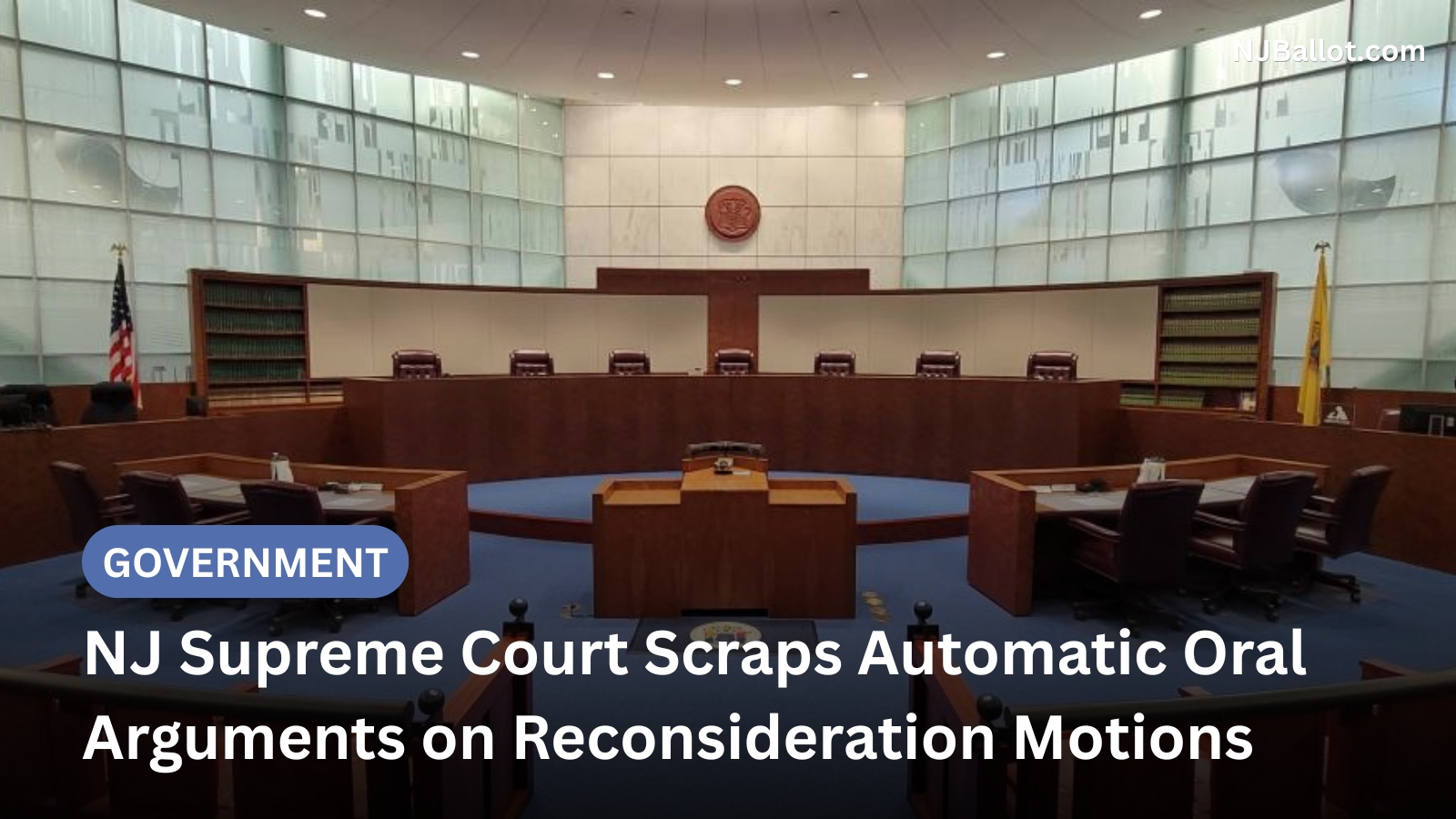

The September 1 rule change makes oral argument discretionary on reconsideration motions in the Civil and Family Divisions. The proposal drew formal opposition from the New Jersey State Bar Association.
Come September 1, litigants in New Jersey's Civil Division and Family Division will lose their automatic right to oral argument on motions for reconsideration. Chief Justice Stuart Rabner signed the 2026 Omnibus Rule Amendment Order on July 23. The New Jersey State Bar Association had recommended the court not adopt the proposed amendment. The Supreme Court adopted it anyway, despite the bar's formal written opposition. Oral argument will now proceed only at the court's discretion.
The revised text reads: "a request for oral argument on a motion for reconsideration shall be granted at the court's discretion." Other motions retain oral argument "as of right." The amendment applies to paragraph (d) of Rule 1:6-2, which governs oral argument on motions in the Civil and Family Divisions; other divisions are not affected by the rule change.
The 2024-2026 Civil Practice Committee Report attributed to one jurist the view that oral argument on reconsideration motions "consumes time that could be better spent on other matters because the same arguments are being raised on reconsideration."
The New Jersey State Bar Association (NJSBA) filed formal opposition to the proposed amendments in March 2026. The association maintained that oral argument on a motion for reconsideration "represents the last step before appeal and provides the final opportunity to present information about an issue a judge may have overlooked or about which there may have been some confusion or misunderstanding." That language framed reconsideration as a safety net rather than a stall tactic.
The association wrote that its members regard oral argument as vital in motions for reconsideration, "especially when the motion is dispositive." A dispositive motion asks the court to resolve the case without a trial.
The NJSBA defended oral argument despite potential repetition. "Our members recognize that, at times, oral argument on a reconsideration motion may just reiterate points previously made, but when weighed against the potential finality of the decision, our members believe the opportunity to present oral argument one last time should not be denied to a party," the group wrote. Their position elevates access over speed. The bar association formally recommended against adoption. Its sole comment on the Civil Practice Committee Report addressed paragraph (d).
Under current practice, the court typically confirms oral argument two days before the hearing. The attorney who brought the motion is responsible for letting all other parties know. The Judiciary's website refreshes its motion schedule each night so attorneys can see whether the court has approved a hearing, according to the New Jersey State Library's civil practice guide. Under the old rule, the court had to approve any request for oral argument automatically. The amendment removes that requirement.
The Legislature cannot easily override what the Supreme Court has done. The state constitution assigns the Court the job of writing rules for how all courts operate, and the Court has previously pushed back when lawmakers tried to interfere with that role, according to the State Court Report. That division of power means the bar association's formal opposition was advisory and played no statutory role in the amendment's adoption.
Efficiency pressures shaped the amendment
The court has cut its case backlog nearly in half since 2023, but efficiency pressure persists. In 2021, the Appellate Division issued Lawson v. Dewar, 468 N.J. Super. 128, which clarified how litigants may challenge orders that are final or interlocutory in nature; judges later saw reconsideration filings rise. The judiciary reported 51,824 backlogged cases in July 2023. The June 2026 dashboard counted 27,251 pending cases, down 47 percent from that peak and roughly 14 percent above the pre-pandemic baseline of 23,917 cases from March 2020. Chief Justice Rabner, addressing the State Bar Association in Atlantic City in May, said the judiciary has made "significant progress" in the backlog but acknowledged that "more work remains."
Rabner, in the same May address, identified another pressure point: artificial intelligence is changing what reaches judges' desks. "Years ago, for example, a self-represented litigant might have filed a 2-count complaint with the court," he said. "Today, with help from AI, the same complaint may well have 15 counts prepared in minutes with the press of a button. Multiply that by thousands to appreciate how much more time and attention judges must devote to resolve those cases each calendar year." He did not tie the AI trend to the reconsideration amendment, but the added workload illustrates the broader efficiency pressures the court faces.
Other states have gone further
Other jurisdictions have gone further than New Jersey in making oral argument discretionary. In Arizona, "all such motions, however denominated, must be submitted without oral argument and without the filing of a responsive or reply memorandum, unless the court orders otherwise." Parties there cannot file responsive briefs unless invited, and the state defaults to no oral arguments. King County, Washington, which includes Seattle, bars oral argument by default like Arizona. "The court will consider the motion without oral argument unless the court orders otherwise," the county rules read.
New Jersey now lands between absolute prohibition and automatic grant; litigants may still request oral argument and they face no restriction on responsive briefs. Neither Arizona nor King County guarantees litigants a chance to speak. New Jersey still permits that possibility, but only if the judge agrees.
The change erases more than four decades of practice for a rule established in 1981. The new restriction applies only to Rule 1:6-2(d) within the Civil and Family Division. The Criminal Division and Special Civil Part remain untouched. The amendment offers no retroactive protection to litigants currently pending. A party filing September 2 faces different rules than one filing August 31.
September 1 marks the shift. Judges retain full power to grant oral argument on motions for reconsideration when they see fit. The court no longer guarantees oral argument on such motions.
Related Articles
• NJ Supreme Court: Personal Email Logs About Government Business Are Public Records
• NJ Legislature Attempted a Constitutional Challenge to Worker Rules. It Ended in Committee.
• U.S. Supreme Court Upholds NJ Affordable Housing Mandate, Denies Towns' Emergency Bid
Sources
• Arizona Supreme Court, Rule 7.1(e)(2), Arizona Rules of Civil Procedure
• Biryukov, Nikita, NJ Monitor, "New Jersey court backlog sees minor bump amid legislative standstill on judges" (Sept. 6, 2023)
• Biryukov, Nikita, NJ Monitor, "NJ chief justice cheers low level of judicial vacancies" (May 15, 2026)
• Chen, Ronald, State Court Report, "The New Jersey Constitution: A Tool of Good Governance, Not Partisan Politics" (August 8, 2025)
• King County, Washington Superior Court, Local Civil Rule 7(B)(6)
• New Jersey Constitution, Article VI, Section 2, Paragraph 3 (adopted 1947)
• New Jersey Courts, Supreme Court, 2026 Omnibus Rule Amendment Order (July 23, 2026)
• New Jersey Courts, Supreme Court Civil Practice Committee, 2024-2026 Report, Rule 1:6-2(d), Oral Argument (p. 1), user-provided image
• New Jersey Courts, Supreme Court Notice, 2024-2026 Civil Practice Committee Recommendations (Civil Rules) (July 23, 2026), user-provided image
• New Jersey Courts, Supreme Court, Rule 1:6-2 (adopted July 16, 1981, effective September 14, 1981), user-provided image
• New Jersey Courts, Trial Courts Backlog Dashboard (June 2026)
• New Jersey State Bar Association, "Comments on 2026 Rules Reports" (March 27, 2026)
• New Jersey State Bar Association, "NJSBA opposes amendment to Rule 1:6-2(d)" (June 30, 2026)
• New Jersey State Library, A Practitioner's Guide to New Jersey's Civil Practice, Section 11: Motion Practice (2009)