
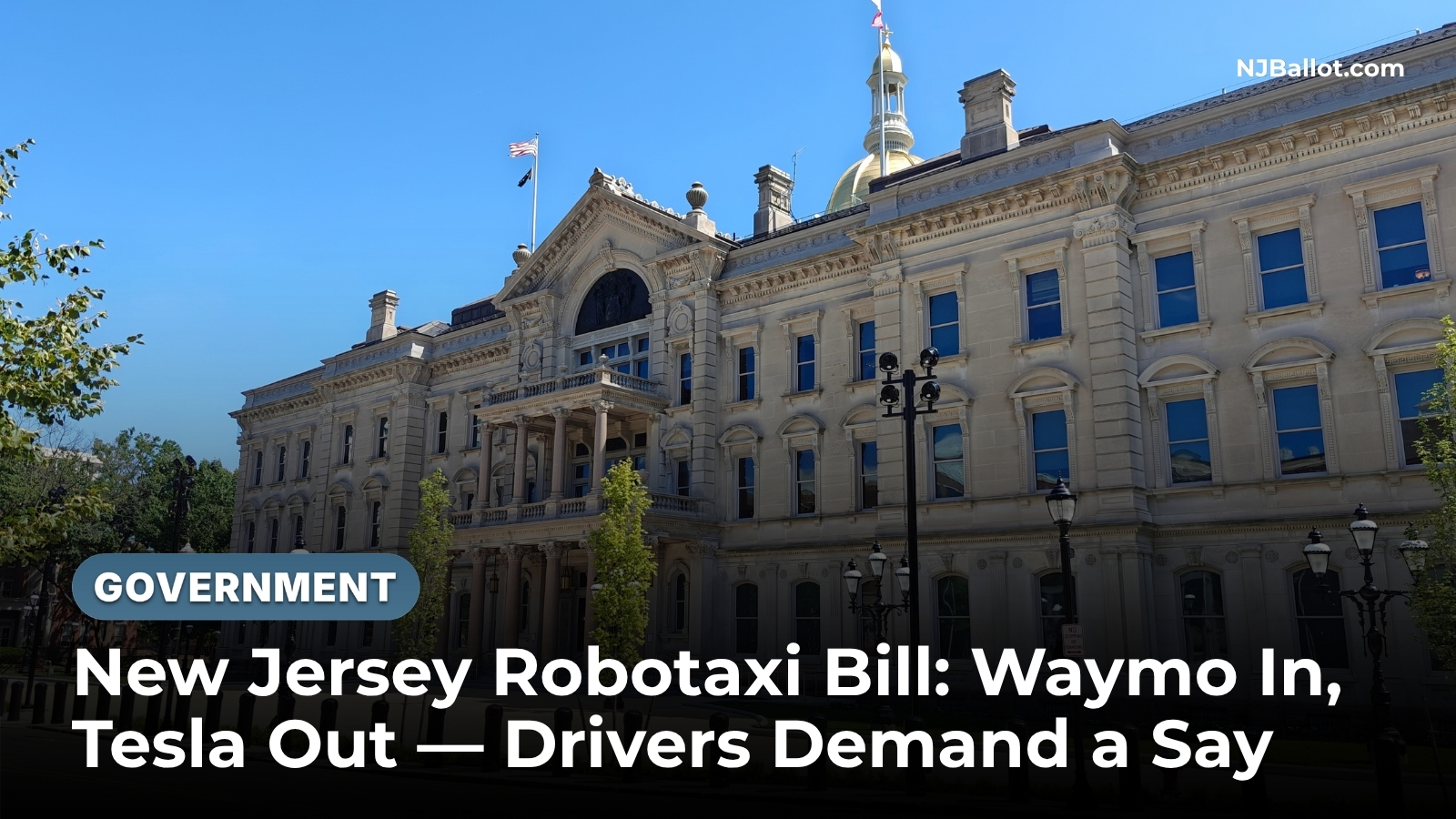

A three-year pilot would put driverless cabs on New Jersey roads but bar camera-only Teslas. Rideshare drivers rallied at the Statehouse to demand union rights first, with new worker-classification rules 12 days away.
Elizabeth Figueroa Núñez drove for app-based ride companies for four years, a single mother of two. At the September 10 rally outside the Statehouse, she said a passenger struck her in the eye earlier this year, pulled a knife and tried to attack her twice while she was working. She ended up in the hospital, she said, and when she called Uber to report the assault, the company "deactivated" her. She stood that day with other rideshare drivers, 32BJ SEIU allies and Assemblyman Gary Schaer (D, 36th District), launching a campaign under the banner "I AM HUMAN." Among the signs: "Drivers Demand Union Rights!" and "NO Robot Cars—Drivers Need Union Rights!" "We are not machines, we are mothers, fathers and workers," she said.
The companies she is up against are national. Philip Koopman, an autonomous-vehicle safety researcher at Carnegie Mellon, puts Waymo's commercial fleet at more than 3,500 robotaxis across 11 U.S. metro areas, he told The Verge in July. Tesla also runs unsupervised cars on public roads, though The Verge, citing an independent tracker, counts the fleet as a handful of vehicles concentrated in Texas. Tesla's cars run on cameras only — no lidar, no radar. Chief executive Elon Musk wrote in a 2025 post on X that "Lidar and radar reduce safety due to sensor contention. If lidars/radars disagree with cameras, which one wins?"
The campaign joins two demands: union rights and no robot cars without them. Drivers organized with the Independent Drivers Guild's New Jersey chapter and 32BJ SEIU (the union estimates 100,000 drivers statewide rely on rideshare work) and want legislation that would let app-based drivers organize and bargain collectively. Schaer is the point man in the Assembly. "It is fundamentally necessary and important that people must have the right to come together to form a union," Schaer told Insider NJ. The precedent is Massachusetts, where in May the state certified the App Drivers Union as the nation's first rideshare union, backed by 32BJ SEIU and the International Association of Machinists.
Three years, $5 million a vehicle, and two ways to see
The bill that drew the crowd is S1677, sponsored by Sen. Andrew Zwicker (D, 16th District) and Sen. Gordon Johnson (D, 37th District). As substituted and advanced by the Senate Transportation Committee on May 11, it would establish a three-year pilot run by the State Department of Transportation in consultation with the Motor Vehicle Commission. Every applicant would need a law-enforcement interaction plan approved before testing begins, plus proof of $5 million in liability coverage per vehicle. A nine-member task force including an insurance-industry representative would oversee the program. Each vehicle would need "a camera system and two distinct sensing modalities," language that effectively excludes a camera-only robotaxi, Tesla's included.
A trained operator must sit in the driver's seat and monitor unless the manufacturer has logged 50,000 miles testing the vehicle in its intended operating domain and another 50,000 miles on New Jersey public roadways with a human driver seated and without a major incident. Autocabs and taxis would run only on designated highways. No pilot vehicle could operate in a school zone, a construction zone or an area the department determines has high rates of pedestrian collisions. Qualifying crashes must be reported to the department within five calendar days and posted publicly every other month.
The Transportation commissioner may immediately prohibit any tester who poses a risk to public safety, and a separate section builds a notice-and-hearing process around suspension and revocation. The bill would bar municipalities from banning autonomous vehicles or imposing vehicle-specific local taxes, fees or other requirements, and it would treat marketing that implies a driver-assistance system is fully autonomous as a consumer-fraud violation enforceable by the Attorney General. The Assembly companion, A3968, carries a five-year pilot in its operative text as introduced and remains pending technical review. The bill has sat in the Senate Budget and Appropriations Committee since May 11. No hearing is scheduled as of Sept. 19.
Waymo negotiated, Uber hedged, and Tesla owners flooded inboxes
Waymo and Uber both pressed for changes, and Tesla mobilized its owners, as The Verge reported in July. Zwicker said Waymo lobbied out a rule requiring safety drivers throughout the pilot, while Uber pushed to keep humans driving most rides. Tesla told its owners the bill "specifically bans Tesla from the New Jersey market," and roughly 4,000 emails hit Zwicker's office within a day. "The messaging wasn't about the details of the bill," Zwicker said in a July interview. "It was that Zwicker is trying to take away your Autopilot." The legislation, he said, "applies only to fully autonomous vehicles" and leaves driver-assistance systems — those requiring a licensed human at the controls — untouched.
The Election Law Enforcement Commission's public filings name The Zita Group as Tesla's registered New Jersey agent, under a designation amended Feb. 17, 2026; no agent for Waymo appears in the commission's New Jersey filings, and its registered lobbying runs through Washington, where Greenberg Traurig filed for the company on May 1, 2026, with four lobbyists including two former New Jersey congressional staffers. At the May hearing, a Waymo representative testified that "until New Jersey does the same, we will not be able to bring the same service we provide in San Francisco, Los Angeles, Phoenix, Austin, and Atlanta to the state." "This is not anti-Tesla," Zwicker said in July. "I'm pro-New Jersey safety."
On July 8, Jonathan Morrison, administrator of the National Highway Traffic Safety Administration, sent driverless-vehicle makers a letter citing "a clear pattern of driverless AVs interfering with law enforcement and other first responders" and calling emergency-scene interference "a functional insufficiency." The incidents included a Waymo that blocked an ambulance at a March mass shooting in Austin and another that intruded on the response to a June gas explosion in Dallas. Morrison set the end of July as his deadline for fixes. The same agency, meanwhile, is working to relax federal vehicle standards so cars can be sold without steering wheels. The New Jersey bill anticipated the letter: advanced in May, it contains a law-enforcement interaction plan, a separate first-responder interaction plan before any commercial driverless service, and tester liability when a driverless vehicle blocks a street, sidewalk or bike lane.
The rules change Oct. 1 either way
New Jersey's new worker-classification rules, codified at N.J.A.C. 12:11, take effect Oct. 1 — 12 days out. "At its core, this action has always been about protecting workers through fairness and clarity," Acting Labor Commissioner Kevin Jarvis said of the adoption on May 5. The final rule dropped the industry-specific examples, so the adopted text does not say which industries it reaches; analysts expect ride-hailing to land inside it. The department's enforcement record, in a July 2025 accounting, explains the anticipation: $84 million in assessments and penalties since 2018, including $37 million in 2025 alone covering nearly 8,500 workers, about $11 million assessed to be paid directly to roughly 13,000 misclassified workers since 2021 and about 200 stop-work orders since 2019. In 2022, Uber and its Rasier subsidiary paid $100 million into New Jersey's unemployment trust fund after state auditors reclassified 297,866 drivers as employees.
The business response so far involves committee testimony, not lawsuits. No employer group has sued, as of Sept. 19. The New Jersey Business and Industry Association opposed the worker rules, and its president called this spring for the Legislature to knock them out. Its lobbyists were back in committee on Sept. 17, days before the effective date, urging lawmakers to delay the rules and stand up a task force to study them. The same association backed the autonomous-vehicle pilot when the earlier version moved last year.
New Jersey has policed the vehicle-for-hire before. In 2019 the state passed Sami's Law, named for Samantha Josephson, the Robbinsville woman killed after she climbed into a car she mistook for her ride; the law requires illuminated signs and scannable codes. The federal version became law in January 2023. The autonomous-vehicle bill applies the same test to the machine.
The disability community is split on the bill. A New Jersey Globe opinion column by a Point Pleasant Beach Tesla owner who writes that he plans to buy Cybercabs argued it "would disenfranchise private owners," because a lidar-and-radar mandate priced for commercial fleets prices disabled New Jerseyans out of owning the technology that could move them independently. Linda Melendez, president of the National Federation of the Blind of New Jersey, has called driverless cars a potential "game changer" for blind residents; a disability rights group testified for the bill at the May hearing, the New Jersey Monitor reported. Koopman, who wants the safeguards stronger, told The Verge in July: "To run 24/7 across the majority of public roads in New Jersey today, it needs lidar."
The Senate Budget and Appropriations Committee has posted no hearing, as of Sept. 19, for a bill the full Senate has not debated. The Assembly has quorum sessions on the calendar beginning Oct. 22. In 12 days, the rules change how the state decides who is an employee. Waymo's cars, meanwhile, spent the summer charting Hoboken, Jersey City's streets and the roads skirting Newark Airport with human drivers at the wheel — groundwork, the company has said, ahead of a New York launch. The state may yet decide those machines never drive themselves here. "No robot cars without union rights," said Ana María Hill, New Jersey state director of 32BJ SEIU.
Related Articles
• Wave of Layoffs Hits New Jersey: Major Employers Cut Thousands of Jobs in 2026
• After $114M Spent, NJ Housing Fund Gets $30M Back. Developers Call It Insufficient.
• NJ Senate Panel Advances Bill to Block State Cops From Aiding Federal Trans Health Probes
Sources
• Axios Austin, report on Waymo vehicle blocking ambulance at the March 1, 2026 mass shooting scene (March 2026)
• GovTech, "New Jersey Bill Could Put the Brakes on Autonomous Cabs" (December 1, 2025)
• Insider NJ, "SEIU 32BJ Rallies in Trenton for Rideshare Drivers" (September 10, 2026)
• International Association of Machinists and Aerospace Workers, release on Massachusetts App Drivers Union certification (May 2026)
• National Highway Traffic Safety Administration, letter from Administrator Jonathan Morrison to driverless AV developers (July 8, 2026)
• National Law Review, "Massachusetts Becomes First State to Certify a Rideshare Union" (August 26, 2026)
• New Jersey Business and Industry Association, Michele Siekerka remarks on classification rules (May 12, 2026); Jack Kelly testimony before the Assembly Appropriations Committee (September 17, 2026)
• New Jersey Department of Labor and Workforce Development, "NJDOL Adopts Clear Rules on Worker Classification to Protect Workers' Rights, Level the Playing Field for Businesses" (May 5, 2026)
• New Jersey Department of Labor and Workforce Development, misclassification enforcement update (July 15, 2025)
• New Jersey Election Law Enforcement Commission, Governmental Affairs Agent Designation (L-2), Tesla, Inc., amendment naming The Zita Group LLC (February 17, 2026)
• New Jersey Globe (Opinion), "New Jersey's self-driving car bill would block out the people who need them most" (July 30, 2026)
• New Jersey Legislature, Senate Committee Substitute for Senate No. 1677 (adopted May 11, 2026)
• New Jersey Legislature, Assembly No. 3968 (introduced, 2026–2027 session)
• NJ.com (Opinion), Shua Sanchez, "New Jerseyans shouldn't be crash-test dummies for self-driving technology" (June 17, 2026)
• Patch, report on the Sept. 10 Statehouse rally and May 11 committee hearing (September 11, 2026)
• TechCrunch, NHTSA autonomous vehicle enforcement coverage (July 2026)
• The Verge, Rani Molla, "The robotaxi law that could ban Tesla" (July 8, 2026)
• WRNJ, Jay Edwards, "New Jersey rideshare drivers rally against autonomous vehicle bill, call for union rights" (September 11, 2026)