
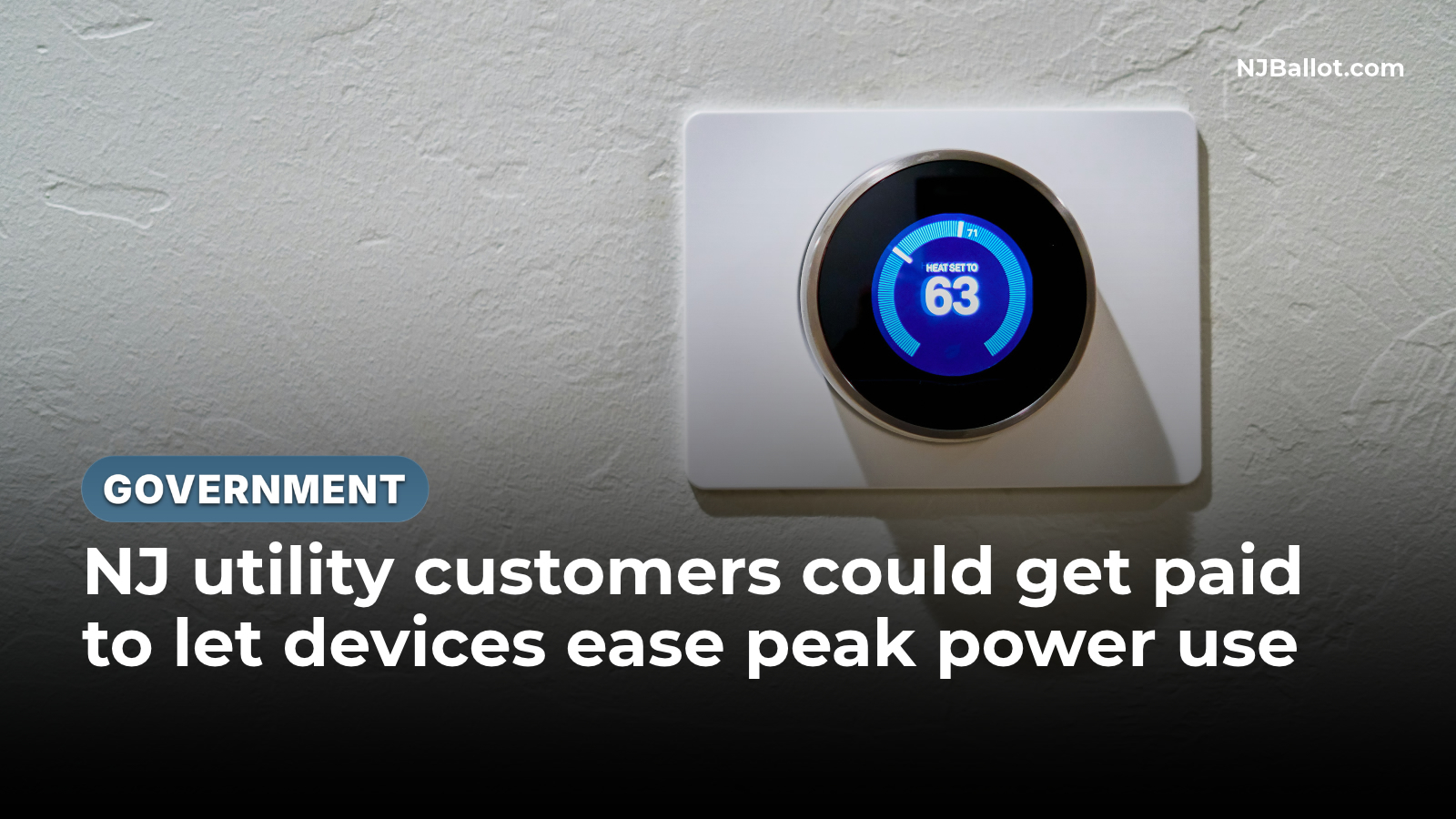

The state Board of Public Utilities created PowerUp NJ on Nov. 12 and set top pay rates for home batteries. Pay rates for smart thermostats and EV chargers will come in utility plans due Feb. 12.
Owners of smart thermostats, EV chargers, smart water heaters and home batteries could get paid for letting those devices draw less power at the grid's busiest hours under PowerUp NJ, a program which the state Board of Public Utilities approved on Nov. 12.
The BPU's announcement calls PowerUp NJ a virtual power plant, "a collection of customer-owned smart devices that briefly shift or trim electricity use when demand is highest."
PowerUp NJ has two parts. One program takes any brand of device, such as smart thermostats, EV chargers and smart water heaters, and requires no new equipment to start; businesses can join it too. A separate program covers batteries at homes and small businesses. A customer can join both, though a single device cannot.
New Jersey's four investor-owned electric utilities, Atlantic City Electric, Jersey Central Power & Light, Public Service Electric and Gas and Rockland Electric, will run PowerUp NJ for their own customers. Customers of town-owned and cooperative utilities are left out, and the order bars them from the battery pay by name. The BPU's staff suggested the board consider ways to bring those utilities into future energy storage programs.
Nobody can enroll yet. Each utility must file its plans by Feb. 12, 2027, and if the BPU approves, the utility's thermostat-and-charger program must be running by Oct. 1, 2027. Each utility's battery program opens for sign-ups within 60 days after the BPU approves that utility's plan.
PowerUp NJ runs on "events," stretches of up to three hours when a utility asks enrolled devices to use less power. The BPU intends most of the changes to go unnoticed, its announcement says. An EV charger might hold off until later in the evening, or a battery might power the home from what it has stored instead of from the grid.
Participants decide which of their devices take part and which events to join, because some changes can be felt. The BPU's example of such a change is a thermostat turned up a few degrees.
Participants can skip any event, but skipping often could cut their pay. They can also quit the program at any time, with no early-exit penalty.
The Nov. 12 order sets battery pay: up to $200 per kilowatt a year for a new battery and up to $100 for one already running, paid for 10 years.
Pay for thermostats, chargers and water heaters is not set yet. Each utility will propose that pay in its February plan, and the BPU wants it in line with the $100 to $200 per kilowatt battery range.
Thermostat and charger owners could be paid directly by their utility
A utility can call no more than 35 power reduction events a year, each lasting three hours at most. Every event comes with notice: at least 21 hours for a standard event and at least 30 minutes for a "grid stress" event, which each utility will define.
A customer can join through the company behind a device, such as a thermostat maker. The utility then compares the home's smart meter readings during an event with its normal use on recent days with no event. The utility pays the customer directly, unlike in the battery program, where the money goes to the battery company first.
A company can also sign up a whole home or business and manage its power use. The utility pays that company, and the BPU set a goal, not a requirement, that that the company pass along to the customer at least 70 percent of what it receives for that home or business.
The pay never shows up as a credit on the electric bill. It arrives as a check, an electronic transfer, a gift card or another direct payment.
Sign-ups to the program are first come, first served, and a utility can pause new sign-ups if it expects to run through its budget.
Home battery rates are set, and the pay goes through the battery company
The battery program covers battery systems installed at homes and small businesses to store energy for the building, including batteries paired with rooftop solar. An owner joins only through a battery company that enrolls in PowerUp NJ.
A battery earns a higher payment if it counts as new, meaning it started running on or after Nov. 12, 2026. The order pays new batteries more to spur new installations, which count toward the state's legal goal of 2,000 megawatts of energy storage by 2030. Batteries already running get less because they went in without this incentive, but they still earn pay for what they do for the grid.
In the order's example, a new battery enrolled at 10 kilowatts, and that steadily puts out 5 kilowatts during events, earns $1,000 a year.
Pay follows what a battery delivers in each event. A battery that delivers nothing in an event gets a zero for the event, lowering the yearly average its pay is based on.
The utility pays the money to the battery company, which keeps part of it under its contract with the owner. The order sets no minimum share for the owner. The owner and the battery company can also agree to hold back part of the charge for backup power for the home or business.
The battery program has its own, separate, limit of 35 events a year, and every battery event comes with at least 21 hours' notice, since that program has no short-notice events.
The program has room for 150 megawatts of new batteries and 100 megawatts of existing ones, filled first come, first served. The 150 megawatts matches the size of Two Rivers Energy Storage, a separate grid battery plant in Ridgefield, Bergen County, that the BPU approved for state incentives in March.
The state wants to shrink demand at the grid's busiest hours
Gov. Mikie Sherrill declared an emergency over the cost of electricity in Executive Order No. 1 on Jan. 20. Executive Order No. 2, signed the same day, called for a virtual power plant program and gave the BPU 180 days to start building it. PowerUp NJ is the BPU's response.
According to EO 2, capacity means future power supply locked in ahead of time through a regional wholesale market that federal regulators oversee and New Jersey takes part in. The price of capacity shapes the supply part of most customers' electric bills.
PJM Interconnection, which runs that market, held an auction in July 2025 that left New Jersey homes and businesses with $2 billion in new costs, the governor's order says. PJM's December 2025 auction added more than $2 billion.
PJM's most recent auction, with results released in July 2026, again ended at the highest price a temporary cap allows, according to the BPU. Even at that price, PJM did not line up as much reserve supply as it aims to maintain in order to keep the grid reliable when demand peaks.
BPU Commissioner Emma Rebhorn, one of the members who approved the program unanimously, explained the focus on the year's peak hours Nov. 12, the New Jersey Monitor reported:
"I don't know if everyone in New Jersey understands, but it is the most expensive hours of the year that are driving the really unsustainable price hikes in the utility and electricity bills that we saw in the last few years.”
The BPU found that virtual power plants, home batteries included, rank among the quickest ways to ease the gap between demand and supply behind New Jersey's power costs. Smart thermostats, chargers and home batteries are in place now or take just months to add, while large power plants wait years for equipment, the order says.
Each of the four utility companies must propose cutting its peak demand by at least 3.5 percent through both parts of PowerUp NJ combined, or explain why it cannot reach that target.
The utilities have a head start, because earlier state and utility energy-efficiency and EV charger programs helped pay for thermostats, EV chargers and water heaters that can join. The utilities have those owners' contact information as a result of that program.
The BPU's staff, which drew up the recommendations the commissioners adopted, expects that signing up three-quarters of those devices could get each utility from nearly half to more than 80 percent of the way to its target.
Staff's preliminary estimate puts the capacity costs avoided at about $60 million a year if peak demand falls 3 percent. The BPU estimated benefits of $1.98 for each $1 of cost in the battery program and $1.16 for each $1 in the thermostat-and-charger program.
Electric customers would pay for the program; an outside auditor would check it
The thermostat-and-charger program has a budget of $100 million for 2027 through 2029; the battery program has $29 million for those years. A utility that proposes spending more than 15 percent above or below its share of the thermostat-and-charger budget must explain why in detail.
Each utility's thermostat-and-charger program is temporary and runs through Sept. 30, 2029. An independent evaluator that the BPU hires, not the utilities, will check the savings after the program's first year. In that review, the BPU will decide whether to change that utility's program, expand upon it or phase it out for a long-term system open to any licensed company on equal terms.
Customers would pay through the part of their electric bills that already covers utility energy-efficiency programs. The cost would be charged the same way to homes, businesses and factories, and the utilities would get back what they spend without making a profit on it.
Customers who never sign up, including those with none of these devices, could still share in the savings, the order says, since a utility's area that draws less power at peak hours can owe less for capacity and transmission.
Related Articles
NJ bill would let utilities seek gas and electric rates based on costs they expect
N.J. Utilities to Issue $25 Bill Credit in August, Seven Months After Emergency Order
Sources
Biryukov, Nikita, New Jersey Monitor, "NJ regulators approve virtual power plant, battery storage programs" (Nov. 12, 2026)
New Jersey Board of Public Utilities, "An Investigation of PJM's Capacity Market: Report on the Evaluation of PJM's Capacity Market and Its Ability to Provide Reliable Service at the Lowest Cost" (August 2026)
New Jersey Board of Public Utilities, "Order Establishing the PowerUp NJ Program and Adopting Minimum Filing Requirements," In the Matter of Establishing the PowerUp New Jersey Program, Docket Nos. QO26100658, QO26030099 and QO26040116, Agenda Item 8A (Nov. 12, 2026)
New Jersey Board of Public Utilities, press release, "NJBPU Moves to Pay Residents and Businesses to Help Power the Grid" (Nov. 12, 2026)
New Jersey Board of Public Utilities, press release, "NJBPU Takes Major Action to Advance Governor Sherrill's Goals for Affordable, Clean Energy" (March 5, 2026)
Office of the Governor, Executive Order No. 1, signed by Gov. Mikie Sherrill (Jan. 20, 2026)
Office of the Governor, Executive Order No. 2, signed by Gov. Mikie Sherrill (Jan. 20, 2026)
Photo: Dan LeFebvre/Unsplash