
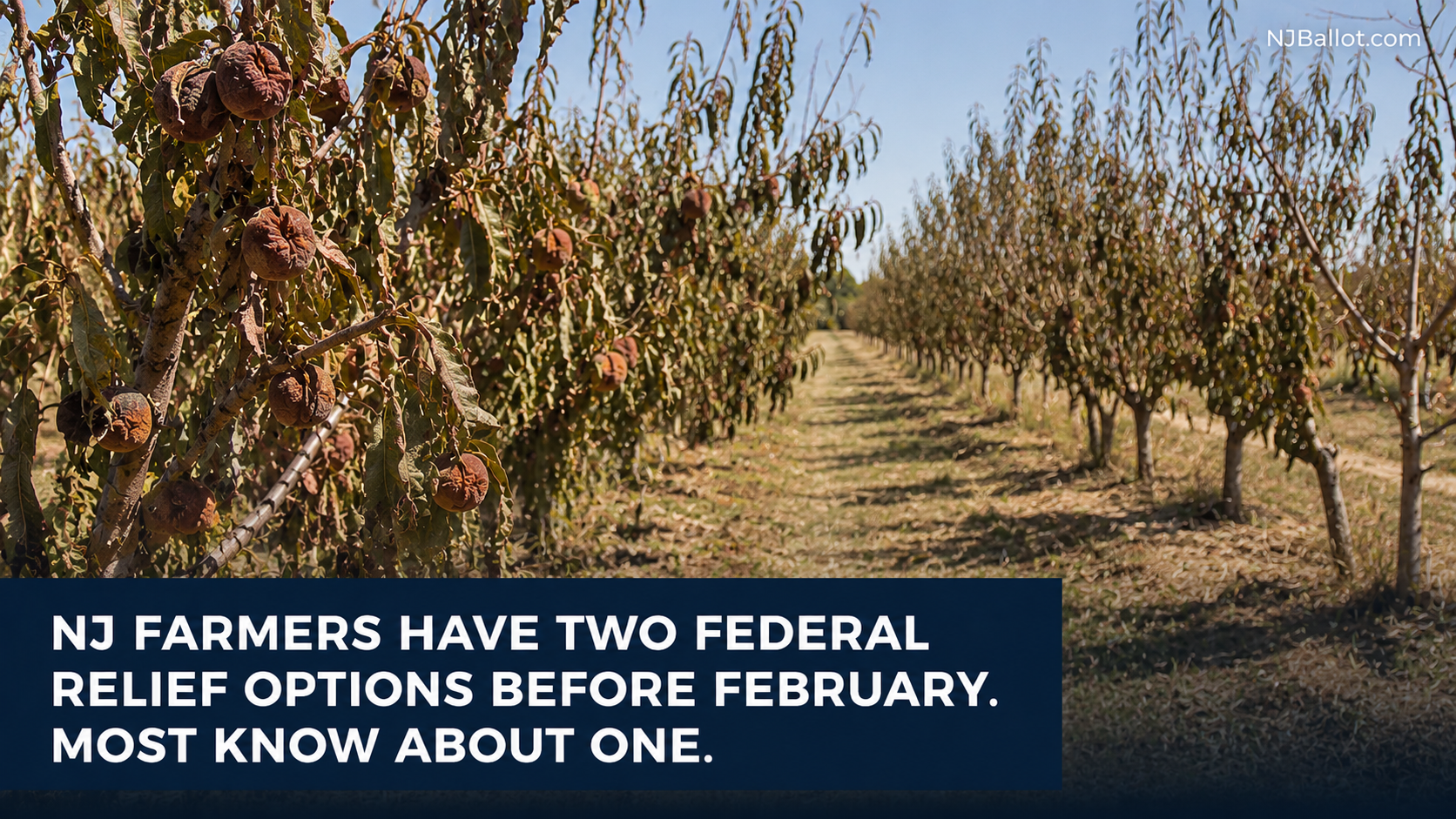

The April 19-22 freeze caused catastrophic crop damage across New Jersey. Two federal responses followed.
On May 8, the USDA Risk Management Agency (RMA) issued Manager's Bulletin MGR-26-006, authorizing emergency procedures to accelerate crop insurance claims across 13 states. The bulletin was later expanded to 15 states on May 28. It received little press attention. On June 10, Secretary of Agriculture Brooke Rollins approved a Secretarial Disaster Designation that opened low-interest emergency loans through the Farm Service Agency (FSA). That announcement made headlines. Most farmers know about only one.
The FSA offers new credit; the RMA accelerates existing insurance claims. Farmers have two federal options—but only one is new money. The FSA designation opens emergency loans. The RMA bulletin only speeds up claims for farmers who already carry insurance. The RMA bulletin is operational guidance to Approved Insurance Providers. It was posted on rma.usda.gov but does not appear that the USDA distributed it as a press release to media outlets. As of June 15, NJBallot found no published coverage of the RMA bulletin's specific provisions for blueberries and peaches in the New Jersey Monitor, NJBIZ, WHYY, NJ 101.5, the Governor's Office, the New Jersey Department of Agriculture or Rutgers Cooperative Extension.
The two options serve different needs, though a farmer with crop insurance who also needs credit could potentially use both. FSA emergency loans are for farmers who need credit to replace equipment, livestock or reorganize operations. The RMA accelerated claims are for farmers who already carry federal crop insurance and need faster indemnity payments for destroyed crops. A farmer with no crop insurance and insufficient collateral falls between both. As of June 14, NJBallot found no state or Extension guidance explaining which farmers should use FSA loans versus RMA accelerated claims, or both.
How the FSA and RMA Options Differ
Farmers in all 21 New Jersey counties are eligible to be considered for FSA emergency loans up to $500,000 at 3.750 percent interest. The loans can cover 100 percent of actual production or physical losses. Under standard FSA emergency loan rules, the loans require collateral and a first lien on property or products acquired. Borrowers may also be required to obtain crop insurance as a condition. Farmers can use the loans to replace equipment or livestock, reorganize operations or refinance certain debts. Congress routes agricultural disaster assistance through the USDA, not the SBA, leaving USDA programs as the only federal relief for farmers.
The FSA designation covers 17 primary counties and 4 contiguous counties. Primary counties are Atlantic, Bergen, Burlington, Camden, Cape May, Cumberland, Gloucester, Hunterdon, Mercer, Middlesex, Monmouth, Morris, Ocean, Salem, Somerset, Sussex and Warren. Contiguous counties are Essex, Hudson, Passaic and Union.
The RMA option allows Approved Insurance Providers to process destroyed-acreage claims faster without full appraisal worksheets when the crop is damaged beyond harvest. For blueberries, the crop provisions normally reduce the indemnity if a farmer fails to use frost-protection equipment. The bulletin provides that this reduction does not apply when the insurer determines the equipment would have caused further damage. For peaches, the bulletin authorizes the Immature Peach Appraisal Deviation for the 2026 crop year. The disposal deadline for all claims under these procedures is December 31, 2026. Farmers who carry federal crop insurance should contact their agent to request accelerated adjustment.
The Governor's Office called the designation a "critical first step." But it is a credit step, not a direct cash grant. For insured farmers, the RMA option provides accelerated indemnity payments that are not loans. For farmers without insurance, the available federal relief is a loan.
The April Freeze and Its Damage
The freeze hit April 19-22, after an early-season heat wave pushed crops into bloom. On April 16, Fort Dix in Burlington County hit 94 degrees, Rutgers NJ Weather Network data show. Five days later, temperatures crashed into the low 20s across northern and central counties. Subfreezing temperatures returned repeatedly through April 22, with some locations recording lows in the low 20s. The freeze arrived during a drought. The Office of the New Jersey State Climatologist ranks April 2026 as the 23rd driest on record, with rainfall 1.19 inches below the historical average. For 21 of the last 24 months, statewide precipitation has run below normal.
Governor Mikie Sherrill issued Executive Order No. 18 on May 20, declaring a statewide emergency. The order estimates losses could reach or exceed $300 million based on early assessments from the New Jersey Department of Agriculture. The Governor's Office requested the federal designation. Senators Cory Booker and Andy Kim sent a letter to Secretary Rollins on May 20 detailing the damage, according to Booker's office.
By late May, the damage was clear. New Jersey Secretary of Agriculture Ed Wengryn called it a "generational freeze" in a May 28 Fox News interview. "Almost like a hundred-year storm — almost a perfect event," he said. He warned the region would produce no peaches this year: "There's just not going to be any peaches from this region."
Jim Giamarese, who farms in East Brunswick, told the New Jersey Monitor in late May he lost 90 percent of his apples and 40 percent of his strawberries. John Melick, a tenth-generation farmer in Oldwick, told the same outlet he lost up to 90 percent of his peaches. Terhune Orchards in Princeton reported in a May 1 update that it lost 80 percent of its apples and anticipated no peach, cherry or Asian pear crop this year. Fox News reported in late May that for the first time, Terhune was opening pick-your-own operations for tomatoes, potatoes, corn, peppers and other vegetables to offset losses.
State Agencies Respond, but Direct Aid Stalls
The Farm Service Agency published county eligibility lists on June 10. The Governor's Office announced the designation June 11. Rutgers Cooperative Extension posted loan guidance on June 12. Extension agents planned to share findings with legislators and FSA officials.
Senator Latham Tiver (R, 8th District) introduced S4354 on May 28. The bill would give the Secretary of Agriculture power to declare agricultural emergencies for up to six months. It also requires a study of available funding sources. It contains no appropriation, the bill summary shows. The Senate Economic Growth Committee received the bill on May 28; as of June 14, no votes had been recorded. The Legislature has not passed a supplemental appropriation for direct relief.
Governor Sherrill and multiple farmers have urged consumers to buy local. Sherrill told 6abc on May 28, "I think what's really important is for people this summer to really buy local." For devastated crops, the message faces a constraint: there are no peaches to buy. But farmers are pivoting to vegetables and agritourism, and the "buy local" message applies to what survives.
Farmers have until February 8, 2027, to apply for FSA emergency loans. They have until December 31, 2026, to use the accelerated procedures under MGR-26-006; standard crop insurance claims remain available after that date.
The designation is a credit step for a state whose governor called agriculture "the very reason we bear the name the Garden State." But credit is not cash, and the Legislature has not yet filled the gap.
Related Articles
• NJ Governor Sherrill Declares Farm Emergency; USDA Silent as Staffing Crisis Deepens
• NJ Drought Warning Enters Fifth Month as Reservoir Recovery Stays Uneven
• NJ Red Flag Warning: Drought, a New Tower and Grid Gaps Test Fire Defenses
Sources
• 6abc, "NJ Gov. Mikie Sherrill tours damaged crops after April freeze" (May 28, 2026)
• Dana DiFilippo, New Jersey Monitor, "NJ Farmers Face Devastating Losses After April Freeze" (May 22, 2026)
• Dr. David A. Robinson, Office of the New Jersey State Climatologist, Rutgers University, "April 2026 New Jersey Weather Summary" (May 8, 2026)
• Michelle Infante-Casella, Rutgers Cooperative Extension, "NJ Freeze Disaster Designation and Emergency Loan Info" (June 12, 2026)
• New Jersey Governor's Office, "Executive Order No. 18" (May 20, 2026)
• New Jersey Governor's Office, "Governor Sherrill Declares a State of Emergency Following Sweeping Agricultural Losses" (May 20, 2026)
• New Jersey Governor's Office, "Statement by Governor Sherrill on Securing Federal Disaster Designation for New Jersey" (June 11, 2026)
• New Jersey Legislature, Bill No. S4354, "Agricultural Emergency Declaration" (May 28, 2026)
• Pete Cuddihy, Fox News, "Late-spring freeze devastates Northeast farms, threatening peach and apple crops" (May 28, 2026)
• Seowoo Sophie Lee, Rutgers Cooperative Extension, "April 2026 Frost Damage in Fruit Crops Survey" (May 17, 2026)
• Senator Cory Booker and Senator Andy Kim, Office of Senator Cory Booker, "Letter to USDA Secretary Rollins" (May 20, 2026)
• Staff, NJBIZ, "USDA Disaster Designation Unlocks Aid for NJ Farmers" (June 12, 2026)
• Terhune Orchards, "Customer Update: April Freeze Damage Report" (May 1, 2026)
• U.S. Small Business Administration, "SBA Offers Relief to New Jersey Businesses and Private Nonprofits Affected by Freeze" (June 11, 2026)
• USDA Farm Service Agency, "Current FSA Loan Interest Rates" (June 1, 2026)
• USDA Farm Service Agency, "Emergency Loan Program" (2024)
• USDA Farm Service Agency, "Secretarial Disaster Designation for New Jersey" (June 10, 2026)
• USDA Risk Management Agency, Manager's Bulletin MGR-26-006, "Emergency Procedures for Crops Damaged by Freeze" (May 8, 2026)
• USDA Risk Management Agency, Manager's Bulletin MGR-26-006.1, "Emergency Procedures for Crops Damaged by Freeze — Expansion to New Hampshire and Vermont" (May 28, 2026)