
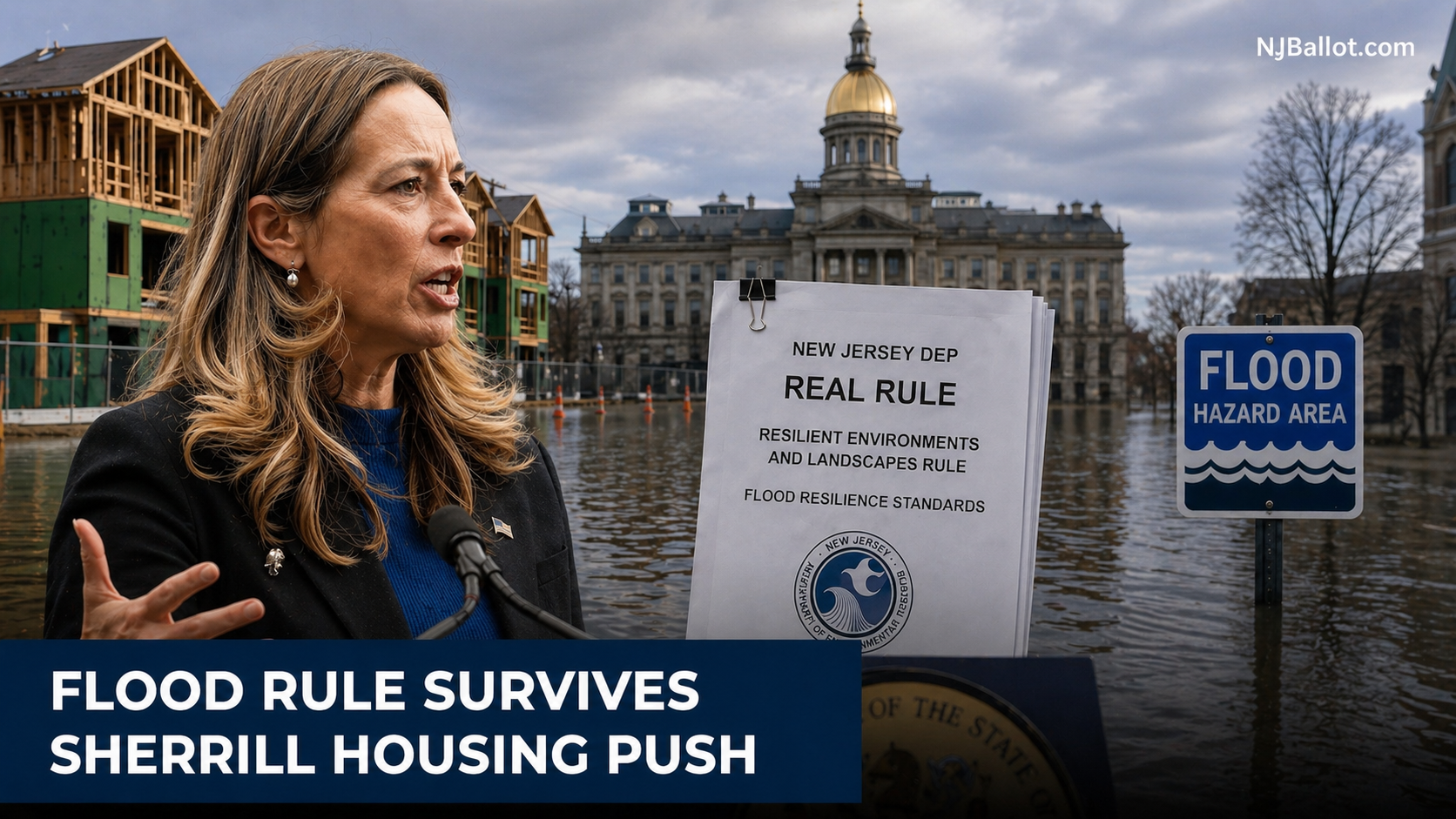

TRENTON — New Jersey's Department of Environmental Protection adopted a 1,000-page flood-resilience rule on January 20, three days before Governor Mikie Sherrill took office. Three months later, Sherrill ordered state agencies to "remove unnecessary regulatory barriers" to housing production. The rule remains in force. As of April 28, 2026, no administration official has publicly explained how both directives coexist.
The Resilient Environments and Landscapes (REAL) rule took effect January 20 under then-Governor Phil Murphy's DEP. It mandates that new and substantially improved buildings in tidal flood zones sit four feet above federal base flood elevation. The rule also creates a new Inundation Risk Zone based on sea-level projections for the year 2100, and it tightens stormwater and wetlands standards.
Sherrill's Executive Order No. 17, signed on April 27, directs agencies to "cut red tape," "remove unnecessary regulatory barriers," and "build on state-owned land" to accelerate housing production. It creates a Housing Governing Council, chaired by Chief Operating Officer Kellie Doucette, and demands agency reports within 60 days.
What REAL Requires
Builders and municipal officials say the two directives collide on paper. DEP maintains that the rules enable safer long-term development. Whether that tension produces stalled projects or permit denials remains unproven, but builders report the conditions for obstruction already exist.
Randall Laing, whose family has built homes at the Jersey Shore for 54 years, told legislators in March he usually lines up three fall projects by that point in the year. This year he has one. "My fear is a serious exit from New Jersey," he said, according to NJ.com.
Bohler Engineering, a land development firm, alerted clients in April that residential housing has "no meaningful grandfathering" under REAL and that "most projects are already in the new rules, whether you realize it or not." The firm warned of "reduced yield, higher costs, and longer permitting timelines."
The rule's legacy window, which allows some pre-existing applications to clear under old standards, expires on July 20. Developers who miss it face the full four-foot elevation standard, expanded dry-access requirements, and more rigorous DEP review.
Sherrill's earlier executive order No. 7, signed on January 23, froze new department rule proposals for 90 days. REAL slipped through because it was already adopted. A coalition of builders, developers, and realtors wrote Sherrill on February 6, asking her to apply that freeze retroactively to REAL. The administration has made no public response.
No Republican legislator has publicly responded to EO 17 at time of writing. The Assembly GOP criticized Sherrill's broader spending increases in budget hearings.
Builder Testimony
The legislature is moving without the governor. Senate President Nicholas Scutari, a Democrat, introduced a concurrent resolution in February to invalidate REAL on the grounds that it exceeds legislative intent. The resolution, which has Republican support, would give the DEP 30 days to withdraw the rule; if the agency refuses, a second vote repeals it. An April 22 joint hearing on the resolution drew testimony from former DEP commissioners, climate researchers, and builders. But a DEP spokesperson declined to say whether the agency would revise or rescind the rule if the resolution passes.
Environmental groups defend the rule. The Watershed Institute called it "the strongest climate resiliency rules in the nation" when DEP adopted it. NJ Future, a planning advocacy group, warned in April that delaying REAL "will only increase risk, defer decisions, and shift more costs onto taxpayers."
Administrative Silence
The administration's silence extends beyond the legislature. DEP issued an Earth Week release on April 28, one day after EO 17 was signed, announcing two new flood-resilience planning regions and up to $350,000 in grants per municipality. The release promoted climate adaptation. It did not mention housing production, the executive order, or the rule under legislative attack.
Doucette, who now chairs the Housing Governing Council, spoke to developers in March about permitting delays. She said DEP staffing shortfalls are "notorious" and that Sherrill's budget adds headcount. She did not name REAL specifically.
The rule also adds another requirement to Sherrill's plan to build on state-owned land. EO 17 names NJ Transit as one agency for housing development. NJ Transit runs a transit-oriented development program and plans to solicit proposals for multiple sites in 2026. NJ Transit has issued no statement on EO 17. The agency has not clarified how REAL interacts with its development sites.
Meanwhile, the state runs a parallel program that operates on different terrain. Blue Acres, administered by DEP, has bought and demolished 1,200 flood-prone homes since 1995, including 120 in Manville and 53 more underway. The program returns land to open space. EO 17 and REAL, by contrast, would place new housing in some flood-prone zones, just elevated higher. The state has not published a unified floodplain housing strategy.
DEP's own guidance claims REAL "does not prohibit any type of development" and that affordable housing qualifies for a "compelling public need" hardship exception. New Jersey law defines affordable housing under the Mount Laurel doctrine as priced at 80% of the area's median income. EO 17 does not specify income thresholds.
But legal alerts from Day Pitney and Scarinci Hollenbeck note that applicants must still prove no threat to public health, safety, or welfare. The legal services added that DEP "has been reluctant to grant" such exceptions in the past. Affordable housing developers now face a procedural maze, even with the presumption in their favor. EO 17 promises to accelerate production, but REAL adds a hurdle that requires extensive documentation and DEP discretion.
The Housing Governing Council must deliver agency reports by June 27. The REAL legacy deadline hits on July 20. Meanwhile, Scutari's resolution sits in committee and DEP has not scheduled public hearings on potential amendments.
As of April 28, builders, engineers, and legislators have all flagged the tension. The administration has not publicly acknowledged it.
Sources
NJ Governor's Office, Executive Order No. 17, April 27, 2026
NJ DEP, REAL Rule Adoption, January 20, 2026
NJ DEP, Legacy Provisions Guide, January 20, 2026 (updated February 2, 2026)
NJ DEP, Myths and Facts, January 29, 2026
NJ Governor's Office, Executive Order No. 7, January 23, 2026
NJBIA, NJBA, NAIOP, NJ Realtors letter to Sherrill Administration, February 6, 2026
NJ.com, "Panic at the Jersey Shore," March 5, 2026
Bohler Engineering, "New Jersey's REAL Regulations," April 17, 2026
Day Pitney, "What Developers Need to Know About NJ's REAL Rule," March 20, 2026
Scarinci Hollenbeck, "NJ DEP Adopts REAL Rules," March 2, 2026
WHYY, "NJ Lawmakers Debate Flood-Protection Rules," April 23, 2026
Senate President Nicholas Scutari, SCR 106, February 2026
NJ DEP, Earth Week Release 26/P15, April 28, 2026
Real Estate NJ, "Doucette: 9 Months to Get Permitted," March 23, 2026
NJ Transit, Transit-Oriented Development Program, current
NJ DEP, Blue Acres Program, December 31, 2025
Watershed Institute, statement, January 20, 2026
NJ Future, "Focus on Implementing NJDEP REAL Rules," April 22, 2026
NJ Assembly GOP, Budget Response, 2026