

The Sherrill administration's recommendations are due September 24. The state's only public count of Mount Laurel affordable units dates to March 2025.
Recommendations on how New Jersey should track housing production are due September 24. The assignment came April 27 in Executive Order No. 17, which convened a Housing Governing Council, called for agency reports on affordability barriers and set the deadline ahead of the Governor's Conference on Housing and Economic Development in Atlantic City on September 29 and 30. Among the five topics the order assigns, in its own words, is "tracking and accelerating housing production."
The New Jersey Department of Community Affairs publishes the state's only public, unit-level count of Mount Laurel affordable housing. The department labels the report "current as of March 6, 2025." It defines the data as an annual snapshot of municipal reports submitted each February 15.
As Governor-elect on December 30, Mikie Sherrill said the Community Affairs department would "reform permitting processes, build housing, and expand shared services."
State Senator Troy Singleton (D, 7th District), a primary sponsor of the 2024 housing law, said in the order's announcement that the state must "clear the roadblocks that keep shovels out of the ground," adding that "we can't fix affordability without fixing supply."
The New Jersey Housing and Mortgage Finance Agency's 2025 annual report records more than $930 million in subsidy and financing committed to spur $1.45 billion in construction across 34 projects; the final round of federal pandemic funds financed 4,699 affordable units.
Legislation enacted in July 2025 authorized up to $500 million in state tax-credit auctions over six years, with proceeds split evenly between set-asides of the Affordable Housing Production Fund and the Workforce Housing Fund. On June 24, the administration announced the council's first coordinated actions, including a second round of municipal aid and nearly $35 million from the first tax-credit auction, according to the Governor's office.
Revised Uniform Housing Affordability Controls, the rules that govern the units, took effect November 6, 2025. In August 2025, $45 million flowed back into the pipeline, split between $35 million for the Affordable Housing Trust Fund and $10 million for Habitat for Humanity, and the application window reopened, according to the Housing and Community Development Network of New Jersey.
No cycle in the half-century of the Mount Laurel affordable-housing doctrine drew filings from more municipalities, by the Fair Share Housing Center's accounting. P.L. 2024, c.2, which then-Governor Murphy signed in March 2024, abolished the Council on Affordable Housing and moved enforcement into the courts, where missed deadlines strip a town of immunity from builder's-remedy suits, the mechanism that lets builders ask judges to override local zoning.
Four hundred thirty-one of the state's 564 municipalities adopted resolutions to participate by the January 2025 deadline. "Over 400 towns have now adopted their final implementing ordinances," Jag Davies, the center's communications director, said in a March interview, leaving about 20 towns without settlement agreements and headed to a judge in the summer. The law survived every challenge, from a with-prejudice dismissal in Mercer County Superior Court to the U.S. Supreme Court's refusal to pause the program in February.
The hourly wage needed to afford a two-bedroom apartment in New Jersey rose $3.90 in a year, to $43.89, against fair market rent of $2,282 a month; the average renter earns $24.92, according to the 2026 Out of Reach report released in July by the National Low Income Housing Coalition and the Housing and Community Development Network of New Jersey.
The count claims 64,713 units against a mandate of more than 146,000
The count lists 7,514 project records and 64,713 reported affordable units across 366 municipalities; 78 more municipalities, 14 percent of the state, submitted nothing at all, according to the report's cover. The stock reaches back to the 1980s, and only 1,095 records carry any completion date. Municipal trust funds took in $1,371,528,123 from inception and held $529,237,473 at the end of 2024; 163 municipalities reported no trust fund activity. Of the 41,879 units with income classifications, 4,803 serve the lowest-income households, about one in nine.
The state's formula splits the Fourth Round need into two parts: a present-need deficit of 65,410 existing units and 84,698 units of projected new need through 2035, a raw statewide sum just above 150,000 under the department's October 2024 calculation. The mandate municipalities actually face is lower. Caps let any town whose obligation tops 1,000 units or 20 percent of its households shrink its prospective number, and the final calculation puts the statewide obligation at more than 146,000 units.
Nearly all of the projected new need remains to be built through 2035. The median sale price reached $587,553 in August, according to Redfin.
The cover warns the report "is not a comprehensive listing of all affordable housing units and developments in New Jersey." The department "makes no certifications to the accuracy of the data," presented as municipalities entered them, and some municipalities still have a backlog of data to enter after the old council's tracking system migrated to the new platform in August 2025. Those limits cut both ways: the file cannot prove the pipeline ran dry before the deadline, and it cannot prove it ran full.
The Regional Plan Association, a research group covering the New York metropolitan region, argued in March for an overhaul of the state's housing data governance, including documented completion dates and income tiers for every unit. The group puts participation resolutions at 452 New Jersey municipalities, up 25 percent from the prior round.
The Housing and Mortgage Finance Agency has put $26.7 million of Workforce Housing Program money into four projects: two phases of Bayfront Promenade in Jersey City, a development at 150-170 South Broad Street in Trenton and a mixed-income project in South Brunswick. Together they will produce 446 units, of which 178 carry the workforce deed restriction. Davies, in the March interview, said "a lot of the affordable housing projects under the fourth round are redevelopment projects," utilizing "underused properties, abandoned malls, empty offices."
Enforcement has produced settlements and sanctions
Brick Township's draft housing plan shows the mechanism at work. The township projected a "realistic development potential" of 29 affordable units; the Fair Share Housing Center and the New Jersey Builders Association objected to its numbers. The township agreed by resolution to a prospective obligation of 322 units, and its council approved the settlement at the end of December. Mayor Crate has said publicly the township "will not be building 322 new affordable units," according to the township's release.
Roxbury Township negotiated its obligation down to 499 units, then filed a plan containing eight. A Superior Court judge ruled the plan fell short and stripped the township of its immunity, The Real Deal reported in March.
As of late December, the state had 460 individual municipal plans on file, and "there is still no accounting of how many housing units municipalities have agreed to allow," NJ Spotlight News reported. Municipal officials had acknowledged about 62,000 new units in their initial certifications; the outlet's review found many towns later cut their numbers, some all the way to zero.
Towns and advocates still fight over what counts toward the number
Montvale, whose mayor helped lead the towns' court fight to its end at the U.S. Supreme Court in February, signed a settlement that would let a developer build a data center under a payment-in-lieu-of-taxes deal in place of affordable housing on a former corporate campus. Mayor Mike Ghassali has said the borough already built 365 affordable units, more than 10 percent of its housing stock; the Fair Share Housing Center called the arrangement a way of turning affordable housing into an optional "fig leaf."
The Affordable Housing Dispute Resolution Program rejected the first version in February; a revised deal followed in April, and the dispute was headed to a judge in the spring or summer, by the center's account.
The recommendations are due September 24. Municipal reports are due each February 15 under the program's rules. The department had set February 15, 2026 as the reporting deadline for the rebuilt system, after a December 2025 training webinar for municipal users. That cycle produced no public update: the report and the dashboard both still carry the March 6, 2025 stamp. The next snapshot, the first to cover the post-deadline building year, would come from the February 15, 2027 reports. Until it arrives, the department's public count of affordable units still ends in March 2025.
Related Articles
U.S. Supreme Court Upholds NJ Affordable Housing Mandate, Denies Towns' Emergency Bid
After $114M Spent, NJ Housing Fund Gets $30M Back. Developers Call It Insufficient.
Toms River Council Blocks Mayor's Amended Housing Plan; 8,500-Unit Builder's Remedy Looms
NJ Senate Panel Advances Singleton Rent Relief Bills, Expands Credits
Sources
• Brick Township, Housing Element and Fair Share Plan, draft (May 30, 2025); Affordable Housing Settlement (approved Dec. 29, 2025); mayor's statement on affordable housing action (via bricknj.gov).
• Fair Share Housing Center, press release on the bill signing (Mar. 20, 2024); press release on municipal plan filings (Feb. 3, 2025); press release challenging the Montvale settlement (Mar. 3, 2026).
• Housing and Community Development Network of New Jersey, press release on restored trust fund funding (Aug. 27, 2025).
• National Low Income Housing Coalition, "Out of Reach 2026" (July 23, 2026).
• New Jersey Department of Community Affairs, Affordable Housing Municipal Status Report (as of Mar. 6, 2025).
• New Jersey Department of Community Affairs, Fourth Round statewide need calculation and methodology (Oct. 2024).
• New Jersey Department of Community Affairs, FY2026 Budget Discussion Point Responses, "Rental Assistance and Housing Programs" (Apr. 2025).
• New Jersey Department of Community Affairs, municipal monitoring and reporting pages (accessed Sept. 12, 2026).
• New Jersey Department of Community Affairs, municipal reporting instructions and webinar notice (Nov. 12, 2025)
• New Jersey Housing and Mortgage Finance Agency, 2025 annual report (2026).
• New Jersey Legislature, P.L. 2024, c.2 (A4/S50), signed Mar. 20, 2024; P.L. 2025, c.111 (July 2025).
• New Jersey Spotlight News, "State sets new affordable housing quotas" (Oct. 21, 2024).
• New Jersey Spotlight News, "'Historic milestone' as NJ towns submit affordable housing plans" (Mar. 20, 2026).
• New Jersey Spotlight News, "NJ 2025: The year in housing" (Dec. 22, 2025).
• Office of the Governor, announcement of the signing of A-4/S-50 (Mar. 20, 2024).
• Office of the Governor, announcement retaining Commissioner Jacquelyn Suárez (Dec. 30, 2025).
• Office of the Governor, Executive Order No. 17 and announcement (Apr. 27, 2026).
• Office of the Governor, announcement of the Governor's Conference on Housing and Economic Development (June 12, 2026).
• Office of the Governor, announcement of Housing Governing Council actions (June 24, 2026).
• Redfin, New Jersey housing market data, August 2026 (updated Sept. 1, 2026).
• Regional Plan Association, "Mapping New Jersey's Growth Part II" (Mar. 25, 2026).
• The Real Deal, "New Jersey Town Stripped of Builder's Remedy Immunity" (Mar. 24, 2026).
• U.S. Supreme Court, Emergency Application No. 25A898, order denying a stay (Feb. 24, 2026).
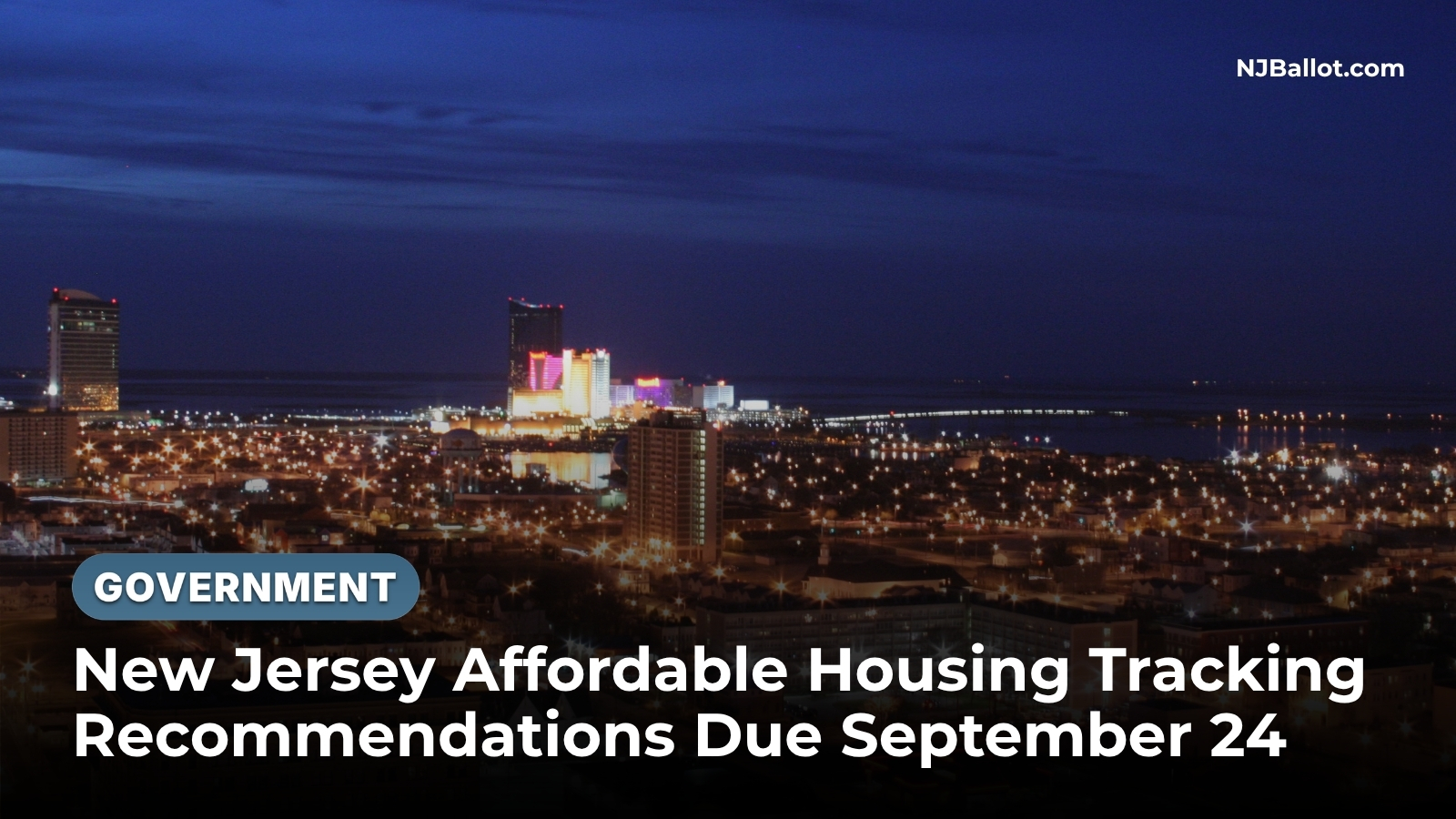
Photo: Night view of Atlantic City, where the Sherrill administration will deliver its housing recommendations Sept. 29–30. Ron Miguel via Wikimedia Commons, licensed CC BY (cropped).