
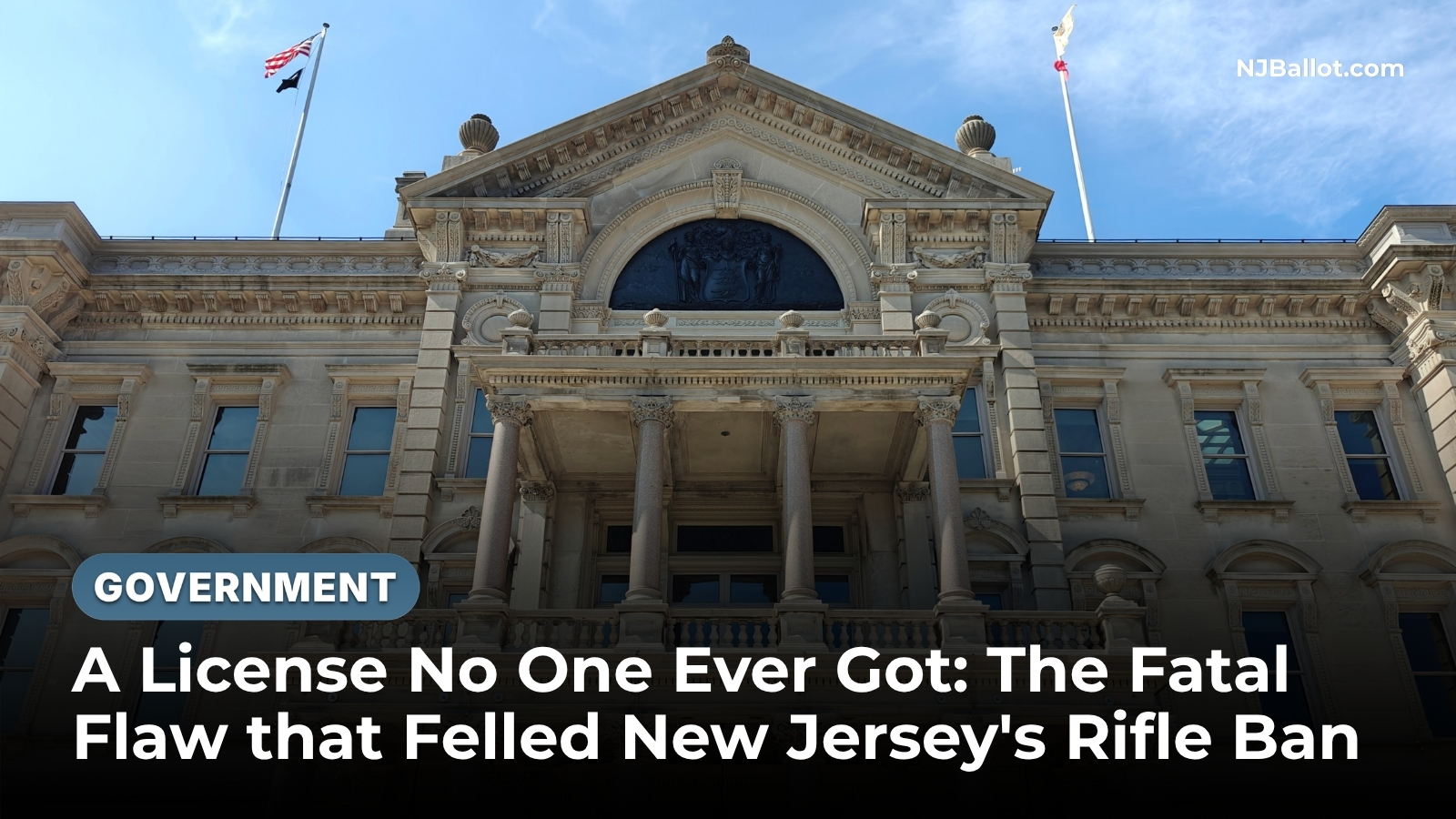

A licensing system that never issued a single license helped sink the state's 1990 assault weapons law. New Jersey is weighing its next move — and the Supreme Court also takes up the issue this fall.
The U.S. Third Circuit Court of Appeals on Friday voided New Jersey's 36-year-old assault weapons ban as applied to semi-automatic rifles and threw out the state's ten-round magazine limit. The rifle ruling turned on a licensing system that never licensed anyone.
Under the 1990 law, a civilian could petition a court for a license to possess an assault firearm after a county prosecutor recommended the application and a judge found that the public safety and welfare required it. The state conceded in litigation that no one ever received one. The Third Circuit held that this unattainable mechanism transformed a regulatory promise into a total prohibition, and that both the rifle ban and the magazine cap violated the Second Amendment.
The en banc court voted 10 to 5 to broaden a 2024 District Court decision that had struck down only the Colt AR-15. It extended that ruling to the full class of semi-automatic rifles. It also reversed the District Court on large-capacity magazines, which Judge Peter G. Sheridan had upheld.
The majority reached its result under the framework the Supreme Court built in New York State Rifle & Pistol Association v. Bruen (2022), which eliminated means-end scrutiny and required the government to demonstrate a historical tradition of comparable firearm regulation. Under that test, the government must identify a "well-established and representative historical analogue" in the law, not just a "dead ringer" for a historical one. New Jersey could not meet that burden.
The combined cases stretched back nearly a decade. A gun rights organization and two of its members first challenged the magazine provisions in 2018, after the legislature lowered the lawful capacity from fifteen rounds to ten. Those amendments gave residents 180 days to surrender, transfer, render inoperable or permanently modify any magazine holding more than ten rounds.
Two more lawsuits targeted the assault firearm ban in 2022, both filed within a week of the Supreme Court's Bruen decision. All three suits were consolidated before Judge Sheridan, who decided them on cross-motions for summary judgment. He confined his assault-firearm analysis to the Colt AR-15, citing a record focused largely on that model and "nuances" in the other regulated firearms he could not examine.
New Jersey built the ban in 1990, widened it in 1996
Then-Governor Jim Florio signed the bill banning assault weapons into law on May 30, 1990. The ban traced in part to a mass shooting at a California elementary school that killed five children and wounded 33 others.
Florio explained his rationale at the time: "Guns capable of wholesale destruction are a direct threat to our police, our citizens and especially our children." He added that the law sought to ensure that "no one can walk off the street and purchase a gun that is designed to wipe out the greatest number of people in the shortest possible time."
The law criminalized possession of more than 30 listed models and types of rifles, pistols and shotguns, plus any firearm "substantially identical" to those listed. It also banned semi-automatic shotguns with magazines exceeding six rounds or with pistol grips or folding stocks. Violators faced up to ten years in prison and a $150,000 fine.
Attorney General Peter Verniero expanded the ban's reach in 1996. His guidelines told prosecutors and police that any semi-automatic rifle accepting a detachable magazine counted as "substantially identical" to a banned weapon once it carried two or more of five listed features. Those features — bayonet mounts, grenade launchers, folding stocks, protruding pistol grips and flash suppressors or barrels threaded to accept them — became the field standard for criminal charges. Similar tests applied to semi-automatic pistols and shotguns.
The memo also reminded prosecutors that no assault firearms conviction could stand without proof that the defendant knew the weapon qualified.
Nothing changes for gun owners right away
Not every prohibition fell. The ruling left the state's bump stock ban untouched, along with its restrictions on parts "designed or intended to convert a firearm into an assault firearm" or any combination of parts "from which an assault firearm may be readily assembled." Those provisions still stand.
The court returned the cases to the District Court to decide the Second Amendment fate of the law's remaining models and types. The District Court must now determine whether the bans on specific pistol and shotgun models withstand constitutional scrutiny. That process could take months.
Until Friday, no federal appeals court had struck down a state assault weapons ban. The state now faces the prospect of defending its remaining firearms restrictions while the struck provisions await final resolution. Prosecutors and police must also determine how to handle any pending charges under the voided provisions.
The state condemned the ruling as gun owners celebrated it
Governor Mikie Sherrill condemned the ruling the same day. "Today's decision is dangerous, wrong, and make no mistake, it will make New Jersey communities less safe," she said in a statement.
Sherrill, a Navy veteran of nearly ten years who "qualified as an expert shot," maintains that "weapons of war do not belong on the streets of New Jersey." She called the ruling "completely out of step with parents" and the state's residents, and credited New Jersey's commonsense gun safety laws with saving lives.
New Jersey Attorney General Jennifer Davenport's office was "considering [their] options," she said Friday. "Today's decision from the Third Circuit invalidating New Jersey's careful laws restricting the AR-15 and large capacity magazines is as unfortunate as it is legally incorrect," she said in a statement. Former New Jersey Attorney General Matt Platkin, Davenport's predecessor, carried the state's defense of the laws until this year.
Gun rights advocates celebrated. "This decision marks the beginning of a very different time," Scott Bach, Executive Director of the Association of New Jersey Rifle and Pistol Clubs, told POLITICO.
Bach predicted the ruling would reverberate beyond New Jersey. "New Jersey lawmakers have had free reign for decades and could pass whatever they wanted without accountability for decades," he said. "That era is over."
He added, "This decision may well inform the Supreme Court's thinking when it ultimately resolves the issue." Bach's organization was the lead plaintiff in the 2018 lawsuit and a plaintiff in one of the 2022 challenges. Firearms Policy Coalition and individual gun owners joined as co-plaintiffs.
The en banc court fractured over the decision. Circuit Judge Arianna J. Freeman wrote the majority opinion. The majority held that the plain text of the Second Amendment covered the plaintiffs' proposed conduct and that the state failed to identify a well-established historical analogue.
Circuit Judge Paul Matey, joined by Judge Mascott, wrote concurrently to say the ruling "returns the Second Amendment to its appropriate place in our constitutional design" and called it "a welcome step" for New Jerseyans "who have been unable to enjoy their natural liberties without wondering what new turn of phrase will descend from Trenton to take away their freedom."
Circuit Judge Cheryl Ann Krause dissented, joined by Judges Restrepo and Smith. She wrote that the majority "disregards democratic will and Supreme Court precedent, risking a dangerous aftermath for the People of New Jersey and those beyond." The state's laws, she argued, were "consistent with our Nation's long-held tradition of regulating particularly dangerous weapons."
Supreme Court will have the final word
The Supreme Court has already agreed to hear two challenges to assault weapons bans — one from Cook County, Illinois, and one from Connecticut. It granted certiorari in Viramontes v. Cook County and Grant v. Higgins on June 30, 17 days before the Third Circuit ruled. A decision from the justices could either moot the Third Circuit's reasoning or cement it into national law.
Governor Jim Florio signed the original law with an eye toward weapons "capable of wholesale destruction." For 36 years, that logic held. The licensing mechanism produced zero licenses. The court cited that absence in its analysis of whether the law functioned as a regulatory scheme or a prohibition on an entire class of arms. The State Police, county prosecutors and local departments now await the state's next move.
Related Articles
• NJ GOP Lawmaker Slams AG Davenport's Warnings on Trump USPS Gun-Mail Plan (May 5, 2026)
• Trenton Mass Shooting: 7 Shot, 50+ Rounds Fired in "Extra Attention Area" (June 12, 2026)
• Mother's Day Shooting Leaves Seven Injured, 36 Hours Before Paterson Voters Head to Polls (May 11, 2026)
• Jersey City Police Report 17 Illegal Gun Arrests in Early 2026 (March 5, 2026)
Sources
• Association of New Jersey Rifle and Pistol Clubs, Inc. v. Attorney General New Jersey, Nos. 24-2415, 24-2450 & 24-2506, U.S. Court of Appeals for the Third Circuit (July 17, 2026)
• Coalition of New Jersey Sportsmen, Inc. v. Whitman, 44 F. Supp. 2d 666, U.S. District Court for the District of New Jersey (1999)
• Peter Verniero, "Guidelines Regarding the 'Substantially Identical' Provision," New Jersey Office of the Attorney General (August 19, 1996)
• "Third Circuit strikes down New Jersey assault weapons ban," Courthouse News (July 17, 2026)
• Joey Fox and Daniel Han, "Appeals court strikes down New Jersey's assault weapons ban, magazine limits," Politico (July 17, 2026)
• Governor Mikie Sherrill, "Statement by Governor Mikie Sherrill on Third Circuit Court Decision Lifting Restrictions on Automatic Weapons and High-Capacity Magazines," Office of the Governor (July 17, 2026)