
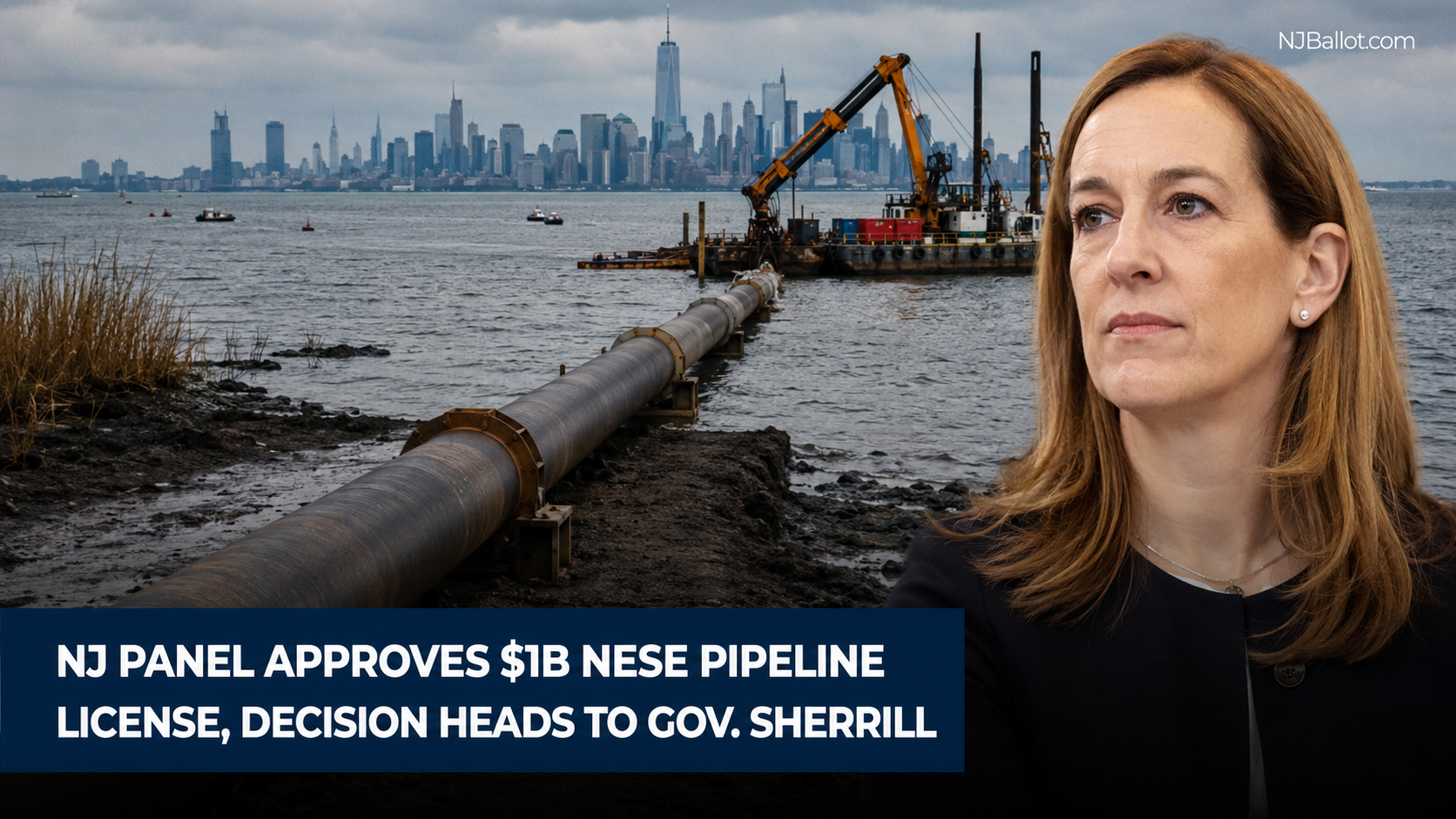

Four times denied by state regulators, the $1 billion NESE pipeline has cleared its final NJ hurdle. Now it heads to Governor Sherrill for final approval, three weeks after federal officials already broke ground.
SOUTH AMBOY, N.J. — A $1 billion natural gas pipeline that would tunnel 23 miles beneath Raritan Bay, delivering zero gas to New Jersey households while dredging through a federal Superfund site, cleared its final state hurdle Wednesday. The decision now goes to Governor Mikie Sherrill for final approval. But her confirmation comes three weeks after federal officials already broke ground on the project.
On May 6, 2026, the NJ Tidelands Resource Council unanimously approved the utility license that Williams Companies needs for its Northeast Supply Enhancement (NESE) pipeline, a 37-mile line from Middlesex County to Queens, New York. The vote capped a five-hour virtual hearing where more than 50 members of the public spoke in opposition and just two spoke in favor. After the gavel fell at that meeting, critics in the chat window called council members 'maggots' and 'criminal.'
The project, which environmental groups have dubbed the 'zombie pipeline' for its habit of returning from regulatory death, now awaits final executive action from a governor who has not publicly stated her position since taking office in January.
The NESE pipeline's regulatory history is a case study in bureaucratic persistence, and the limits of state authority under federal pressure. In 2017, the NY State Department of Environmental Conservation (DEC) denied a water quality certification, finding the project "inconsistent with statewide GHG emission limits" under New York's Climate Leadership and Community Protection Act.
The following year, the NJ Department of Environmental Protection (NJDEP) followed suit, rejecting the project over threats to water quality and marine habitats. NJDEP affirmed its denial in 2019 after Williams resubmitted. The NY DEC denied the project a second time in 2020, citing continued climate and water quality concerns.
Each denial rested on Section 401 of the federal Clean Water Act, which gives states authority to certify or reject federal permits for projects affecting their waterways. For three years, the pipeline appeared dead.
Then came January 2025.
President Trump's 'energy emergency' executive order fundamentally altered the project's trajectory. The order directed federal agencies to treat state water quality certifications as time-limited, compressing the review window that New York and New Jersey had used to reject the project four times. The Federal Energy Regulatory Commission (FERC), which had approved the pipeline in 2019, reinstated its permit under the new federal directive.
The industry investment was substantial: $450 million in election spending from the oil and gas industry helped reshape the political landscape, according to Climate Power, a national advocacy group that has tracked campaign finance and fossil fuel permitting.
The federal momentum culminated in an April 15, 2026 groundbreaking ceremony attended by U.S. Energy Secretary Chris Wright, EPA Administrator Lee Zeldin, and Interior Secretary Doug Burgum. All three were physically present alongside Williams executives. The event occurred less than a month before the NJ Tidelands Resource Council's final vote, let alone the Governor's approval.
Williams now anticipates a Q3 2026 construction start (July–September) with completion targeted for Q4 2027. That timeline assumes litigation will not block work.
The pipeline's path cuts through the Raritan Bay Slag Superfund Site. Peer-reviewed research published by the National Institutes of Health (NIH) documented heavy sediment contamination there, with lead concentrations up to 198,000 parts per million. That figure means the soil is approximately 20% lead by weight. The site also contains arsenic, antimony, copper, and mercury from decades of industrial slag dumping.
NJDEP's own 2017 environmental assessment identified three "worst-case" sample sites along the proposed route where sediment exceeded biological effects thresholds for dioxins, PCBs, polycyclic aromatic hydrocarbons (PAHs), and mercury. The study found some contaminant concentrations were up to 10 times above levels known to harm marine life.
Dredging this seabed to bury a 36-inch pipeline, opponents argue, will "kick up this toxic history," dispersing contamination into shellfish beds and causing bioaccumulation up the food chain to striped bass and the humpback whales that have returned to NY/NJ waters in recent years.
"The water quality violations are really foundational," one environmental advocate testified at a prior hearing. "Can you safely swim here? Can you safely eat fish from here?"
The pipeline would be operated by Williams Companies through its Transcontinental Gas Pipe Line (Transco) subsidiary. Transco has a documented pattern of safety failures across its national network.
According to Pipeline and Hazardous Materials Safety Administration (PHMSA) enforcement records, a 2015 explosion and fire at a Williams facility in Gibson, Louisiana, killed four workers and seriously burned two others. The company paid a $1.6 million civil penalty.
Two years prior, in 2013, an explosion at the Neshanic compressor station in New Jersey injured three workers and required treatment for 13 others. The group paid out $167,000. As recent as 2024, Williams faced nearly s60,000 in state fines for misclassifying areas in Harrison where pipeline leaks could pose the highest environmental consequences.
Between January 2020 and May 2025, Williams reported 59 incidents to federal regulators nationwide. The incidents released approximately 8,837 total metric tons of methane, a potent greenhouse gas, with repair costs exceeding $20 million.
Pipeline Safety Trust testimony and federal briefing papers have repeatedly documented serious failures across the Williams network, and the organization has flagged the company's incident rate in public comments to regulators.
The new NESE compressor station would be located in Franklin Township, Somerset County, at the Trap Rock Quarry area. The site adds a significant land-use and industrial noise concern for a community outside the Bayshore region.
The economic and political asymmetry of the project has fueled local opposition.
The pipeline would deliver 400,000 dekatherms of natural gas per day. That's enough to supply approximately 2.3 million homes. But none of it to New Jersey. The gas flows to Brooklyn, Queens, and Long Island, serving New York ratepayers while New Jersey bears most of the construction, environmental, and safety risks.
Fifteen New Jersey local governments have passed resolutions opposing the pipeline, including Aberdeen, Atlantic Highlands, Keyport, Matawan, Monmouth Beach, Monmouth County, Middletown, Old Bridge, Red Bank and Sea Bright. They form a coalition of Bayshore communities whose economies depend on fishing, tourism, and water quality.
The project also jeopardizes an estimated $6 billion in federal, state, and local investments already made to clean up the NY/NJ Harbor estuary system — one of the nation's most expensive and long-running environmental restoration efforts.
But the business community sees the project differently. The New Jersey Business & Industry Association (NJBIA) and the Chemistry Council of New Jersey support the pipeline, citing electricity costs for NJ manufacturers that run 55% higher than the national average. The chemistry and manufacturing sector is New Jersey's largest industrial energy consumer, and business groups argue the pipeline would improve supply reliability and cost competitiveness.
Pipeline opponents counter with a study by Synapse Energy Economics, which shows that the Northeast has a regional gas surplus projected through 2034, making the NESE pipeline unnecessary even for New York's needs.
Governor Mikie Sherrill now faces the project's final executive checkpoint. The Tidelands Resource Council is a governor-appointed body, but current members were appointed by the administration of Sherrill’s predecessor Phil Murphy. The governor has not publicly stated her position on the NESE pipeline since taking office in January 2026, and her office did not respond to requests for comment following the May 6 vote.
Murphy signed off on key NJDEP permits in November 2025, reversing his own administration's 2018–2019 denials. His reversal came after the Trump administration's federal pressure campaign and followed a pattern of Democratic governors in energy-producing or transit states accommodating federal fossil fuel priorities.
The Tidelands Council, in its May 6 vote, imposed conditions: a 7-year license (Williams had requested 24 years), restoration bonds, and updated engineering drawings.
Three federal lawsuits about the pipeline are also pending, with oral arguments expected by the end of June 2026. In NRDC v. NJDEP (3rd U.S. Circuit), an environmental nonprofit challenges NJ's water quality certification reversal. In Central New Jersey Safe Energy Coalition et al. v. FERC (D.C. Circuit), a group of non-profits challenges federal approval and failure to analyze upstream and downstream methane emissions. Finally, NY/NJ Baykeeper et al. v. NYSDEC (2nd Circuit) challenges New York's reconsideration and approval of the pipeline.
Environmental groups have also signaled potential additional litigation over the Tidelands Resource Council's process, citing the lopsided public opposition and the council's apparent disregard for its own prior environmental findings.
Williams, meanwhile, is preparing for a summer 2026 construction start. They aim to begin drilling through a Superfund site, beneath a bay that 15 New Jersey towns have formally opposed, to deliver gas to New York. All with several deaths and millions of dollars of federal fines in their past.
For the 'zombie pipeline,' the final burial may still require a court order. Or, if Sherrill chooses to deny it, a governor's pen.
Sources
• New Jersey Department of Environmental Protection, "Northeast Supply Enhancement (NESE) Project" (ongoing)
• U.S. Department of Energy, "Wright, Zeldin, and Burgum Break Ground on NESE Pipeline in New York City to Deliver Reliable, Affordable Natural Gas to the Northeast" (April 15, 2026)
• Joanna Burger et al., National Institutes of Health / PubMed Central, "Lead (Pb) in Biota and Perceptions of Pb Exposure at a Recently Designated Superfund Beach Site in New Jersey," Journal of Toxicology and Environmental Health, Part A (2012)
• Pipeline and Hazardous Materials Safety Administration, Williams Companies Enforcement Records (various dates)
• Pipeline Safety Trust, "Pipeline Briefing Papers" (various dates)
• Dana DiFilippo, New Jersey Monitor, "‘Zombie pipeline’ lands final OK, sparking alarm among environmentalists" (May 6, 2026)
• Mike Deak, MyCentralJersey, "Pollution fears rise after NJ pipeline clears key hurdle" (May 7, 2026)
• Patch, "Raritan Bay Natural Gas Pipeline One Step Closer To Starting Construction" (May 8, 2026)
• Natural Resources Defense Council, "Northeast Supply Enhancement (NESE) Pipeline Lawsuits" (ongoing)
• Climate Power, "Big Oil Spent 450 Million To Influence Trump & The 119th Congress" (January 21, 2025)
• Synapse Energy Economics, "Assessment of National Grid's Long-Term Capacity Report" (April 6, 2020)
• New Jersey Business & Industry Association, "NESE Pipeline Clears Final Regulatory Hurdle" (May 8, 2026)
• Sierra Club New Jersey Chapter, "NESE Gains Air Permit, Locking-In New Dirty Gas Infrastructure in NJ" (January 13, 2026)