
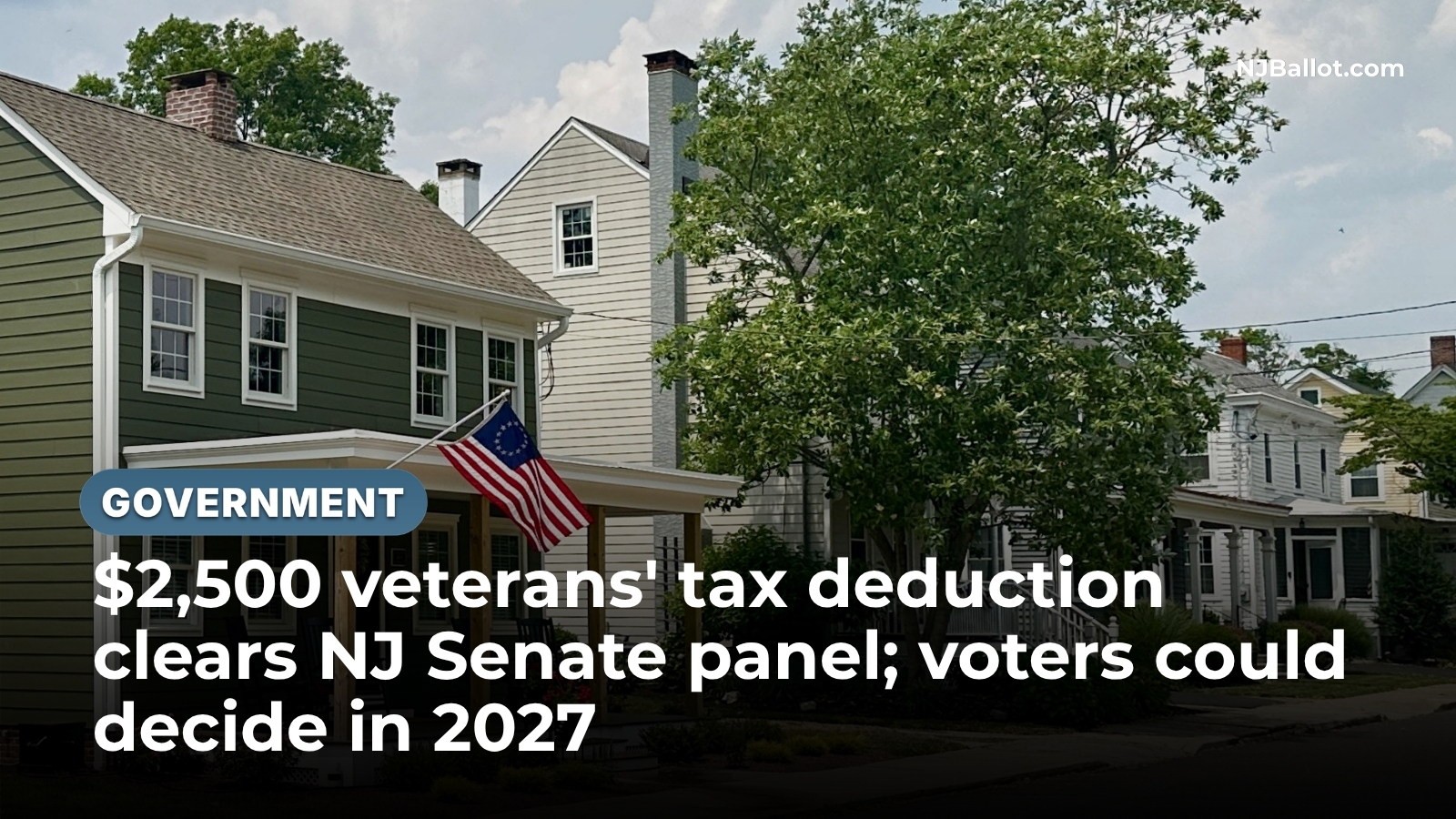

A bipartisan constitutional amendment that cleared a state Senate committee 12-0 would phase in the increase from 2028 to 2031 with the state repaying towns, but the Constitution requires a public hearing before any floor vote, and voters could decide no sooner than November 2027.
Veterans who own homes in New Jersey have taken the same $250 off their property-tax bills since 2003, and a proposed constitutional amendment would lift it to $2,500 by 2031, with the state picking up the cost.
The Legislature's Office of Legislative Services, known as OLS, estimates the increase would add $72.8 million to state costs in fiscal 2029, its first year. By fiscal 2032, the analysts project, the added cost would reach $181.8 million a year.
The current state budget sets aside $28.5 million for the existing deduction and lets the state pay whatever more the reimbursements to towns require, according to the fiscal 2027 appropriations act.
The measure, SCR96, cleared the state Senate Budget and Appropriations Committee 12-0 on Oct. 5. State Senators Troy Singleton (D, 7th District) and Carmen Amato Jr. (R, 9th) sponsor it. No version introduced in the previous two legislative sessions got that far, and none has reached a floor vote in either house, state records show.
Before the full Senate can vote on it, the state Constitution requires a public hearing on the amendment. As of Oct. 21, the Legislature's records showed none held or scheduled.
If lawmakers pass it, the resolution's timetable would put the question before voters in November 2027 at the earliest.
"The veterans' property tax deduction has remained stagnant for over 20 years, even as the cost of owning a home has risen dramatically," Amato said in a statement the day the committee acted.
Singleton put it more briefly. "This is a tangible way we can honor their service," he said.
The amendment covers honorably discharged veterans who live in New Jersey and the surviving spouses of qualified veterans. A veteran whose tax bill is smaller than the deduction "shall be entitled to a cancellation of the tax bill," the amended resolution says.
To qualify now, a veteran must have been honorably discharged from active duty. As of Oct. 1 of the prior year, the veteran must also be a New Jersey resident who owns the property, according to the state Division of Taxation.
The increase would phase in over four years, starting at $1,000 in 2028 and reaching $2,500 in 2031. The version introduced in February would have started the climb in 2025; the committee updated the schedule Oct. 5.
The last increase worked the same way. Voters approved it in 1999, lifting the deduction from $50 to $250 over four years. The amount had not changed since 1963, according to that year's ballot statement.
That question passed 886,481 to 258,972, the state's official tally shows. In 2020, voters extended the deduction to veterans who served in peacetime, 3,064,810 to 942,612.
The state, not towns, would pay for the increase
Trenton repays towns for the revenue the deduction takes off their tax bills, plus 2 percent for administrative costs, according to the OLS estimate.
That money comes out of the state's Property Tax Relief Fund. OLS projects the cost rising through each year of the phase-in, then declining after it, as the analysts expect the number of eligible recipients to keep falling.
Towns would end up with a net gain of $1.4 million in fiscal 2029, peaking at $3.6 million by fiscal 2032, OLS estimates.
OLS wrote that it produced the estimate "due to the failure of the Executive Branch to respond to our request for a fiscal note." A fiscal note is the administration's own estimate of what a bill would cost. Its 2024 estimate for an earlier version carried the same note.
The Sherrill administration has not put a cost estimate or a position on the amendment on record.
Peter Chen, president of New Jersey Policy Perspective, a Trenton think tank that says it works to "advance economic, social, and racial justice," questioned the price. "Raising a benefit tenfold and locking it into the Constitution, when the State is struggling to pay its basic bills, is not fiscally responsible, even if the goal is admirable," Chen said in a statement to NJBallot.
Fewer veterans claim the deduction every year
The group the increase would reach keeps getting smaller. In fiscal 1979, 462,220 veterans and surviving spouses received the deduction; in fiscal 2026, 114,894 did, according to OLS.
Recently the count has fallen about 6.0 percent a year, the analysts wrote, and their estimate assumes the slide continues.
The state Treasury's budget documents project 107,670 recipients this fiscal year. Neither those documents nor the OLS estimate says what drives the drop.
Ocean County led the state in 2025 with $4,061,000 in veterans' deductions, according to the Division of Taxation's Abstract of Ratables, its yearly ledger of property values and deductions by town. Manchester Township accounted for $667,500 of that, and Berkeley Township for $600,750.
Veterans who rent would not see the increase
The deduction comes off a property-tax bill, so it reaches only veterans who own property. The resolution sets no income limit.
"It gives the same break to a veteran with a high income and a paid-off home as it does to a veteran struggling to stay in their home, and it gives nothing to veterans who rent," Chen said.
Will Kramer, who chairs the legislative committee of the American Legion's New Jersey department, said the group backs SCR96 and opposes a means test. Military service never came with a test of a veteran's finances, he said, and the deduction should honor that service rather than work like another income-based grant.
Ken Hagemann, state commander of the Veterans of Foreign Wars in New Jersey, wrote that his group backs the later start date. "While the VFW would consider supporting an income limit to make the bill affordable, this resolution does not have one. The VFW would also support a rebate for veterans who rent," he wrote.
Separate legislation introduced in January would give veterans with a service-connected disability a state rebate on part of their property taxes, scaled to their disability rating. The rebate would top out at $5,000, and veterans with more than $200,000 in gross income could not claim it. Veterans who rent could count 18 percent of their rent as property taxes.
That bill has not moved out of committee in either house. Singleton and Amato are lead sponsors for the Senate version, and Assemblywoman Carol A. Murphy (D, 7th) is primary sponsor for the Assembly version.
A public hearing has to come before any floor vote
The Constitution sets the order. The Legislature must print an amendment and place it on members' desks at least 20 calendar days before the first vote in the house where it started, then hold a public hearing before that vote.
Senate rules leave it to the full Senate to order that hearing before one of its committees.
The second house does not have to hold one of its own, according to the OLS handbook for lawmakers.
SCR96's legislative history listed no hearing as of Oct. 21, and none appeared on any posted committee schedule. The Senate meets for a voting session Oct. 22, and as of Oct. 21 its posted list of bills for that day did not include SCR96.
The last veterans' amendment to reach voters shows where that step falls. The 2020 peacetime-veterans measure got its public hearing before an Assembly committee Jan. 6, 2020, and passed both houses without a dissenting vote Jan. 13, legislative records show. Unlike that measure, which started in the Assembly, SCR96 started in the Senate, so its hearing would fall to a Senate committee.
The Senate version has been on the Assembly's desk since Oct. 5. Assembly rules bar that house from amending a Senate resolution that proposes a constitutional amendment. Murphy's own Assembly version, ACR129, has not had a committee vote since its introduction in March; she sponsored earlier versions in 2023 and 2024.
To reach the ballot in one year, the amendment needs three-fifths of each house, 24 votes in the Senate and 48 in the Assembly, with no action from the governor, according to OLS.
A majority short of three-fifths would carry it to the next legislative year, when a majority of each house could send it to voters, the state Constitution provides.
The resolution sends the question to voters at the first general election more than three months after the Legislature's final agreement. Singleton's chief of staff, Jennifer Crea Aydjian, told NJBallot the measure is still in the legislative process and would not go before voters this November. "We are hopeful we can get it through both houses, and have it on the ballot in the future," she said.
If lawmakers do pass it, the ballot would ask: "Do you approve amending the New Jersey Constitution to increase the amount of the veterans' property tax deduction from $250 to $2,500? The increase would occur over four years. The surviving spouse of a qualified veteran would also receive the increased property tax deduction."
NJBallot is arranging a follow-up interview with Murphy, the Assembly sponsor, and will add her comments to this story in an update.
Related Articles
New Jersey Property Tax Relief Payments Are Out; Here's What Changed This Year
NJ Governor Sherrill Submits $60.7B Budget With Record $4.2B Relief
Sources
American Legion, Department of New Jersey, Legislative Committee report, 2025-2026 Legion year (accessed Oct. 21, 2026)
American Legion, Department of New Jersey, written statement to NJBallot (Oct. 20, 2026)
New Jersey Constitution, Article IX, amendments (accessed Oct. 14, 2026)
New Jersey Department of the Treasury, Circular No. 91-13-OMB, "Fiscal Note Procedures" (accessed Oct. 21, 2026)
New Jersey Department of the Treasury, fiscal 2027 appropriations handbook, veterans' property tax deductions (accessed Oct. 14, 2026)
New Jersey Department of the Treasury, Governor's fiscal 2027 budget detail, veterans' property tax deduction recipients (accessed Oct. 14, 2026)
New Jersey Division of Elections, official results, 1999 general election public questions (Nov. 29, 1999)
New Jersey Division of Elections, official results, 2020 general election Public Question 2 (November 2020)
New Jersey Division of Taxation, 2025 Abstract of Ratables, veteran deductions by county and municipality (accessed Oct. 14, 2026)
New Jersey Division of Taxation, "$250 Veterans Property Tax Deduction" (accessed Oct. 14, 2026)
New Jersey General Assembly, Rules of the General Assembly, 2026-2027 (Jan. 13, 2026)
New Jersey Governor's Office, 2026 news releases (accessed Oct. 21, 2026)
New Jersey Legislature, bill histories for earlier versions, SCR140 and ACR177 (2022-2023 session) and SCR81 and ACR58 (2024-2025 session) (accessed Oct. 14, 2026)
New Jersey Legislature, Bill No. ACR129, introduced text and bill history (March 10, 2026)
New Jersey Legislature, Bill No. ACR253, bill history, 2020 peacetime veterans amendment (accessed Oct. 14, 2026)
New Jersey Legislature, Bill No. S1459, "Allows property tax rebate for disabled veterans" (Jan. 13, 2026); companion Bill No. A1907
New Jersey Legislature, Bill No. SCR96, bill history, sponsors and committee vote (accessed Oct. 21, 2026)
New Jersey Legislature, Bill No. SCR96, first reprint, "Proposes constitutional amendment to increase amount of veterans' property tax deduction from $250 to $2,500 over four years" (Oct. 5, 2026)
New Jersey Legislature, Bill No. SCR96, introduced text and sponsors' statement (Feb. 9, 2026)
New Jersey Legislature, committee schedules and public hearing index (accessed Oct. 21, 2026)
New Jersey Legislature, legislator roster, Sens. Troy Singleton and Carmen Amato Jr. and Assemblywoman Carol A. Murphy (accessed Oct. 14, 2026)
New Jersey Policy Perspective, staff and media pages (accessed Oct. 14, 2026)
New Jersey Policy Perspective, written statement to NJBallot (Oct. 19, 2026)
New Jersey Senate Budget and Appropriations Committee, statement to SCR96 (Oct. 5, 2026)
New Jersey Senate Republicans, "Budget Committee Approves Amato Bill to Lower Veterans' Property Taxes" (Oct. 5, 2026)
New Jersey Senate, Rules of the Senate, 2026-2027 (Jan. 13, 2026)
Office of Legislative Services, Legislative Calendar (Oct. 20, 2026)
Office of Legislative Services, legislative fiscal estimate, SCR81 (Aug. 6, 2024)
Office of Legislative Services, legislative fiscal estimate, SCR96 first reprint (Oct. 9, 2026)
Office of Legislative Services, Legislator Handbook, "Constitutional Amendments" (September 2026)
Office of Legislative Services, "The Legislative Process" (accessed Oct. 14, 2026)
Office of Sen. Troy Singleton, written statement to NJBallot (Oct. 19, 2026)
Vasil, Jim, PIX11 News, "NJ lawmakers propose raising veteran property tax deduction" (Oct. 6, 2026)
Veterans of Foreign Wars, Department of New Jersey, written statement to NJBallot (Oct. 20, 2026)
Photo: Zeete, Wikimedia Commons, CC BY-SA 4.0