
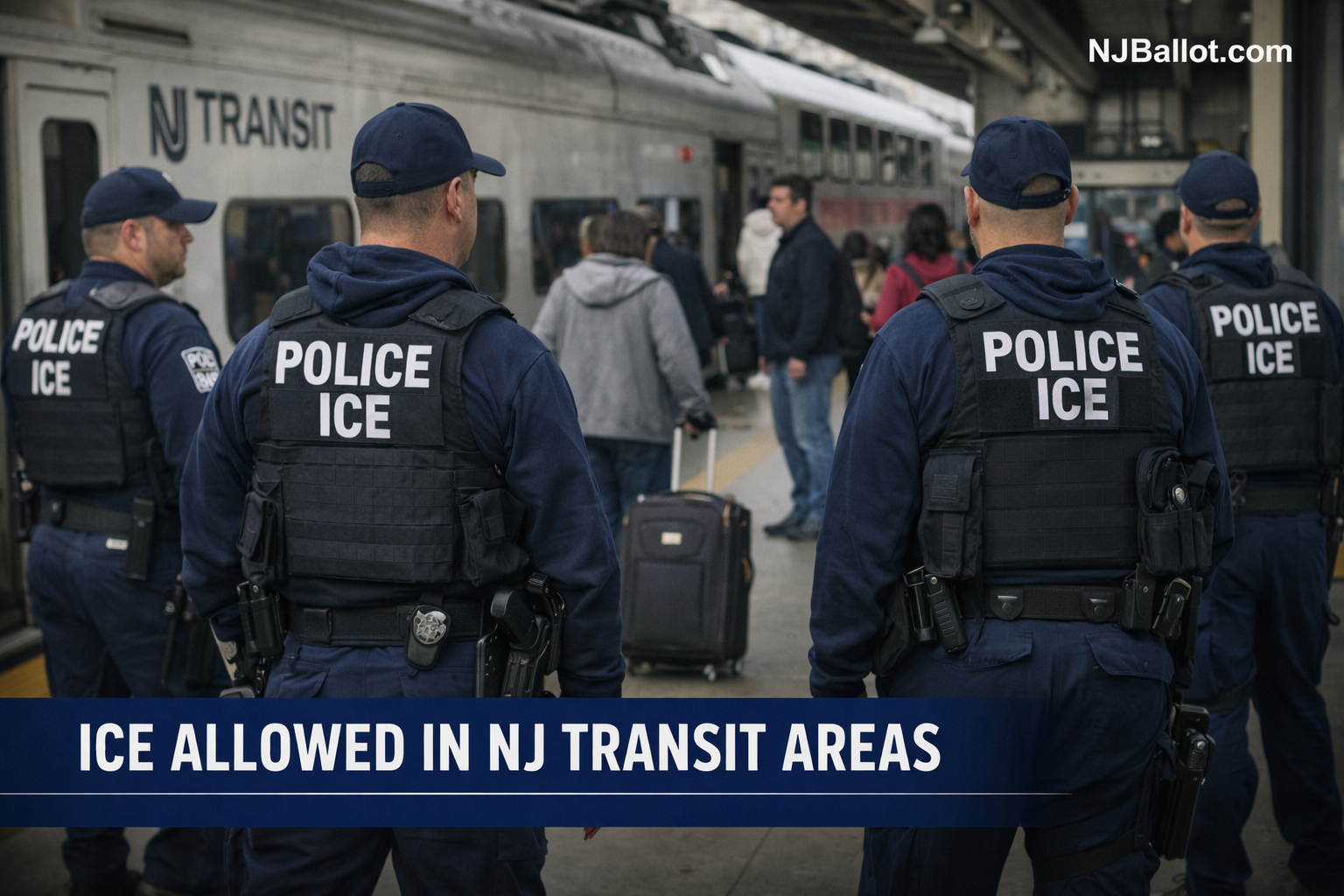

TRENTON—NJ Transit officials confirmed on March 20 that federal immigration agents may access the agency's trains, platforms, buses, and stations, clarifying that Governor Mikie Sherrill's executive order restricting ICE activity never barred such public access. Attorney General Jennifer Davenport's office stated that transit areas are "generally considered public spaces" where agents may operate even without a warrant. NJ Transit CEO Kris Kolluri said the agency is finalizing protocols for how employees should interact with federal agents and will communicate procedures to staff and riders once completed.
The clarification aligns with the text of Executive Order No. 12 itself. The order, signed February 11, explicitly preserves public access in paragraph 5(e), stating it does not restrict access to "any State property that is open to the general public, on the same terms on which the general public can access such property."
The order defines "state property" as facilities, premises, and parcels owned, operated, leased, or controlled by Executive Branch departments, including office buildings, parking lots, and garages. Paragraphs 2 and 3 prohibit federal immigration officers from entering "nonpublic areas of State property" or using state property as "a staging area, processing location, or operations base" without judicial warrant or order.
The March 20 statement resolves ambiguity that followed the order's initial rollout. On February 11, when asked about compliance, Kolluri told reporters, "We will follow the executive order, and I'll leave it at that," without elaborating on the public access exception. At that time, Sherrill had launched an online portal for residents to report ICE interactions and barred agents from using state-owned nonpublic property for immigration enforcement. The order makes exception for immigration officials who obtain judicial warrants or orders, and explicitly preserves access for joint law enforcement task forces unrelated to civil immigration enforcement.
Under the clarified policy, ICE agents remain prohibited from using stations or platforms as staging areas or for processing detained individuals. The distinction hinges on whether agents are merely passing through public areas or actively conducting enforcement operations. The Department of Justice filed a 21-page lawsuit on February 24, 2026, challenging Sherrill's executive order as an unconstitutional obstruction of federal immigration enforcement.
The lawsuit argues the order violates the Supremacy Clause by "directly regulating and discriminating against the Federal Government." Attorney General Pam Bondi stated that "New Jersey's leaders are enacting policies designed to obstruct and endanger law enforcement," while Acting Attorney General Davenport called the suit a "pointless legal challenge."
Kolluri brings significant transportation experience to the dual role of NJ Transit President and New Jersey Turnpike Authority Executive Director, having previously served as state Transportation Commissioner under Governor Jon Corzine from 2006 to 2008. He also led the Gateway Development Commission, securing the largest federal investment in mass transit history for the $16.1 billion Hudson Tunnel Project before taking the NJ Transit helm on January 2025. Former Governor Phil Murphy appointed Kolluri to both positions; Sherrill retained him to unify strategy ahead of the 2026 FIFA World Cup, when tens of thousands of visitors will rely on New Jersey's transit network.
The practical impact for the 944,000 daily riders on NJ Transit's 250 bus routes, three light rail lines, and 12 commuter rail lines is that ICE agents may patrol public areas of the transit system, as has always been permitted under the executive order's text. While the agency develops its protocols, commuters retain the right to document interactions with federal agents through the state portal. In February, responding to the federal lawsuit, Sherrill said the administration should focus on "training their ICE agents with some modicum of training, like any law enforcement officer in the state of New Jersey would have, so they can operate better and more safely" rather than "attacking states like New Jersey working to keep people safe."
Sources
- NJ.com, "NJ Transit: ICE Can't Be Barred from Buses, Trains, Stations," March 20, 2026
- NJ1015.com, "NJ Transit: ICE Can't Be Barred from Buses, Trains, Stations," March 20, 2026
- State of New Jersey, Executive Order No. 12, February 11, 2026
- NJ.com, "NJ Transit to Abide by Sherrill's ICE Ban from Property," February 11, 2026
- Courthouse News Service, "Trump Administration Sues New Jersey Over Immigration Enforcement Limits," February 24, 2026
- Police1, "DOJ Sues New Jersey, Gov. Sherrill Over Immigration Enforcement Limits," February 24, 2026
- ABC3340, "Trump Administration Sues New Jersey Over Immigration Enforcement Limits," February 24, 2026
- NJ Transit, "Meet Kris Kolluri," official biography, accessed March 20, 2026
- NJ Transit, "System Facts," ridership statistics, accessed March 20, 2026
- State of New Jersey, "Governor Murphy Announces Senior Staff Appointments," January 8, 2025