
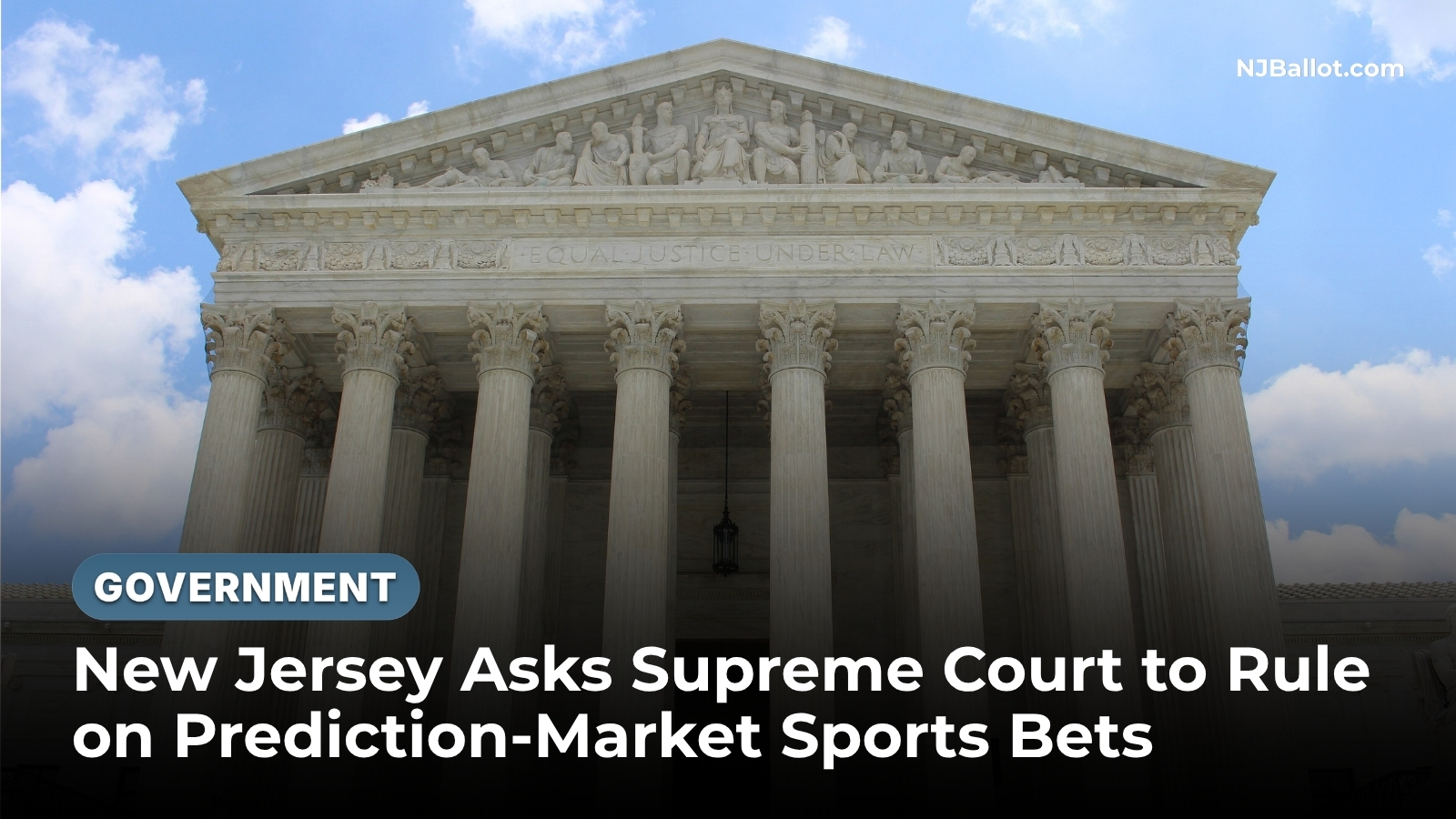
New Jersey's petition asks the justices to decide whether prediction-market platforms must follow state gambling law or answer only to federal regulators, a fight that runs through Donald Trump Jr.'s stakes in the industry and the federal regulator's lawsuits against Democratic-led states.
New Jersey Attorney General Jennifer Davenport asked the U.S. Supreme Court on September 2 to decide whether New Jersey can enforce its own gambling laws against platforms that take sports bets without a state license. The petition sets up what could be the defining case over who regulates prediction markets: the states that license and tax sports betting, or the federal commodities regulator that the platforms say shields them from state law entirely.
New Jersey taxes mobile sports betting at 19.75 percent, up from 13 percent last year, in a compromise projected to add $209 million to state revenue in the 2026 fiscal year. Licensed operators reported $102.1 million in sports wagering revenue in April 2026 alone.
Prediction market platforms take wagers on the same games, and sports bets accounted for more than 90 percent of Kalshi's trades and 95 percent of its revenue last year, according to the Ninth Circuit's opinion. They hold no New Jersey license and pay no New Jersey tax.
The fight began in March 2025, when the New Jersey Division of Gaming Enforcement sent Kalshi a cease-and-desist letter. The exchange had listed its sports event contracts with the Commodity Futures Trading Commission, the federal regulator of futures and derivatives markets, two months earlier, under self-certification rules that treat such listings as approved unless the commission moves to block them. New Jersey's position was that the listing changed nothing.
Under the Sports Wagering Act, N.J.S.A. 5:12A-11, only licensed entities may offer sports wagering to people in New Jersey, and the state constitution separately bars wagering on college sports events held in New Jersey or involving New Jersey teams, no matter where the game is played. In litigation, the state argued Kalshi could keep offering nearly every sports contract on its exchange if it took a New Jersey license and followed the Sports Wagering Act.
Kalshi instead went to federal court, arguing that state law cannot reach trading on an exchange registered with the federal government. According to the district court's opinion, Kalshi said identifying and blocking New Jersey users would cost an estimated tens of millions of dollars a year.
U.S. District Judge Edward S. Kiel agreed with Kalshi and blocked the state from enforcing its laws while the case moved forward. On April 6, a divided Third Circuit panel affirmed. Judge David J. Porter, joined by Chief Judge Michael A. Chagares, held in a 2-1 decision that Kalshi's sports contracts likely qualify as swaps under the federal commodities law and that the law likely preempts New Jersey's gambling statutes as applied to them.
Judge Jane R. Roth dissented. Describing a Carolina Panthers-Tampa Bay Buccaneers game page on Kalshi's site, she wrote that she could have bet on the winner, the point spread, the combined total and whether a particular player would score.
"These offerings are virtually indistinguishable from the betting products available on online sportsbooks, such as DraftKings and FanDuel," she wrote. The majority, she continued, treats Kalshi's federal registration and its labeling of the wagers as event contracts as "acts of alchemy that transmute its products from sports gambling to futures trading." "Because Kalshi is facilitating gambling," she wrote, "it can be subjected to state regulation."
The ruling blocks New Jersey from enforcing its laws against Kalshi for now, and as circuit precedent it covers Pennsylvania, Delaware and the Virgin Islands along with New Jersey. It is not a final decision. The judges found only that Kalshi had a reasonable chance of winning the suit, and the underlying case continues before Judge Kiel.
Out West, the Ninth Circuit calls it gambling
The federal appeals court for the West reached the opposite conclusion on August 28 in a case out of Nevada, ruling that the 2010 Dodd-Frank financial overhaul, which amended the commodities law, likely does not block state gambling enforcement. That decision clears the way for Nevada to police Kalshi's sports contracts as unlicensed gambling. The majority noted that Kalshi advertises itself as "the first app for legal sports betting in all 50 states." It wrote that "Kalshi has a gambling problem," that the exchange pitches its sports event contracts as "legal sports betting," and that denying the contracts are "sports bets under a reasonable person's understanding" is disingenuous.
Davenport's petition asks the justices to adopt the Ninth Circuit's rule and resolve the split between the two courts. New Jersey is not alone on its side of it: 34 states, the District of Columbia and the Northern Mariana Islands appeared as amici supporting the state at the Third Circuit. State attorneys general from both parties have called the product gambling. Utah's Republican attorney general, Derek Brown, called the marketing "a wink and a nod," and Washington's Democratic attorney general, Nick Brown, said betting on sports through the sites is "the same thing as gambling.”
The platforms' position has drawn backing from the commission itself. Chairman Michael Selig has described the regulator's duty, in remarks the Third Circuit cited, as defending "the CFTC's exclusive jurisdiction over commodity derivatives."
The Commodity Futures Trading Commission has a regulation on the books, 17 C.F.R. § 40.11(a), that currently prohibits gaming-related contracts on registered exchanges, a rule the Ninth Circuit relied on even as the Third Circuit majority observed the commission had taken no action on sports event contracts of any kind and the agency has opened a proceeding on the scope of the term "gaming." It has also gone on offense: between April 2 and April 24 it sued Arizona, Connecticut, Illinois and New York, its first lawsuits against a state over regulatory issues in the agency's half-century history, according to New York Times reporting. All nine of the commission's state suits are against Democratic-led states; its strongest action against Republican-led challengers has been friend-of-the-court briefs.
The Trump administration broadly supports the prediction market industry. Donald Trump Jr. has served as a paid adviser to Kalshi since January 2025 and holds equity in the company, the Times reported. His investment firm is leading a $1 billion funding round for rival platform Polymarket with a roughly $300 million commitment, announced at the end of August, days before New Jersey filed. Kalshi says his advice covers marketing. In early March, he told Republican state attorneys general at a closed-door retreat that gambling firms attacking prediction markets were protecting their "monopolies," according to four people familiar with his remarks.
A House Judiciary Committee Democrat, Rep. Jamie Raskin of Maryland, demanded records from 1789 Capital on August 26, citing the timeline of federal decisions that benefited the firm's prediction market holdings. The firm refused: in a September 8 letter, its lawyers called the demand a "spaghetti-against-the-wall approach" and turned over none of the requested records, according to CBS News. Raskin's office dismissed the letter as "blustering and evasive."
So what do I do with this
Kalshi signaled it will defend the lower court record. "Kalshi is an open, nationwide financial exchange," spokeswoman Dani Lever said. "It cannot be regulated by 50 different regulators." "We remain confident in the lower courts' rulings," she added, "and nothing in New Jersey's filing today changes our view."
The taxed market is fighting alongside the state
The Casino Association of New Jersey and the American Gaming Association, the trade groups representing the taxed industry, filed briefs supporting the state's position when the appeal was heard. FanDuel and DraftKings, which operate under casino licenses and pay the 19.75 percent rate, have attacked the platforms as unlicensed competitors operating outside the state gambling rules the licensed companies must follow.
The court has not said when it will act on the petition. If the justices take the case, arguments would likely come this fall with a decision by next summer. If they decline, the injunction keeps New Jersey's cease-and-desist letter unenforced, Kalshi keeps taking sports bets from New Jersey residents, and Judge Kiel's court moves toward a final ruling.
Davenport's petition reaches back to the state's last landmark win at the court for support. It quotes Murphy v. NCAA, the 2018 decision that struck down the federal ban on state-authorized sports betting: "Americans have never been of one mind about gambling, and attitudes have swung back and forth." New Jersey decided yes, built a licensing and tax regime around that choice, and now argues that a federally registered exchange cannot nullify it by relabeling the wager.
Until the court acts, the same wager on the same game answers to two different laws depending on which app opens on a New Jersey phone: taxed and licensed through a casino partner, untaxed and unlicensed through Kalshi. Someone will close the split: the court, the commission or Congress. The money moves while they wait.
Related Articles
U.S. Supreme Court Upholds NJ Affordable Housing Mandate, Denies Towns' Emergency Bid
NJ Secures $2.5B PFAS Settlement, Largest Single-State Environmental Deal
Sandoz to Pay $400 Million in Generic Drug Price-Fixing Settlement
Sources
• Commodity Futures Trading Commission, "CFTC Sues Trio of States to Reaffirm its Exclusive Jurisdiction Over Prediction Markets" press release (April 2, 2026)
• Commodity Futures Trading Commission, "CFTC Sues New York Over Prediction Markets Amid Ongoing Efforts to Preserve Jurisdiction" press release (April 24, 2026)
• Flaherty v. KalshiEX, LLC, U.S. Supreme Court, No. 26-299, petition for writ of certiorari (September 2, 2026)
• KalshiEX, LLC v. Assad, U.S. Court of Appeals for the Ninth Circuit, No. 25-7516 (August 28, 2026)
• KalshiEX, LLC v. Flaherty, U.S. Court of Appeals for the Third Circuit, No. 25-1922, 172 F.4th 220 (April 6, 2026)
• KalshiEX LLC v. Flaherty, U.S. District Court for the District of New Jersey, No. 1:25-cv-02152 (Kiel, J.), preliminary injunction ruling (April 28, 2025)
• New Jersey Division of Gaming Enforcement, "DGE Announces April 2026 Gaming Revenue Results" (May 15, 2026)
• Bobby Allyn, NPR, "New Jersey asks Supreme Court to resolve fight over Kalshi's future" (September 2, 2026)
• CBS News, "Donald Trump Jr.'s venture capital firm rejects House Democrat's accusations of 'insider political influence'" (September 9, 2026)
• Declan Harty, Politico, "New Jersey asks Supreme Court to take up prediction market fight" (September 2, 2026)
• David Purdum, ESPN, "CFTC sues Arizona, Connecticut and Illinois over prediction markets" (April 2, 2026)
• David Yaffe-Bellany and Sharon LaFraniere, New York Times, "Clash Between Prediction Markets and States Sets Off a Furious Political Battle" (August 27, 2026; updated August 29, 2026)
• Lauren McCarthy, New York Times, "Donald Trump Jr.'s Firm Leads $1 Billion Funding Round for Polymarket" (August 31, 2026)
• NJ Spotlight News, "Strong NJ gambling revenues should benefit the state" (August 25, 2025)
• NJBIZ, "NJ gaming revenue rises to $585.6M in June" (July 20, 2026)
• Jennifer Davenport, New Jersey Attorney General, statement on prediction markets petition (September 2, 2026)
• Jamie Raskin, Ranking Member, U.S. House Committee on the Judiciary, letter to 1789 Capital partners (August 26, 2026)
• Holland & Knight, "Federal Appeals Court: CFTC Jurisdiction Over Sports Event Contracts Likely Exclusive" client alert (April 7, 2026)