
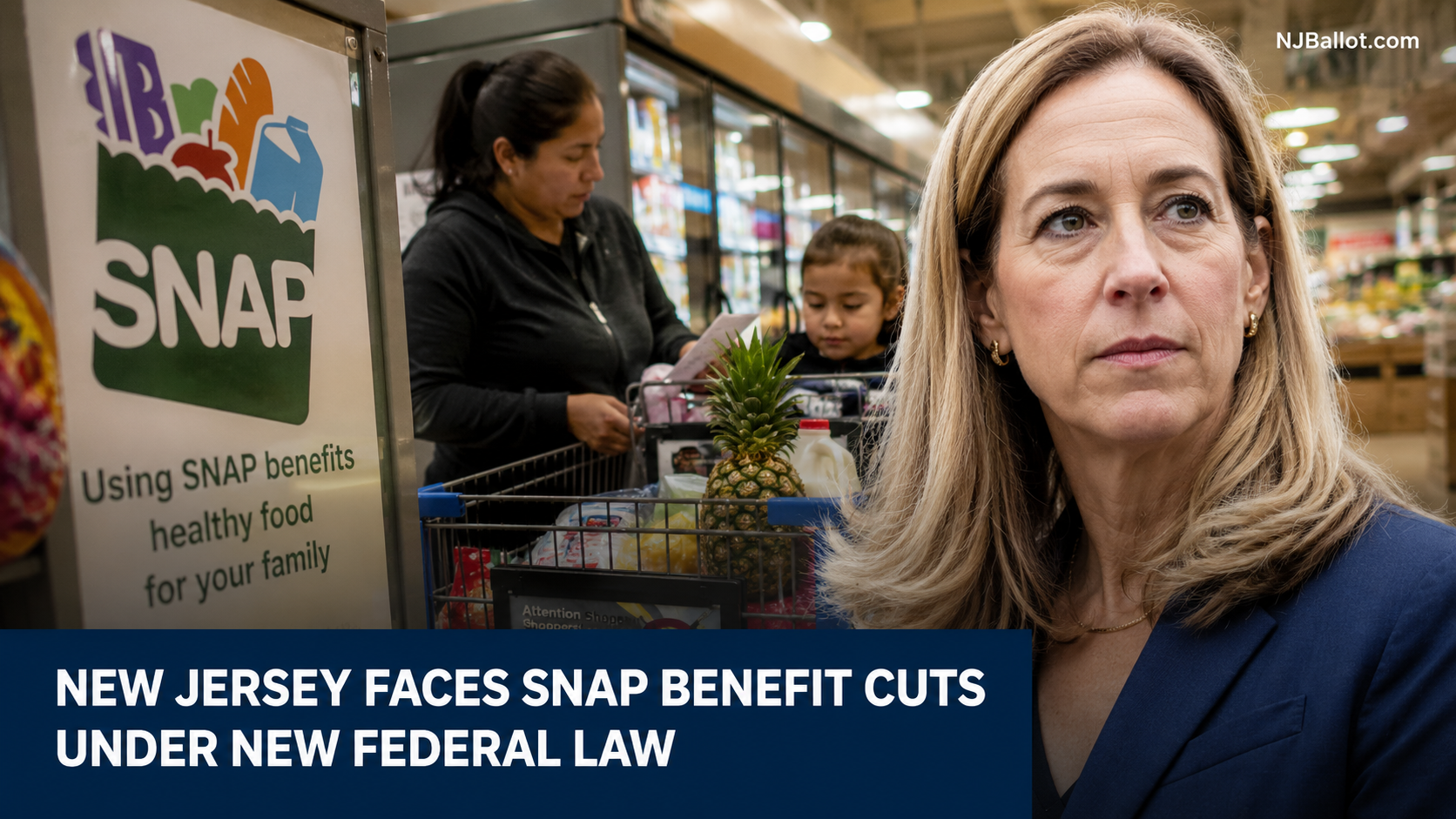

TRENTON, N.J. — The 785,810 New Jersey residents who rely on food assistance face benefit reductions or a complete loss of eligibility under sweeping federal changes to the Supplemental Nutrition Assistance Program (SNAP), according to the New Jersey Department of Human Services and state enrollment data from January 2026.
The changes stem from H.R. 1, the "One Big Beautiful Bill Act" signed by President Donald Trump in July 2025. Among other things, the bill expands work requirements, alters benefit calculations, and shifts hundreds of millions of dollars in administrative costs from the federal government to state and county taxpayers.
New Jersey Department of Human Services Commissioner Stephen Cha warned the Assembly on May 4 and the Senate on May 6 that the federal funding reductions could reach $150 million this year and $270 million next year, with as many as 47,000 residents losing benefits entirely in any given month.
Enrollment data already shows the impact: SNAP participation in New Jersey fell from 424,644 households in January 2026 to 420,026 in February, a drop of 4,618 households in a single month. The year-over-year decline is even steeper, with 33,406 fewer individuals receiving benefits compared to January 2025.
The new federal rules eliminate exemptions that previously protected several vulnerable populations from work requirements. Under the Able-Bodied Adults Without Dependents (ABAWD) rules, individuals aged 18 through 64 who do not reside with a child under 14 and are physically and mentally fit for work must now prove they are working, volunteering, or participating in approved programs for at least 80 hours per month to maintain benefits beyond a three-month limit.
Groups newly subject to these requirements include military veterans (who were previously exempt from work rules), people experiencing homelessness, and young adults aging out of foster care. The requirements now also apply to healthy adults aged 55 to 64, up from an age limit of 54, and parents whose youngest child is 14 or older, down from a previous age limit of 18. Refugees, asylum seekers and immigrants with humanitarian protections face separate federal eligibility restrictions but were not previously covered by the ABAWD exemption that H.R. 1 eliminated.
The Congressional Budget Office projects that the new requirements will result in nearly 2.4 million fewer SNAP recipients nationwide over the next decade. In New Jersey alone, the Urban Institute estimates that approximately 400,000 households could lose some or all benefits.
Recipients subject to ABAWD rules who fail to meet the 80-hour requirement will lose benefits after three months of non-compliance. To regain eligibility, they must document meeting the requirement for 30 consecutive days or qualify for an exemption. Work can include paid employment, self-employment, volunteer work, or in-kind work exchanged for goods and services.
Beyond work requirements, the federal law changes how SNAP benefits are calculated. The non-partisan Congressional Budget Office estimates that while many recipients will see modest reductions, others could lose significantly. The current maximum monthly benefit for a single person is $298 and $994 for a family of four, though actual benefits vary based on household income and expenses.
The federal cost-shift poses a direct threat to New Jersey's 21 county governments. Historically, the federal government and counties split SNAP administrative costs 50/50. Under the new law, the federal share drops to 25%, leaving counties and the state to cover 75% of administrative expenses. New Jersey has committed to maintaining a state-funded minimum benefit of $95 per month for approximately 40,000 households, at a cost of $30.2 million annually, but this covers only a fraction of those affected.
In a hypothetical model published by the New Jersey Association of Counties, a representative mid-size jurisdiction labeled "County C" faces an increase of approximately $1.57 million annually in administrative costs alone. The Department of Human Services estimates the administrative cost shift will cost New Jersey $94 million per year beginning October 2026, totaling $991 million by 2034. Commissioner Cha warned that "this shift would place significant financial pressure on counties and could drive property taxes or reduce service capacity."
A looming provision threatens even deeper cuts. Starting in fiscal year 2028, states with SNAP payment error rates exceeding 6% will be penalized. States with error rates at or above 13.34% in fiscal year 2025 can delay implementation until fiscal year 2029. New Jersey's fiscal year 2025 rate of 8.69% falls below that threshold, meaning the state faces the fiscal year 2028 start date unless its fiscal year 2026 rate triggers the alternative delay.
New Jersey's error rate presents a significant challenge. Its payment error rate spiked to 35.7% in fiscal year 2023, the highest in the nation, before improving to 14.33% in fiscal year 2024 and 8.69% in fiscal year 2025. All three figures exceed the 6% threshold.
Commissioner Cha warned Senate lawmakers on May 6 that this penalty could cost New Jersey between $89 million and $239 million annually. A separate May 1 letter to the congressional delegation cited a range of $98 million to $293 million. Cha also announced alongside Governor Sherrill on May 1, 2026, that they had sent letters to every member of New Jersey's congressional delegation, urging repeal or delay of the error-rate provisions until at least fiscal year 2030.
Sherrill's proposed $60.7 billion state budget includes $71 million to address the administrative cost shift, including $61 million for county welfare agencies and $10 million for state operations. The administration has also launched outreach efforts to help recipients understand and comply with new requirements.
However, advocates say confusion is widespread. "A lot of people just don't know that this is coming, and I think that is one of the scariest things for us," said Elizabeth McCarthy, president and CEO of the Community FoodBank of New Jersey. McCarthy noted that 80% of SNAP households in New Jersey include a working adult, according to national anti-poverty advocates. Federal data for fiscal year 2024 shows 31% of New Jersey SNAP participants live in working families, a metric that captures households with reported wage income.
"It's not as though people are not working. It's just the compliance… is going to be very difficult for some people," McCarthy said.
The policy changes have exacerbated tensions between New Jersey and the federal government. In December 2025, the Trump administration demanded states turn over SNAP recipients' personal data, including immigration status. New Jersey was among 21 states that refused, prompting Agriculture Secretary Brooke Rollins to threaten withholding federal administrative funding. Then-Attorney General Matt Platkin joined a multi-state lawsuit arguing the administration was illegally denying benefits to eligible non-citizens.
State officials have also warned SNAP recipients to beware of scams amid the federal policy uncertainty. In November 2025, Platkin issued a consumer alert about fraudsters impersonating SNAP representatives and requesting EBT card numbers, PINs, and Social Security numbers.
New Jersey's congressional delegation split along party lines on H.R. 1. All three Republican representatives—Jeff Van Drew (R-2nd), Chris Smith (R-4th), and Tom Kean Jr. (R-7th)—voted in favor of the bill, while all Democratic members voted against it.
The law also contains provisions affecting Medicaid, with Commissioner Cha warning that more than 300,000 New Jerseyans could lose NJ FamilyCare coverage. The Department of Human Services continues working with county welfare agencies to improve data quality and reduce error rates. Federal guidance on several provisions remains pending, and states are awaiting USDA clarification on implementation timelines.
For recipients, the immediate concern is compliance. SNAP participants subject to new work requirements must document 80 monthly hours of labor to maintain benefits beyond the three-month time limit. Recipients then must recertify their eligibility every 12 to 24 months, with interim reporting required at the 4-month or 10-month mark. Failure to provide documentation or attend scheduled interviews can result in benefit termination.
Related Articles
• NJ Governor Sherrill Joins Three Multistate Alliances on Climate, Health, and Reproductive Care
• NJ GOP Lawmaker Slams AG Davenport's Warnings on Trump USPS Gun-Mail Plan
• DOJ Sues New Jersey Over ICE Mask Ban as State Leaves Law Unenforced
Sources
• NJ Department of Human Services, "Who is Eligible for SNAP?" (February 13, 2026)
• NJ Department of Human Services, "Able-Bodied Adults Without Dependents" (February 13, 2026)
• NJ Department of Human Services, "Staying on SNAP" (February 13, 2026)
• NJ Department of Human Services, Current Program Statistics (January 2026)
• NJ Department of Human Services, Current Program Statistics (February 2026)
• NJ Department of Human Services, "Key Direct Impacts of H.R. 1: New Jersey" (May 3, 2026)
• Stephen Cha, NJ Department of Human Services, Assembly Budget Committee testimony (May 4, 2026)
• Stephen Cha, NJ Department of Human Services, Senate Budget and Appropriations Committee testimony (May 6, 2026)
• Stephen Cha, NJ Department of Human Services, letter to New Jersey congressional delegation (April 28, 2026)
• Governor Mikie Sherrill and Stephen Cha, NJ Department of Human Services, press release on SNAP cost shifts (May 1, 2026)
• U.S. Department of Agriculture Food and Nutrition Service, "Supplemental Nutrition Assistance Program (SNAP) Provisions of the One Big Beautiful Bill Act of 2025 — ABAWD Exceptions — Implementation Memorandum" (October 3, 2025)
• U.S. Department of Agriculture Food and Nutrition Service, SNAP Quality Control Annual Report, FY2023 (September 2025)
• NJ Monitor, "Thousands of NJ residents face food stamp cuts under new federal rules" (May 11, 2026)
• Raven Santana, NJ Spotlight News, "SNAP benefits at risk as federal-state showdown escalates" (December 10, 2025)
• NJ Spotlight News, "SNAP recipients may be hit hard by federal cuts" (July 9, 2025)
• Matthew J. Platkin, NJ Office of Attorney General, Consumer Alert on SNAP scams (November 3, 2025)
• NJ Association of Counties, "A County Overview of SNAP and Medicaid" (no date)
• Fox 29 Philadelphia, "What are the new monthly SNAP amounts in New Jersey?" (September 30, 2025)
• New Jersey State Policy Lab (Rutgers), "New SNAP Work Requirements Take Effect" (December 8, 2025)
• Shalina Chatlani, Stateline (Pew Charitable Trusts), "New work rules could deny food stamps to thousands of veterans" (August 12, 2025)
• Center on Budget and Policy Priorities, "SNAP Households with Earnings" (fiscal year 2024 data)
• Morristown Minute, "New Jersey Seeks Delay of Federal SNAP Cost Shifts Tied to Error Rates" (May 4, 2026)
• U.S. House of Representatives, Office of the Clerk, Roll Call Vote 145 (May 22, 2025)