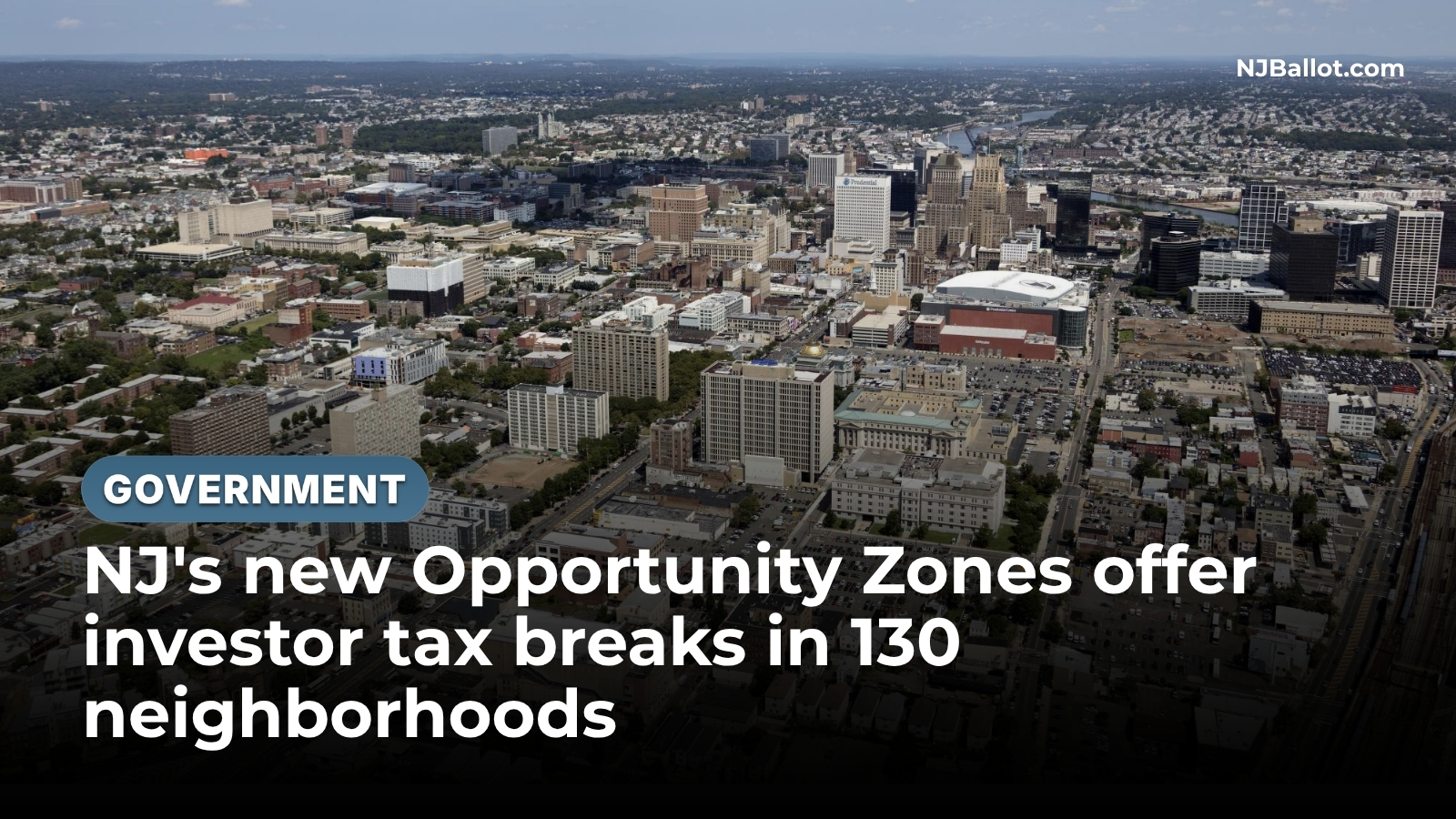

Starting Jan. 1, investors who back projects in 130 New Jersey neighborhoods can get federal tax breaks for 10 years. Big cities stay on the map, and towns such as Morristown and Woodbine join it.
New Jersey's new federal Opportunity Zone map takes effect Jan. 1, with 130 zones in neighborhoods from Newark and Trenton to Morristown and Woodbine. Investors who put profits from selling stock, real estate or other property into projects there can get federal tax breaks.
Opportunity Zones are part of a federal program that Congress created in a 2017 tax law. It offers a federal tax break to draw private money into low-income neighborhoods, which the map marks. Congress made the program permanent in a second tax law, signed July 4, 2025. That law also calls for a new map every 10 years, according to the IRS.
An investor who sells stock at a profit, for example, can put that profit into a Qualified Opportunity Fund, an investment fund set up for the zones, instead of paying federal tax on it right away. The fund puts the money into property there, such as apartment buildings, offices or businesses. Under federal law, the fund has to keep 90 percent or more of what it owns in the zones. About 12,800 such funds existed nationwide in 2024, according to a June 2026 working paper by two U.S. Treasury tax analysts.
The investor gets two federal tax breaks. The first is on the original profit. The tax on it can wait up to five years, and then the investor owes tax on all but 10 percent of it. The second is on what the fund investment earns. If the investor keeps that investment at least 10 years, the new profit is free of federal tax.
The federal government and the states drew the map together. In April, the U.S. Treasury Department and the IRS, the federal agencies that run the program, listed every census tract in the country that meets federal tests for low-income areas. A census tract is a small area the U.S. Census Bureau uses for its counts, usually home to 1,200 to 8,000 people. Each governor then picked zones from that list.
In New Jersey, three state agencies ran the selection: the Department of Community Affairs, the Economic Development Authority and the Department of State. Federal law limited the state to 25 percent of its eligible tracts, or 130 of 518, the Department of Community Affairs said. New Jersey sent its picks in late October. Treasury and the IRS approved them Nov. 5, when they designated zones in every state.
Living in a zone, or running a business there, does not bring a tax break. The designation itself "does not provide funding or guarantee investment," the Department of Community Affairs says on its website.
"I'm especially focused on putting these designations to work in Trenton, Atlantic City, and downtowns across the state," Gov. Mikie Sherrill said in a Nov. 6 statement. "This program will help turn vacant properties into homes and businesses, advance smart growth near transit, and strengthen our vital urban centers."
The state's 130 picks reach every county but Hunterdon
Newark, Jersey City, Paterson, Elizabeth, Trenton, Camden, New Brunswick, Perth Amboy and Atlantic City all have zones on the new map, as they did on the 2018 map, according to the state's lists.
Other towns are new to the map: Bloomfield, Dunellen, East Newark, Edgewater Park, Ewing, Gloucester Township, Guttenberg, Jackson, Keansburg, Morristown, Mount Olive, Newton, Parsippany-Troy Hills, Paulsboro, Penns Grove, Sayreville, Seaside Heights, Woodbine and Woodlynne. The Department of Community Affairs' website lists every zone by town, county and census tract.
Each zone is a single census tract, not a whole town, and each has to pass the federal test by itself. None of Hunterdon County's tracts made the federal list of eligible areas.
The state reached out to counties and towns over four months and received letters backing more than 200 tracts for its 130 spots, according to the Department of Community Affairs. The State Development and Redevelopment Plan, New Jersey's road map for growth, steered the choices. So did the governor's goals for housing and the economy.
The state gave priority to tracts with land ready for building, room for housing near transit and jobs, signs of economic need and backing from local officials, residents and businesses. It also weighed displacement risk, the chance that people who live there now would have to move out. The list is "final and cannot be changed," the Department of Community Affairs says.
"We will work to make sure any investment attracted through this program benefits the people and neighborhoods of Perth Amboy," Perth Amboy Mayor Helmin J. Caba said last week, after the state picked a zone in the city.
Congress rewrote the rules after the first map
The U.S. Treasury approved New Jersey's first map on April 9, 2018. It covered 169 tracts in 75 municipalities, with at least one zone in every county, according to the Department of Community Affairs.
By the end of 2024, funds had put $3.14 billion into those 2018 zones, and 78 percent of the zones had drawn at least some of it, the state said, citing U.S. Treasury figures.
Nationally, the money tilted toward zones that were already doing better, the June paper by U.S. Treasury analysts found. When the authors ranked zones by income within each state, the top fifth drew nearly twice as much money as an even split would have given them. Zones where incomes and home values were rising faster before the program began were also more likely to draw investment.
The authors said the pattern will help judge whether the 2025 federal changes, which tighten the income test and add a bigger break for rural zones, shift where the money goes.
Under the 2025 federal law, a tract counts as low-income if its median family income is no more than 70 percent of its metro area's. The original 2017 law allowed up to 80 percent. In Morristown's zone, the median family income is 65.8 percent of the New York metro area's. In Mount Olive's, it is 61.7 percent, Treasury's data show.
A poverty rate of 20 percent or higher is the other way in. Under the 2025 federal law, though, a tract cannot use that route if its median family income is above 125 percent of its metro area's. Parsippany-Troy Hills' zone qualified this way, with a poverty rate of 23.1 percent, according to Treasury.
Some 2018 towns are not on the new map because the state could pick only 130 zones this time, not 169, state officials said. Parts of the 2018 map also fail today's federal test.
That includes the census tract that covers Flemington, Hunterdon County's only zone in 2018. Its median family income is now 93.3 percent of its metro area's, and its poverty rate is 11.8 percent, Treasury's data show. Asbury Park, Englewood, Linden, North Bergen and Red Bank are also among the 2018 towns not on the new map.
Zones on the 2018 map stay in place through Dec. 31, 2028, according to IRS guidance. But starting next year, if a fund buys new property in a zone that is only on the old map, that property generally cannot count toward the 90 percent the fund must keep in the zones. One exception covers projects already under way. If a business in an old-map zone adopted a written spending plan by the end of this year, and by then had received at least 10 percent of the planned money and spent at least 5 percent, property it buys under that plan can still count.
Investors get a bigger break in rural zones
A fund gets a larger tax break when 90 percent or more of what it owns sits in zones that the U.S. Treasury Department labels rural under a federal definition. For money invested starting next year, an investor in such a fund owes tax on all but 30 percent of the original profit after five years, rather than all but 10 percent. Normally, a fund that buys an existing building has to spend more fixing it up than it paid for the building before it counts toward the 90 percent. In a rural zone, half that amount is enough.
Federal law counts an area as rural unless it sits in a city or town of more than 50,000 people or in a built-up area that touches one. The test looks at the city or town itself, not the wider region. Treasury checked each eligible tract against census maps of those big cities and the built-up areas that touch them.
Atlantic City had an estimated 38,959 residents in 2024, according to the Census Bureau, putting it below that mark. All five Atlantic City zones fell outside both, so Treasury labels them rural. Zones in Egg Harbor Township, Pleasantville, Somers Point, Woodbine, Bridgeton, Salem City and Newton carry the same label.
In Woodbine, a Cape May County borough new to the map, Mayor William Pikolycky said in October that the zone would help draw private investment across town, "especially at our municipal airport which is the focus of our revitalization efforts.”
Atlantic City's new zone takes in the whole Marina District, the casino area around the Borgata and Harrah's. Mayor Marty Small Sr. celebrated the designation in a statement last week: "Adding another Opportunity Zone, especially one that includes the entire Marina District, is a big deal for us."
Related Articles
Governor Sherrill's First Housing Plan to Debut at Atlantic City Conference
Sherrill faces a Jan. 1 deadline on the new federal scholarship tax credit
Sources
Coyne, David, and Craig Johnson, U.S. Department of the Treasury, Office of Tax Analysis, Working Paper 128, "Use of the Opportunity Zone Tax Incentive through 2024: An Update" (June 2026)
Internal Revenue Service, IR-2026-132, "Treasury, IRS announce Opportunity Zones designations for over 6,500 communities across America" (Nov. 5, 2026)
Internal Revenue Service, Notice 2026-40, "Transitional Guidance on Qualified Opportunity Zones under §§ 1400Z-1 and 1400Z-2," Internal Revenue Bulletin 2026-28 (July 6, 2026)
Internal Revenue Service, "Topic no. 409, Capital gains and losses" (Sept. 24, 2026)
New Jersey Department of Community Affairs, "2026 Nominated Opportunity Zones" (Nov. 4, 2026)
New Jersey Department of Community Affairs, Division of Local Planning Services, "Opportunity Zones" (accessed Nov. 7, 2026)
New Jersey Department of Community Affairs, "New Jersey Designated Opportunity Zones," list of 2018 designated census tracts (accessed Nov. 7, 2026)
New Jersey Department of Community Affairs, press release, "Sherrill Administration Submits Maximum Number of 130 Opportunity Zones for Federal Designation" (Oct. 29, 2026)
Office of the Governor, "Statement from Governor Sherrill on the Approval of New Jersey's Opportunity Zones" (Nov. 6, 2026)
ROI-NJ Staff, ROI-NJ, "Atlantic City primed to get fifth federal Opportunity Zone, expanding potential for development" (Nov. 5, 2026); "Perth Amboy receives nomination for Federal Opportunity Zone designation" (Nov. 6, 2026)
U.S. Census Bureau, "City and Town Population Totals: 2020-2024," Vintage 2024 population estimates for New Jersey (accessed Nov. 7, 2026)
U.S. Census Bureau, "Glossary," entry "Census Tract" (accessed Nov. 7, 2026)
U.S. Code, Title 26, Section 1400Z-1, "Designation," as amended by Public Law 119-21 (July 4, 2025)
U.S. Code, Title 26, Section 1400Z-2, "Special rules for capital gains invested in opportunity zones," as amended by Public Law 119-21 (July 4, 2025)
U.S. Code, Title 26, Section 45D(e), "Low-income community" (accessed Nov. 7, 2026)
U.S. Department of the Treasury, Office of Tax Analysis, "Methodology for Determining Census Tracts Eligible to be Nominated as 2027 Qualified Opportunity Zones Comprised Entirely of a Rural Area under § 70421 of the One, Big, Beautiful Bill Act" (March 2026)
U.S. Department of the Treasury, Office of Tax Policy, "2027 QOZ Designations," data file (Oct. 30, 2026)
U.S. Department of the Treasury, Office of Tax Policy, "Eligible LICs for Nomination as 2027 QOZs," data file (Oct. 30, 2026)
Photo: Carol M. Highsmith/Library of Congress