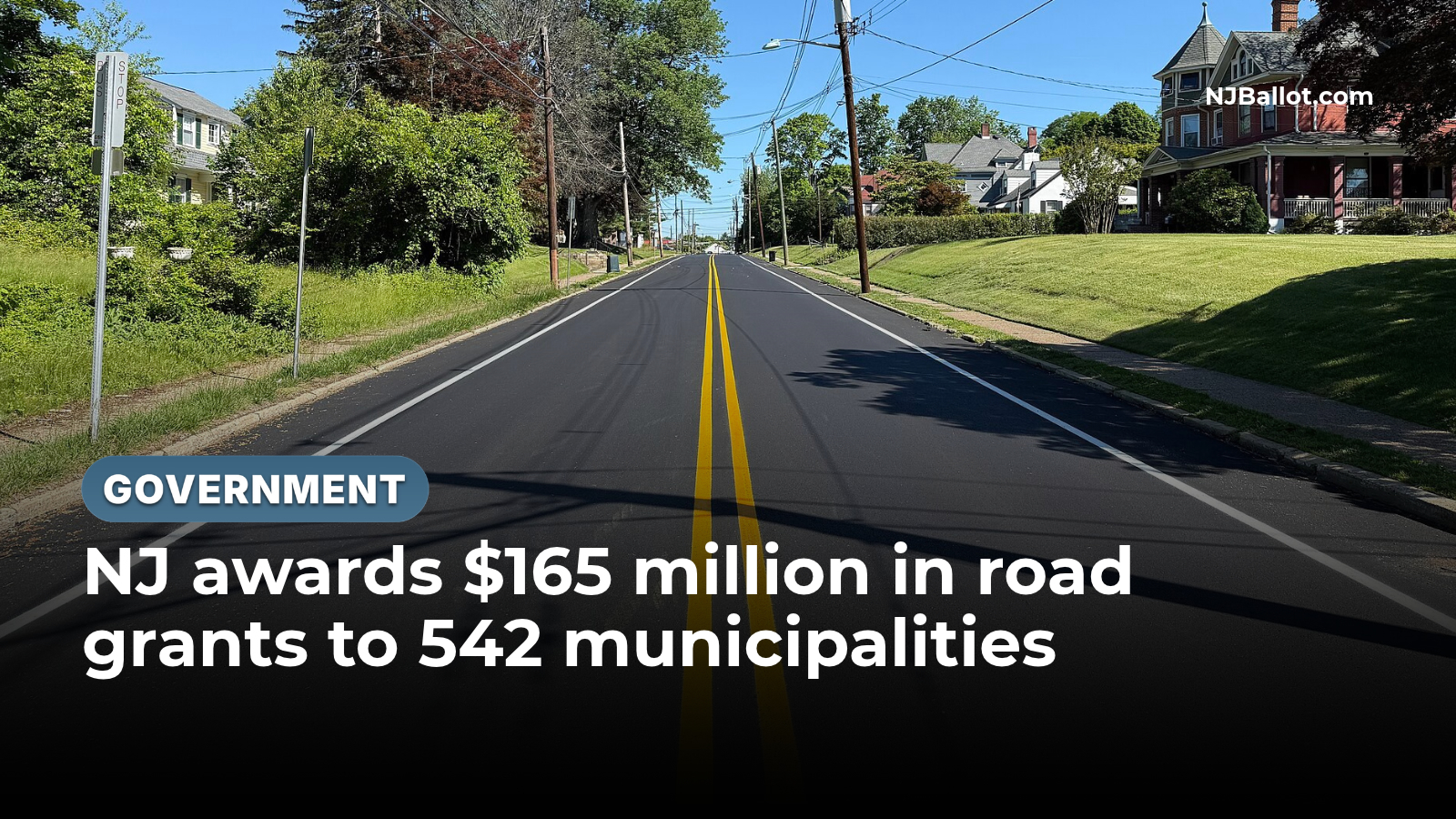

The state's yearly Municipal Aid list shows each town's grant and, for most, the street and project behind it. The state pays most of that money once a town hires a contractor, and towns have two years to do so.
New Jersey's newest list of local road grants runs from $57,526 to restore Rader Road in Warren County's Liberty Township to $1,849,697 for pedestrian safety work on Monticello Avenue in Jersey City.
Gov. Mikie Sherrill announced the round Monday, awarding $165 million in Municipal Aid grants to 542 municipalities for roads, bridges, safety work and other local projects.
The state Department of Transportation (NJDOT) runs Municipal Aid, and the state Transportation Trust Fund pays for it. By state law, the fund receives an amount equal to what the state collects from its two gas taxes, along with payments from toll road agencies and a yearly fee on zero-emission vehicles, among other money.
"These grants will help 542 communities make critical infrastructure improvements while easing the burden on local taxpayers," Sherrill said in the announcement.
The 46-page list gives the town and the grant for every entry, and in most cases the project and street, so residents can look up what their own town plans to build or repair. NJDOT's Division of Local Aid and Economic Development posts the full list on its website.
Most of the projects on the list are repaving and rebuilding jobs. Others pay for traffic lights, sidewalks, bike paths and a trail boardwalk.
Elizabeth will use $887,183 to replace traffic lights at two East Jersey Street intersections. Englewood's $181,966 goes toward repairing sidewalks on Tenafly Road, and Montclair's $437,017 will pay for traffic calming on Park Street.
Roosevelt, in Monmouth County, will put $185,942 toward its Woodland Trail boardwalk, and Manasquan's grant pays for drainage work on South Jackson Avenue. In Atlantic County, Linwood is getting $452,341 for the second phase of its bike path expansion.
In Warren County, Hope Township's $131,779 goes to Lake Just It Road, and Lopatcong Township's $146,421 covers Pudding Stone Way and Brier Place. Both fall under what NJDOT calls roadway preservation, which covers repaving, drainage and rebuilding on roads already in place.
Buena Vista Township's $319,299 is for the third phase of rebuilding Old Landis Avenue. Its second phase was on the list for the state's 2024 budget year, at $245,450.
Montgomery Township in Somerset County has $546,165 for the third phase of rebuilding Orchard Road, including a pedestrian route and an extension of its bicycle lanes. Brooklawn, in Camden County, is getting $164,568 for the second phase of safety, accessibility and streetscape work on South New Broadway.
The state divides the money by county first
All 564 of New Jersey's municipalities can apply for work on roads and bridges under their control, and each can file up to two applications a year, according to NJDOT.
The department said that 542 municipalities sent in 592 applications this year, and that all 542 are receiving grants. The round before, worth $150 million, gave a grant to each of the 537 municipalities that applied, the department said a year ago.
This year's applications asked for $384 million in projects, against $165 million in the program. That number is up from $150 million last year because the 2024 law that renewed the Trust Fund added $15 million for municipalities in the 2027 budget year.
The same law sets an extra $30.5 million for municipalities in the 2028 budget year and an extra $46.25 million in 2029. Each year's extra is added to the regular amount for that year alone, as long as the Legislature provides the money.
The state first splits the money among the counties, using a formula in state law that considers each county's population and its miles of municipal roads equally. That formula is why towns in Salem County receive $1,765,943 in totak and towns in Bergen County receive $14,716,590.
Within each county, staff from one of NJDOT's four local aid district offices, in Mount Arlington, Newark, Trenton and Cherry Hill, inspect each proposed project and score it, using NJDOT's rating sheet and the town's application.
A committee of NJDOT staff and members of the Society of Municipal Engineers reviews the scores and recommends projects to the transportation commissioner, Priya Jain as of Nov. 2026, who makes the final picks.
The rating sheet looks at how much a project would serve the public, along with the road's condition, its traffic and the safety work a town proposes. Projects that meet what NJDOT calls "equity criteria such as low-income earners and ethnic minorities" get extra consideration.
Scores also reflect "the applicant's past performance in managing grants," the program page says. This year's round was additionally the first in which the scoring counted whether a project sits on the state's High Injury Network, roads where fatal and serious crashes are concentrated.
That process carries out a state law that leaves the final ranking to the transportation commissioner. Under the law, the commissioner must evaluate each project for traffic, safety, growth potential, how soon a town can put the money under contract and how much it can raise through local taxes, along with pedestrian safety and hazards identified for school busing.
Urban Aid is a state designation created by a 1978 law. A town qualifies through a mix of measures, among them how many of its children receive public assistance, whether it has publicly financed housing and how its tax rate and property value per resident compare with the state's.
The state Department of Community Affairs manages the Urban Aid list, which also includes towns added through state budget language. DCA also sets each town's share. Those shares take up $10 million of this year's total, according to the announcement.
On the grant list, a town's Urban Aid share goes to the same project as its grant. Jersey City's $1,849,697 for Monticello Avenue combines a $736,879 grant with a $1,112,818 Urban Aid share, and Trenton's $709,410 share goes toward rebuilding South Warren Street and Brunswick Avenue.
Towns get paid after they hire a contractor
Award letters go to the municipalities on the new list by Nov. 30. Each then signs an agreement with NJDOT by March 1 or within 90 days of its letter, whichever date is later, under NJDOT rules.
The list sets no construction dates. A town has 24 months from its award letter to hire a contractor, and the rules call for canceling the grant if it misses that deadline, unless NJDOT extends it by up to six months.
NJDOT grants extensions at its discretion, and only when bids come in over the estimate, environmental permits are still pending, utility work has to come first, needed land is not yet available or the governor or president declare an emergency that directly affects the contract.
Even then, more time is not automatic. The department considers whether the town is likely to award a contract in the added months and how it has managed grants in the past. If NJDOT cancels a grant, the transportation commissioner can steer the money to other transportation projects.
The grant money goes to the town, which hires and pays the contractor. Once NJDOT approves the construction contract, the town can draw 75 percent of the grant or 75 percent of the eligible contract costs, whichever is less.
The rest comes after a final inspection, once the town documents what it actually spent. The state never pays more than the grant.
Besides construction, a grant can cover inspection and materials testing during the work, and a town can spend up to 5 percent of it on design, or 10 percent in an Urban Aid town. It cannot pay for planning or for work by a town's own employees, such as its public works crew.
NJDOT will invite applications for the next round by April 30, 2027. Each town chooses which roads to put forward and applies by July 1, followed by a resolution from its governing body no later than July 31. The next list is due by Nov. 30, 2027.
When NJDOT opened this year's round in April, it urged towns to put forward projects that make walking and biking safer. Gov. Sherrill agreed with that sentiment in Monday's announcement: "Whether driving to work, walking to school, or biking through their neighborhoods, New Jerseyans deserve roads and bridges that are safe and well maintained."
Related Articles
NJ's Nov. 15 gas tax review hinges on gallons sold, not pump prices
No Cause Found in $200,000 Phillipsburg Sinkhole Study as 8 Homes Sit Empty
Sources
New Jersey Department of Community Affairs, "Urban Aid Municipalities SFY 2027" (accessed Nov. 18, 2026)
New Jersey Department of Transportation, "FY 2024 Municipal Aid Grants by County" (accessed Nov. 18, 2026)
New Jersey Department of Transportation, "FY 2027 Municipal Aid Grants" (Nov. 16, 2026)
New Jersey Department of Transportation, "Municipal Aid Handbook: Procedures and Criteria for Municipal Aid Grant Program" (June 2026)
New Jersey Department of Transportation, "Transportation Trust Fund Authority Act State Aid Handbook" (June 2026)
New Jersey Department of Transportation, Division of Local Aid and Economic Development, "Municipal Aid" (accessed Nov. 18, 2026)
New Jersey Department of Transportation, Division of Local Aid and Economic Development, "Municipal Aid applications being accepted for $165 million in FY27 grants" (April 22, 2026)
New Jersey Department of Transportation, Division of Local Aid and Economic Development, press release, "Governor Sherill Announces $165 million in Fiscal Year 2027 Municipal Aid Grants" (Nov. 17, 2026)
New Jersey Department of Transportation, press release, "Governor Murphy Announces $150 million in Fiscal Year 2026 Municipal Aid Grants" (Nov. 17, 2025)
New Jersey Legislature, Bill No. A4011, "Revises 'New Jersey Transportation Trust Fund Authority Act,' revises calculation of gas tax rate, and establishes annual fee for zero emission vehicles," P.L.2024, c.7, sponsored by Clinton Calabrese, Benjie E. Wimberly, Yvonne Lopez, Garnet R. Hall, Paul A. Sarlo and Nicholas P. Scutari, 221st Legislature (March 26, 2024)
New Jersey Legislature, Bill No. A5522, "Expands definition of qualifying municipality for purposes of urban aid under P.L.1978, c.14," sponsored by Antwan L. McClellan, 222nd Legislature (Sept. 17, 2026)
Photo: Famartin/Wikimedia Commons, CC BY-SA 4.0, modified