
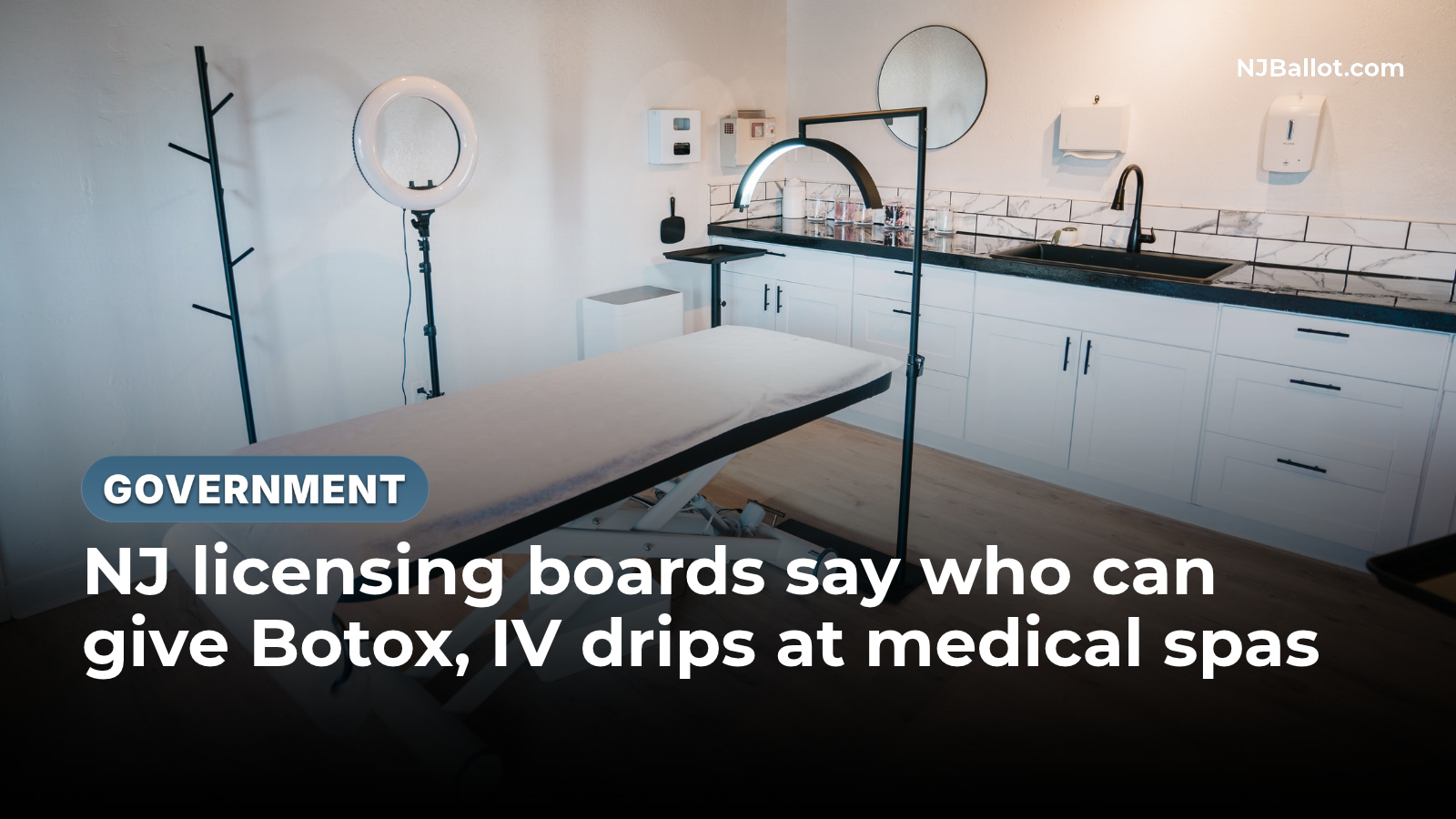

The state Division of Consumer Affairs and four licensing boards say Botox, fillers and IV hydration drips are medical care, in guidance announced Friday. A licensed prescriber must examine each customer and order the treatment.
Before a New Jersey medical spa gives a customer Botox, another cosmetic injection or an IV hydration drip, a licensed prescriber must examine that person, according to state guidance announced Friday.
The guidance spells out who may prescribe and give cosmetic injections and IV hydration, what a customer is owed before and after treatment and who may own a medical spa or IV hydration business. It applies existing law to these businesses. New Jersey's guidance notes that Rhode Island, South Carolina, Virginia and Wisconsin have issued similar documents.
The state Division of Consumer Affairs issued it with four state licensing boards: the Board of Medical Examiners, the Board of Nursing, the Board of Pharmacy and the Board of Cosmetology and Hairstyling. The boards put it out because people who own or work at medical spas and IV businesses keep asking them which license covers which treatment and what the law requires of them.
Attorney General Jennifer Davenport and the division announced the guidance together Friday. "This guidance seeks to ensure there is no ambiguity about the rules governing medical services offered in spa-like settings," Davenport said.
Only a prescriber may order Botox and other cosmetic injections
Medical spas, also known as medispas, offer health care services. The guidance's examples are cosmetic procedures, such as injections and laser hair removal, meant to change how a person looks rather than treat an illness, and some medical spas sell IV hydration drips as well.
Botox, Restylane and fillers such as collagen are prescription drugs under the guidance, so a prescriber has to order them. Doctors may, and so may advanced practice nurses and physician assistants who are allowed to write prescriptions, though each may order only what their own training and experience qualify them for.
Doctors, nurses and physician assistants may give the injections. Cosmetologists may not. "A certification or a course certificate of completion does not constitute a license," the boards say. Anyone can check a practitioner's license by name and profession on the state Division of Consumer Affairs' online license lookup.
"A hair removal laser is a medical device and the person using it is performing a medical service," the boards say. The laser belongs in the hands of doctors and other health care providers who have both the license and the training for it.
That leaves out cosmetologists. Electrologists, who remove hair permanently with an electric probe, are left out too. Under the medical board's rule describing their field, an electrologist's license does not reach lasers.
Cosmetologists, skin care specialists and other salon licensees may not offer their services at a place that also gives injections or IV hydration, the guidance says. Their work belongs in a licensed salon or school, and state law makes only a few exceptions, among them hospitals, nursing homes and "other licensed health care facilities."
Every IV drip needs a prescriber's order
IV hydration means fluid dripped into a vein, sometimes with vitamins, minerals or medication added. Medical spas and stand-alone IV businesses sell these drips, and some bring them to customers in mobile units.
Any IV fluid is a prescription drug, even a bag of plain fluid with nothing mixed in, the boards say. Putting in an IV therefore means giving medication, and only a licensed or certified health professional may order one or put one in. The same doctors, advanced practice nurses and physician assistants may prescribe the drips, and doctors, nurses and physician assistants may give them.
A certified medical assistant, someone who finished an accredited medical assisting program and holds a current certification, may also give an IV drip at a doctor's direction. The assistant may do so only while the doctor or another licensed professional who can provide that care is on site the whole time.
Before any treatment, the prescriber must examine the customer and take a health history. "A self-administered questionnaire does not constitute a patient exam," the guidance says.
The prescriber also checks whether anything in the person's health rules the treatment out, sometimes with bloodwork, depending on the treatment. The prescriber must then tell the person what the problem is and which treatment the prescriber recommends, along with its upsides, its downsides and what happens without it.
Customers may not "self-prescribe" by picking a drip or a mix off a menu; the prescriber decides what fits each person. A group event where everyone gets the same drip is acceptable only if a prescriber at the event examines each person and writes each one a prescription.
Because the treating prescriber decides for one person at a time, a doctor may not issue a blanket standing order for IV drips. Nor may a prescriber use one to hand off the exam, the health check or the consent.
A virtual visit must meet state telehealth rules and include the same exam, health screening and consent, and a prescriber treating someone in New Jersey needs a New Jersey license. The same steps apply in mobile units.
Adding vitamins or another drug to the bag counts as compounding, which falls under state Board of Pharmacy rules. When a business orders a compounded drug from a pharmacy, it must be made for one patient's prescription; the business may not order it in bulk to keep on the shelf.
Once examined and treated, the customer is a patient, and the prescriber has to check on that patient afterward. Every step, from the exam through the follow-up, goes into a medical record that the prescriber keeps and must protect under state and federal law.
Only licensed health professionals may own a medical spa
Existing state law requires licensed health professionals to own a medical practice. Friday's guidance says that rule reaches medical spas and IV businesses too, since what they sell is medical care. A doctor's co-owners may only be professionals licensed by the state's boards in medicine or a "closely allied" health field.
Cosmetology does not count as allied, so an outside investor, a salon owner or a cosmetologist cannot be a co-owner of the medical practice behind a medical spa. The business's medical director must hold a license for every treatment it sells and is responsible for every customer's care.
Nurses and physician assistants cannot own all of a medical spa or IV business, or most of one, because they cannot direct the doctor who signs off on treatment.
That includes the advanced practice nurses who now qualify to practice on their own under a state law approved March 30, 2026, which began as Senate bill S2996. The law still requires them to work with a collaborating doctor for "elective aesthetic or cosmetic services."
Under the guidance, anyone who does health care work without the right license risks a fine, professional discipline, or civil or criminal penalties.
Related Articles
The Four-Day Amendment That Changed New Jersey's Nurse Practitioner Law
What New Jersey Law Says About the Credit Card Surcharge on Your Receipt
Sources
New Jersey Division of Consumer Affairs, "License Verification System," person search page (accessed Nov. 14, 2026)
New Jersey Division of Consumer Affairs, "New Jersey Consumer Affairs Guidance Circular No. 2026-01, Operation of Medical Spas and Intravenous (IV) Therapy Businesses," signed by Acting Director Christopher L. Peterson (Nov. 12, 2026)
New Jersey Legislature, Bill No. S2996, "Eliminates certain practice restrictions for advanced practice nurses," Senate Committee Substitute, sponsored by Senator Joseph F. Vitale, Senator Troy Singleton, Assemblyman William W. Spearman, Assemblywoman Katie Brennan and Assemblywoman Annette Quijano, 222nd Legislature (March 19, 2026)
New Jersey Legislature, New Jersey Statutes, N.J.S.A. 45:5B-8, "Premises exceptions" (accessed Nov. 15, 2026)
New Jersey Legislature, P.L.2026, c.6, "An Act concerning advanced practice nurses, revising various parts of the statutory law, and supplementing P.L.1991, c.377 (C.45:11-45 et al.)" (March 30, 2026)
New Jersey Office of the Attorney General, press release, "AG Davenport and the Division of Consumer Affairs Announce Guidance Clarifying Rules for Owning and Operating Medispas in New Jersey" (Nov. 13, 2026)
New Jersey State Board of Medical Examiners, N.J.A.C. 13:35-12.2, "Definitions" (accessed Nov. 14, 2026)
New Jersey State Board of Medical Examiners, N.J.A.C. 13:35-6.4, "Delegation of administration of subcutaneous and intramuscular injections and performance of venipuncture to certified medical assistants" (accessed Nov. 14, 2026)
Photo: Deane Bayas/Pexels