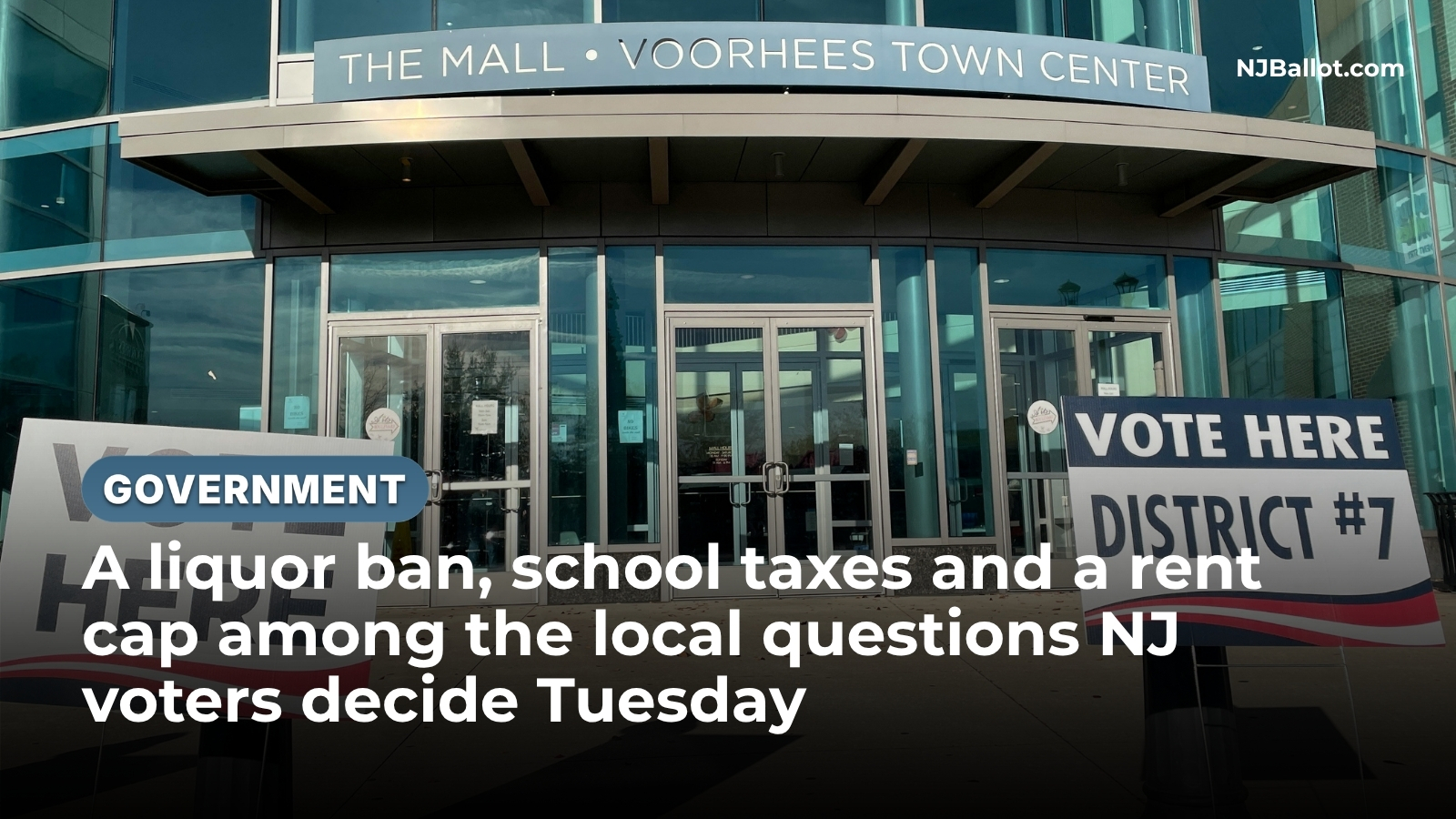

Collingswood voters choose whether bars and restaurants may serve alcohol and whether to permanently raise school taxes by $4.56 million, while voters elsewhere decide on an armed school officer, a rent cap, open space and school construction.
Voters in Collingswood will decide Tuesday whether restaurants and bars may serve alcohol in the Camden County borough, where a ban on alcohol sales has stood since the 19th century.
A separate question on the same ballot asks them to raise the school district's tax levy by $4,560,822 and to make the increase permanent.
Collingswood's two questions are among many local measures on Tuesday's ballots across New Jersey that voters answer directly, according to official county sample ballots and a list of school ballot questions compiled by the New Jersey School Boards Association, the statewide group for school boards. Several of them set property tax bills or determine town rules.
The association counted 13 school districts asking voters to approve construction projects, and its list includes tax levy questions in Oradell, Burlington Township and Collingswood. Lakewood and East Newark ask voters to shrink their school boards from nine members to seven, and a third question would trim Washington Township's board, in Burlington County, from five members to three.
Elizabeth voters decide whether to put a dollar limit on rent increases, and a Camden County question asks for a higher open space tax, the sample ballots show. Polls are open from 6 a.m. to 8 p.m.
A residents' petition put Collingswood's liquor question on the ballot
If most voters say yes, the borough could license bars and restaurants to serve drinks for customers to finish on the spot, "by the glass or other open receptacle," in the words of the question, which appears only on Collingswood's ballot.
State law prescribes that wording and sends it to voters once at least 15 percent of a town's voters, measured against turnout in its last Assembly election, sign a petition.
Organizer Joe Sperlunto said a group of residents called Booze on the Ballot gathered the signatures over three weeks, at the farmers market, outside shops on Haddon Avenue and door to door. The group backed neither a yes nor a no, presenting the petition as a way for residents to settle the matter themselves.
"We've just seen it kicked around a lot for a long time, and we just felt like it was time for the community to make a decision about it," Sperlunto said in August.
Borough officials counted 1,019 valid signatures from recent Collingswood voters, a total that cleared the legal minimum by eight. That left the three-member Board of Commissioners no choice under the law. On Aug. 19, it voted to put the question before voters.
State law allows a town one license for on-site drinking for every 3,000 residents, based on the latest U.S. Census Bureau estimates.
Collingswood has about 14,400 residents and could qualify for as many as four, according to published reports.
At a commissioners meeting this year, the borough's solicitor, Caitlin Harney Norcia, laid out two ways to hand out licenses if voters allow them. Selling them to the highest bidder would bring the borough a one-time sum, while a review process would require would-be license holders to pitch their plans publicly and pay a fee every year. By her estimate, those yearly fees could total $1,000 to $10,000.
Restaurants where diners bring their own alcohol could keep operating if the borough issues licenses, Mayor Daniela Solano-Ward said.
Some owners fear Collingswood's own restaurants could lose to higher bidders in an open auction for licenses, according to Borough Administrator Cassandra Duffey. She said the borough would aim to protect its current businesses and avoid steps that would "disrupt the balance."
Local lore holds that the liquor ban was a condition of the 1888 dedication of Knight Park, the nearly 70-acre park at the center of the borough. In that telling, the land would go to developers if the borough ever allowed alcohol sales.
"It's an old wives tale," Duffey told The Philadelphia Inquirer this summer. "There is no relationship between Knight Park and liquor licenses."
If the question passes, state law directs the municipal clerk to notify state liquor regulators and any local licensing board, and the borough may then begin issuing licenses. Whatever the result, the same law keeps the question off Collingswood's ballot for five years.
Collingswood's school board asks for a permanent tax increase
The school question asks voters to let the Collingswood Board of Education raise an extra $4,560,822 in property taxes for the 2027-2028 school year. The money would keep staffing, programs and facilities at current levels and support student services, according to the sample ballot.
The increase would be permanent, the ballot's own statement says, and the extra sum would stay in the district's yearly tax levy instead of ending after one year. A no vote means the district cannot raise that money through this question.
The owner of a home assessed at $448,000, the borough average, would pay $1,324 more a year, according to a published estimate.
One resident who opposes the question argued against it in a letter to a local weekly newspaper, faulting the district for what it spends on administration.
The money would bring down class sizes, keep teachers and programs and cover daily operations, Superintendent Fred McDowell said. Once the state releases school aid figures next February, the district could face another shortfall of $2 million to $4 million, he said.
To close a $3.3 million deficit this school year, the district shut James Garfield Elementary, its second oldest school building, according to published reports. It also cut 33 positions and raised property taxes 6.4 percent.
"We've done everything at the local level that we can do in order to address this systemic problem," McDowell said in October. "The funding is no longer there that allows us to do that without devastating additional reductions."
State law caps how much a district's school tax levy can grow each year, starting from a 2 percent increase plus set adjustments. A district may ask voters to go higher, and a simple majority decides. The question has to say what the money pays for and whether the increase is permanent, the law says.
A district can also carry forward unused room under the limit for up to three years, a practice known as banking cap. If voters approve Collingswood's question, the law bars the district from adding that carried-over room to its 2027-2028 levy as well.
Kelly Maia, the school board president, has two children in the district. "We understand this is a huge ask," she said in October. "If we had another option, we would take it."
Two more districts ask voters to pay for a school officer and building repairs
Voters in Oradell, in Bergen County, decide whether to permanently raise their school tax levy by $73,118.42. The money would cover an "armed Special Law Enforcement Officer" at Oradell Public School and a fill-in on days the regular officer misses, according to the question.
The Bordentown Regional School District in Burlington County wants voters to approve an $86,107,900 bond for work at its five schools, with $34,443,160 proposed in state funding, the association's list shows.
Superintendent James Altobello said the projects include replacing leaking roofs and upgrading heating, air conditioning, fire alarm and security systems. If the bond passes, Bordentown Township's average annual tax bill would climb $588, according to published reports. In Bordentown City the increase would be $456, and in Fieldsboro $420.
The state helps repay the debt on approved school building projects each year, covering at least 40 percent of eligible costs under the school construction law the state passed in 2000, according to the school boards association.
A defeat would leave the district paying for the repairs from its regular operating budget over a span of years, with no state money, Altobello said. "The work doesn't go away," he said in October.
Camden County seeks more open space money, and Elizabeth votes on a rent cap
The Camden County question would raise the levy for the county's open space and preservation trust fund to 3 cents per $100 of equalized property value, with a public audit every year. The rate now stands at 2 cents.
The levy would cost the average Camden County homeowner $1.83 a month, according to the ballot's explanatory statement. The statement lists uses such as protecting the Cooper River's water quality and restoring wetlands that help prevent flooding.
In Elizabeth, the question would amend the city's rent control ordinance, according to the Union County sample ballot. No landlord could raise base rent by more than 3 percent or $20 over the prior year, whichever is less. The city had a dollar cap in 2022 until the City Council amended the ordinance, the ballot's statement says.
The cap would apply to rent-controlled apartments. In Elizabeth, apartment buildings of three or more units come under rent control once they are 30 years old, according to published reports.
Residents petitioned to put the question on the ballot, and 13 landlords sued to keep it off. Under New Jersey law, rent control must still leave landlords a "just and reasonable return." In July, Union County Superior Court Judge John M. Deitch dismissed the suit, ruling that the landlords offered no proof the cap would drop their return below that standard.
The landlords argued the limit would cut so deeply into what their buildings earn that it would violate the Fifth Amendment's protection of private property. "This proposed dollar cap is inconsistent with every other rent control ordinance in the state," their attorneys wrote in court filings.
Renée Steinhagen, executive director of the New Jersey Appleseed Public Interest Law Center, represented the petitioners. "If the landlords disagree with the policy and think they should be able to raise rents even more, they can make their case directly to voters," she said in July.
The landlords appealed in August, and a state appeals court refused their request to put the ruling on hold, according to a Rutgers Law School clinic that filed a brief supporting the petitioners.
If Elizabeth voters approve the question, the cap becomes binding city law. Under state law, the City Council could not amend or repeal it on its own for three years. Any change in that time would have to go before voters at a later general or municipal election.
Related Articles
NJ School Funding Review Reaches South Jersey as Premiums, Tax Caps Squeeze District Budgets
NJ early voting starts Saturday: What to know for the Nov. 3 election
Sources
Brodner, Curtis, Jersey Vindicator, "Elizabeth voters will decide on $20 per month rent cap after judge rejects landlords' lawsuit" (July 29, 2026)
Burney, Melanie, The Philadelphia Inquirer, "Collingswood voters will decide on a $4.56 million operating bond to keep schools running" (Oct. 30, 2026)
Camden County Clerk, official general election sample ballot, Collingswood Borough, District 1 (accessed Nov. 1, 2026)
Latch, Lacey, The Philadelphia Inquirer, "Voters will have the final say about lifting Collingswood's liquor license ban" (Aug. 19, 2026); "Could Collingswood lose Knight Park if its liquor ban is lifted? We dig into the 'persistent rumor'" (Sept. 1, 2026)
New Jersey Legislature, N.J.S.A. 18A:7F-38, school district tax levy growth limit (accessed Nov. 1, 2026)
New Jersey Legislature, N.J.S.A. 18A:7F-39, voter approval of school tax levy increases above the limit (accessed Nov. 1, 2026)
New Jersey Legislature, N.J.S.A. 33:1-12.14, population limit on retail consumption licenses (accessed Nov. 1, 2026)
New Jersey Legislature, N.J.S.A. 33:1-45, municipal referendum on retail alcoholic beverage sales (accessed Nov. 1, 2026)
New Jersey Legislature, N.J.S.A. 40:69A-196, voter-approved ordinances under the Faulkner Act (accessed Nov. 2, 2026)
New Jersey School Boards Association, "Voters to Decide Proposed Construction Questions and More In November School Board Election" (Oct. 28, 2026)
Retrospect, letter to the editor opposing Collingswood's $4.56 million school question (accessed Nov. 1, 2026)
Rutgers Law School, "Rutgers Law Housing Justice Clinic Wins Amicus Victory in Rent Control Referendum" (accessed Nov. 1, 2026)
Tanenbaum, Michael, PhillyVoice, "Collingswood weighs dropping dry town status to allow liquor sales at restaurants" (June 30, 2026)
Union County Clerk, official general election sample ballot, City of Elizabeth, Ward 1 (accessed Nov. 1, 2026)
Photo: Ernie Journeys/Unsplash