
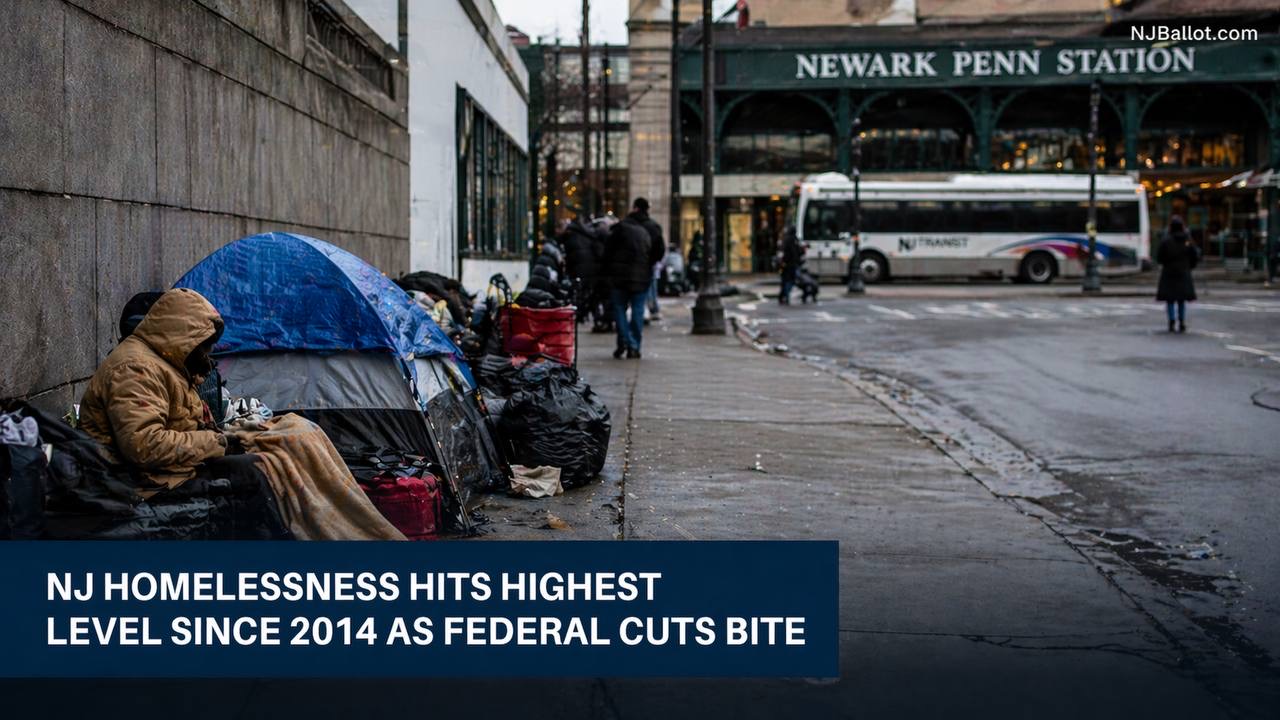

The 2025 count found 13,748 people homeless in New Jersey. With Medicaid, SNAP and HUD funding all facing cuts, counties and hospitals are scrambling to fill the gap before the release of the 2026 count.
NEWARK—At 2 AM on a Tuesday in February, the Essex County overnight program was turning away its sixth person of the night. The count had hit 18 people, 145% of the space's intended capacity. The shelter system statewide has operated at more than 90% capacity daily. This is what 13,748 looks like at the ground level.
That number, from New Jersey's 2025 Point-in-Time count, is the highest since 2014 and an 8% jump over the prior year. New federal guidance used in the 2025 count classified individuals in seated shelter at warming centers as unsheltered for the first time, which contributed to the 14.9% unsheltered increase. The pending results of the 2026 count, conducted in January, will test whether the trajectory holds.
The rise comes as federal policy changes remove stabilization mechanisms that historically prevented housing loss. The federal "One Big Beautiful Bill Act", enacted July 4, 2025, triggered the restructuring. SNAP work requirements enacted in February 2026 now demand 80 hours monthly of work or volunteering, with a three-month limit in any three-year period. The requirements apply for the first time to homeless individuals, veterans aged 55-64 and foster youth transitioning to independence. New Jersey's SNAP enrollment already dropped 38,596 persons (-4.6%) between November 2024 and November 2025, with Essex County showing a 12.3% decline.
Medicaid cuts pose a parallel threat. State and national partners estimate 350,000 residents will lose Medicaid coverage, triggering a $360 million annual state budget cut and a $3.3 billion reduction in hospital funding. The state Department of Health's FY2026 budget cuts Charity Care reimbursement to $61.2 million, down from $650 million a decade ago. Hospitals sued the state, arguing the funding is constitutionally inadequate; the Supreme Court upheld the obligation but not the funding level, leaving a gap that hospitals absorb as bad debt.
Hospital executives dispute claims that facilities are closing due to federal cuts. But national hospital finance data from Kaufman Hall show bad debt and charity care up 8% year-over-year and 40% higher than January 2023, with nearly half of all hospitals posting negative margins.
George Helmy, executive vice president at RWJBarnabas, said five hospitals on an advocacy group's "at-risk" list "will continue to operate normally for the foreseeable future." Mary McGeever, a Hackensack Meridian spokeswoman, noted a $50 million emergency department renovation at Palisades Medical Center demonstrates the system "is not just remaining open — it is growing and enhancing its services." Heights University Hospital in Jersey City closed its emergency room on March 14, 2026, after years of financial losses. The owner projected $30 million in ER losses for 2026 and withdrew its application for full closure in April, leaving the facility's status unresolved.
The HUD Continuum of Care funding crisis adds housing pressure. Lawsuits, including one filed by then-state Attorney General Matthew Platkin, blocked a federal funding notice that would have capped permanent supportive housing at 30% of grants. The state estimated it would lose more than half of $66 million in annual CoC funding, putting 3,000 people at immediate risk of losing housing services. A national survey of 168 CoCs found that 268 grants were lost in the first quarter of 2026 and 492 in the second quarter, with 29,617 permanent supportive housing beds eliminated nationwide.
New Jersey's legislative response has been fragmented rather than comprehensive. The FY2026 budget increased Department of Human Services funding by $58 million (2.4%), but existing child care, SSI and nutrition programs absorbed the growth. The budget also included unprecedented language permitting the department to "pause or terminate" child care subsidy applications if funding proves insufficient, establishing executive discretion for benefit restriction that mirrors federal austerity logic. No bill backfills the Medicaid or SNAP federal cuts. The FY2027 budget proposal, released in April, includes a $25 million homelessness response, new money for shelter and outreach that does not close the federal gap.
A Senate resolution designated November as Homeless Children and Youth Awareness Month, and a bill directs the Department of Community Affairs to end veteran homelessness within three years, but neither includes appropriations. An Assembly bill would require municipalities to participate in sheltering homeless individuals, while a separate bill would create municipal homelessness trust funds through fee surcharges, unfunded mechanisms that counties, already facing a $78 million annual SNAP administrative cost shift, may struggle to implement.
Republican legislative leaders argue the state's $60.7 billion budget, a record high, leaves insufficient room for backfill without tax increases or deeper cuts elsewhere. "Government taking more money isn't the way to make things more affordable," said Senator Declan O'Scanlon, the GOP budget officer. O'Scanlon has also challenged grant cuts to disability services, warning that closing facilities like Cheshire Home in Morris County "might have to destroy some lives."
Homelessness stems from multiple causes; federal cuts act as an accelerant on existing pressures including New Jersey's housing affordability crisis, the opioid crisis, and pandemic-era eviction backlogs. Monmouth County saw the steepest increase in homelessness at 40.2%, far outpacing the statewide average. The state has 31 affordable homes per 100 extremely low-income households and a shortage of 205,000 additional homes.
Camden County is piloting a "master leasing" model that uses local trust funds, supplemented by opioid settlement revenue instead of federal dollars, to house youth and reentering women. The adaptation is limited to specific populations, but may prove necessary if federal housing funding remains unstable.
State enforcement has intensified simultaneously. NJ Transit Police cleared encampments at Newark Penn Station and Trenton Transit Center in February, and NJDOT swept highway corridors in Newark in January. The removals push individuals into the same shelter system that is already over capacity.
This pattern is not unique to New Jersey. Other states are grappling with similar Medicaid restructuring and HUD funding challenges. What happens in Essex County's overnight program is a preview of what happens when federal benefit cuts meet local housing shortages, a collision playing out in real time across the country.
The 2026 Point-in-Time count, anticipated in the coming weeks, will test whether the decade-high mark holds or climbs further. If SNAP enrollment continues declining and HUD funding remains contested, the state's emergency shelter capacity, already strained statewide, may face its most severe test since the Great Recession.
Sources
• Jacquelyn A. Suárez, NJ Department of Human Services, Commissioner Statement (2026)
• NJ Legislature, SJR 115 (March 12, 2026)
• NJ Legislature, FY2026 Appropriations Act, Department of Human Services Budget Analysis (2025)
• NJ Department of Health, FY2026 Budget Analysis (2025)
• NJ Department of Human Services, Monthly Enrollment Reports (November 2024–November 2025)
• NJ Department of Community Affairs and NJ Housing and Mortgage Finance Agency, Budget Documents (2025–2026)
• Matthew Platkin, New Jersey Office of the Attorney General, HUD Continuum of Care Lawsuit Filing (November 25, 2025)
• NJ Department of Health, OPRA Portal (2025–2026)
• NJ Department of Human Services, OPRA Custodian Records (2025–2026)
• U.S. House of Representatives, "One Big Beautiful Bill Act" (July 4, 2025)
• Brett Sholtis, WHYY, "NJ hospitals fear closures as federal funding cuts loom" (April 2026)
• David Matthau, NJ 101.5, "NJ counties face $78M cost for new SNAP work requirements" (February 2026)
• Daily Record, "SNAP Enrollment Coverage" (2025)
• North Jersey, "Christ Hospital Closure Coverage" (March 2026)
• NJ Monitor, "New Jersey could lose more than half of $66 million in annual homeless funding" (2025)
• NJ Spotlight, "N.J. child care subsidy enrollment freeze leaves thousands in limbo" (2026)
• Newsweek, "Trump Admin Guts Homeless Services, 30,000 Housing Beds Lost" (2026)
• Shelterforce, "Camden County's Master Leasing Model" (2026)
• Andrea Hetling, Rutgers Bloustein School, "Research on SNAP Work Requirements" (2026)
• Brookings Institution/Hamilton Project, "Analysis of SNAP Work Requirements" (2026)
• National Low Income Housing Coalition, "The Gap: A Shortage of Affordable Homes" (2025)
• National Alliance to End Homelessness, CoC Grant Loss Survey (2026)
• Katelyn Ravensbergen, Monarch Housing Associates, "NJ Counts 2025: New Jersey Point-in-Time Count" (2025)
• Kaufman Hall, "National Hospital Flash Report: January 2026" (January 2026)
• Public Citizen, "12 New Jersey Hospitals at Risk of Closure" (April 2026)
• Robert Jakubowski, Camden County, "Homeless Trust Fund Master Leasing Program" (2026)
• NJ Transit Police, "Encampment Clearance Operations" (February 2026)
• NJ Department of Transportation, "Highway Encampment Sweeps" (January 2026)