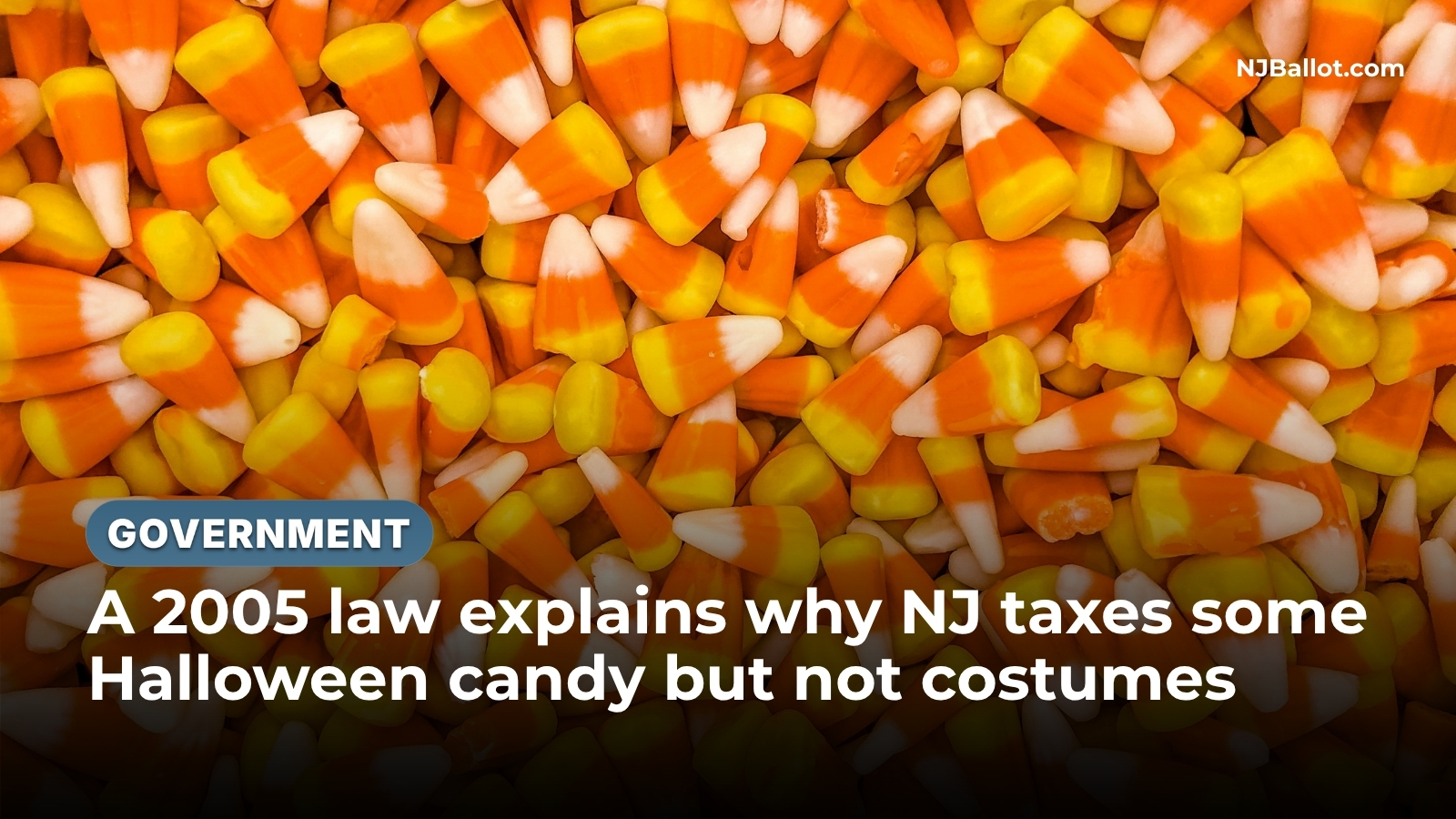

The sales tax rules that a Halloween shopper runs into come from general product definitions New Jersey adopted in 2005 under a multistate agreement, which is why flour on a label can make a candy bar count as grocery food.
New Jersey shoppers will pay the state's 6.625 percent sales tax on some Halloween candy this weekend but not on a costume, under definitions the state wrote into its tax law in 2005 to join a multistate agreement.
But not everything in the candy aisle counts as candy under those definitions. State law leaves out any product with flour among its ingredients or one that requires refrigeration, and it treats those items as grocery food, which New Jersey generally exempts.
That line comes from the Streamlined Sales and Use Tax Agreement, an interstate agreement which coordinates product definitions across member states. The agreement means that retailers who sell in many states can work from one set of terms. New Jersey and other states kept the choice of which categories to tax. Its version took effect Oct. 1, 2005, according to a Division of Taxation notice from that fall.
A 2005 law moved some candy bars and every adult costume off the tax list
Then-Assemblyman Louis D. Greenwald (D, 6th District) introduced the bill Nov. 4, 2004, with then-Assemblywoman Bonnie Watson Coleman (D, 15th), now a member of Congress. Then-Assemblyman Upendra J. Chivukula (D, 17th) was the third sponsor. It became law July 2, 2005.
New Jersey had taken part in the multistate talks since 2001, the Assembly Budget Committee wrote in a June 29, 2005, statement on the bill. By the committee's count, 42 states and the District of Columbia were part of the effort that year.
In 2005, sellers with no physical presence in a state did not have to collect its tax, the committee noted, so the agreement offered them a simpler way to collect it voluntarily. New Jersey has required larger out-of-state sellers to collect since November 2018, according to the Streamlined Sales Tax Governing Board, which runs the agreement.
In its June 2005 statement, the committee listed flour-heavy snack foods, then taxed as candy, among the items that the bill's definitions would move into tax-free grocery food. It counted that change among several the bill made and estimated that, taken together, they would be "revenue neutral."
Officials at the New Jersey Department of the Treasury offered a separate estimate in testimony, tied only to a one-time offer in the bill to forgive past unpaid tax for out-of-state and online sellers that agreed to charge New Jersey sales tax on their sales to New Jersey customers. They put the added sales and use tax collections from it at $40 million a year, the committee reported.
Before Oct. 1, 2005, the sales tax law itself taxed candy and confectionery without defining either term, the bill's text shows. The flour test arrived with the 2005 law.
In its notice on the change, the Division said products it had taxed as candy would become tax-free under the flour test, and it pointed to Twizzlers licorice, Milky Ways and Twix bars.
Adult costumes went tax-free the same day. Until then, the state exempted children's costumes but taxed adult costumes, bought or rented, according to the Division's notice on the clothing exemption. The 2005 definition of clothing set no age line, the Division explained, so every costume, sold or rented, became exempt.
The 2005 rules still decide what a shopper pays
A follow-up measure approved in December 2008 left the treatment of candy and costumes where the 2005 law had put it.
Under the Division's 2013 bulletin on food and candy, the word flour has to appear on the ingredient list, and any kind of flour counts. The bulletin's examples of products the Division did not tax as candy for that reason included Nestle Crunch, KitKat and Tootsie Roll. The refrigeration exception applies when a product's label requires refrigeration, and the bulletin's example is a frozen ice cream bar.
For a variety bag of individually wrapped treats, the bulletin sets a separate test. If the label lists each kind's ingredients separately, the bag goes untaxed when more than half of its pieces are food rather than candy. A combined ingredient list makes the whole bag candy unless the seller can show candy is half or less.
On costumes, the Division's sales tax guide, last revised in July 2022, still lists costumes for adults and children as tax-free clothing. It classes wigs and makeup as accessories, which carry the tax, and it taxes a costume mask sold as a separate item, even when bought in the same purchase as a costume.
The same guide treats a pumpkin bought to eat as tax-free food. A pumpkin bought for decoration is taxable, as are paper and plastic decorations and candles.
A 2008 state guide for farm businesses, which the Division approved, counts admission to a farm's haunted hayride or corn maze as a taxable amusement. It treats a farm's ride out to a pick-your-own field as transportation, which draws no tax.
Member states split on whether to tax candy and clothing
When New Jersey joined the interstate agreement in 2005, the Division of Taxation wrote that "each state remains free to either impose tax or to provide an exemption for all products within a definition."
The states' 2026 filings with the board show where those choices fell. Minnesota and Rhode Island match New Jersey, taxing candy and exempting clothing, though Rhode Island only taxes the part of a clothing item's price above $250. Vermont exempts candy and clothing alike.
Michigan and Washington are among the states that exempt candy and tax clothing. Indiana, Iowa and Wisconsin are among those that tax both while exempting grocery food.
In an Aug. 3, 2026, letter, the Division told the board that nothing in New Jersey's law or rules had changed over the past year that could affect its compliance with the agreement.
A Senate bill would widen the tax on candy and bakery items
State Sen. Angela V. McKnight (D, 31st) introduced a bill in March that would strike the flour and refrigeration exceptions from the candy definition. Candy made with flour would then count as taxable candy again, the bill's text shows.
The same bill would make bakery items with 30 or more grams of sugar, such as cookies and muffins, subject to the sales tax, while those with less would stay exempt, according to the bill.
It would also create a Children's Health Promotion Fund and steer into it the tax collected on those bakery items and on candy and soft drinks with 30 or more grams of sugar. The bill's statement says the money would pay for programs aimed at getting healthy food and drinks to low-income children, among other uses.
The Senate referred the bill to its Health, Human Services and Senior Citizens Committee on March 12, and the Legislature's record lists no action since. Bills with the same title and the same change to the candy definition have been introduced since 2014, and none has become law.
For items the rules don't name, the Division's sales tax guide says its lists of taxable and exempt goods are not complete and points shoppers who are unsure to the Division itself.
Related Articles
Mischief Night and Halloween curfews in NJ are a town-by-town call
Sources
New Jersey Department of Agriculture, "Farming and New Jersey Sales and Use Tax" (Sept. 3, 2008)
New Jersey Division of Taxation, "New Jersey Enacts Streamlined Sales and Use Tax Agreement Legislation" (Oct. 18, 2005)
New Jersey Division of Taxation, "New Jersey Sales Tax Guide," Tax Topic Bulletin S&U-4 (July 2022)
New Jersey Division of Taxation, "Sales and Use Tax Exemption for Clothing under the Streamlined Sales and Use Tax Law" (Sept. 1, 2006)
New Jersey Division of Taxation, "Sales of Food and Food Ingredients, Candy, Dietary Supplements, and Soft Drinks Sold by a Grocery Store," Technical Bulletin TB-70 (May 13, 2013)
New Jersey Division of Taxation, streamlined sales tax compliance recertification letter to the Streamlined Sales Tax Governing Board (Aug. 3, 2026)
New Jersey Legislature, Assembly Budget Committee, statement to the Assembly Committee Substitute for Bill No. A3473 (June 29, 2005)
New Jersey Legislature, Bill No. A3473, "Conforms the sales and use tax to the Streamlined Sales and Use Tax Agreement to provide for entry therein" (Nov. 4, 2004)
New Jersey Legislature, Bill No. A3826, "Establishes Children's Health Promotion Fund" (Oct. 16, 2014)
New Jersey Legislature, Bill No. S3899, "Establishes Children's Health Promotion Fund" (March 12, 2026)
New Jersey Legislature, N.J.S.A. 54:32B-8.2, sales tax exemption for food and the candy definition, as amended (accessed Oct. 30, 2026)
New Jersey Legislature, P.L.2005, c.126, streamlined sales and use tax law (July 2, 2005)
New Jersey Legislature, P.L.2008, c.123, law revising the sales and use tax to conform with the Streamlined Sales and Use Tax Agreement (Dec. 19, 2008)
Streamlined Sales Tax Governing Board, member state Taxability Matrices, Library of Definitions, 2026 versions (accessed Oct. 30, 2026)
Streamlined Sales Tax Governing Board, New Jersey state page (accessed Oct. 30, 2026)
Photo: Mary Jane Duford / Unsplash