
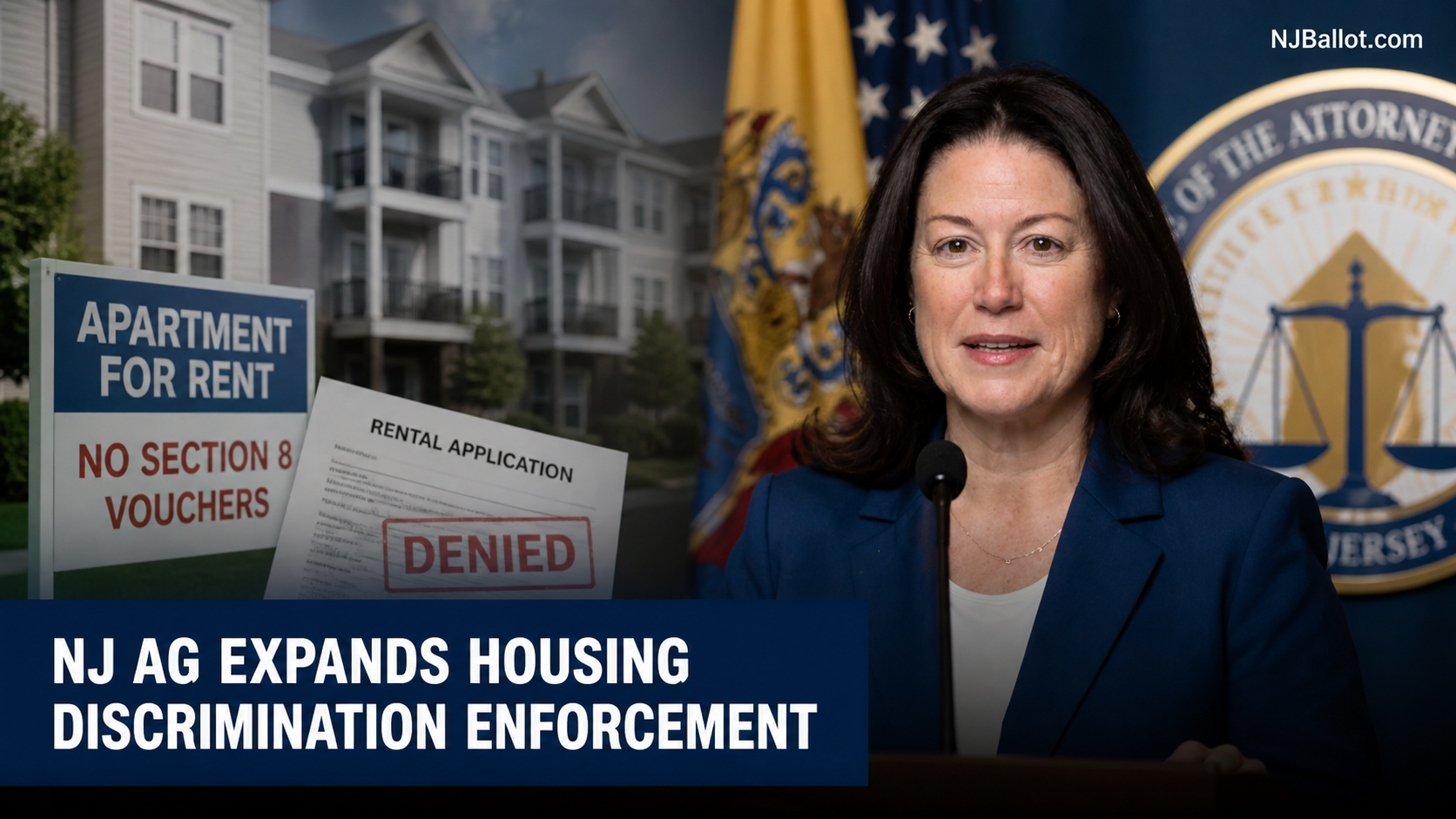

Davenport bundles Fair Chance Act violations, source-of-income findings, and mortgage redlining continuation in first major housing enforcement announcement since February confirmation
TRENTON, N.J — New Jersey landlords in nine municipalities refused to rent to applicants with criminal records. Housing providers in six cities rejected tenants who pay with Section 8 vouchers. A Philadelphia-area mortgage lender continues operating under an $18.4 million redlining settlement that federal regulators abandoned last year.
Attorney General Jennifer Davenport announced 14 Fair Chance in Housing Act violations and 11 source-of-income probable cause findings on April 28. The action marks her first major housing discrimination action since the Senate confirmed her February 24.
The Attorney General's office said first-time penalties under the Fair Chance in Housing Act can reach $1,000 but did not disclose individual amounts. Under DCR regulations, conciliation agreements are generally available to the public unless both parties agree to confidentiality and the Attorney General determines disclosure is not required to further the purposes of the law.
Davenport took office in January as acting attorney general after Matthew Platkin left office and subsequently founded Platkin LLP, a private litigation firm. On February 10, 2025, Platkin announced 20 source-of-income cases, including 15 findings of probable cause and 5 consent decrees, in a similar enforcement push. Davenport's April announcement expands the category mix and adds the redlining continuation.
The Fair Chance in Housing Act, signed by Former Governor Phil Murphy in 2021, bars landlords from asking about criminal history on initial rental applications.
Davenport's 14 Fair Chance violations involve properties in Blackwood, East Orange, Lakewood, Mays Landing, Newark, New Brunswick, Rahway, Somerset, and Williamstown. Her 11 source-of-income findings involve East Orange, Hackensack, Jersey City, Newark, Paterson, and Tuckerton. Seven of the income complaints came from the Housing Rights Initiative, a nonprofit that uses undercover testers posing as voucher holders.
HRI is a nonprofit housing watchdog organization that files testing-based complaints in multiple states. The group was founded in 2016 by Aaron Carr, a former chief of staff to New York State Assemblymember Michael Blake. HRI now operates in five states and maintains six full-time staffers led by Carr as executive director. Carr earned $146,923 in the fiscal year ending February 2024, records show.
Carr has publicly framed his work in partisan terms. On January 20, 2025, after President Trump's inauguration, Carr said in a statement accompanying HRI's Illinois enforcement filing: "Today is the day where an unscrupulous landlord gets inaugurated into the White House. Let this historic filing send an important message to every real estate player: no matter how empowered you feel over the next four years, you will be held accountable to the law. Break the law and it will not be a question of whether you get caught, but when.”
As of April 29, no public statements from landlord associations had been reported by outlets covering the announcement. The New Jersey Apartment Association and New Jersey Realtors did not respond to requests for comment from NJ Globe or WRNJ.
Yolanda N. Melville, director of the Division on Civil Rights, said the enforcement reflects a commitment to civil rights protections. "Many New Jerseyans rely on rental assistance programs like Section 8 to acquire affordable housing. Having a history with the criminal legal system cannot automatically bar you from having fair access to housing. And race should never be a determining factor of whether someone can get a mortgage," Melville said. "We are committed to enforcing the protections offered by our civil rights laws because safe, affordable housing is a necessity, not a privilege.”
Acting Consumer Affairs Director Jeremy Hollander, whose division will enforce a separate $50 rental application fee cap taking effect May 1, said his office will begin enforcing the caps as soon as the law takes effect. Davenport said "dishonest landlords" who use application fees to extract money from applicants they know cannot qualify will face the consequences. The fee cap guidance, issued on April 13, is legally distinct from the discrimination matters but operationally adjacent: both target housing affordability barriers within a 15-day window.
HUD's September 2025 directive withdrawing fair housing guidance and threatening to withhold Fair Housing Assistance Program funding from states preceded Davenport's April enforcement. The U.S. Department of Housing and Urban Development issued memos that month targeting state-level protections covering sexual orientation, gender identity, criminal record, source of income, and English proficiency. Davenport joined 15 other attorneys general in a March 16 lawsuit challenging the withdrawal. HUD has not publicly responded to the lawsuit as of April 29.
The NJOAG's April 28 release explicitly framed the enforcement blitz as a state response to federal inaction. "New Jersey is stepping up to protect its residents from housing discrimination even where the federal government has stepped back," the release said. It also noted that "the U.S. Department of Justice and Consumer Financial Protection Bureau declined to protect prospective homebuyers from redlining."
In mortgage lending, Trident Mortgage Company and Fox & Roach reached an $18.4 million settlement in 2022 for allegedly redlining majority-Black neighborhoods in Philadelphia. Federal regulators terminated the related consent order in 2025. New Jersey, a party to the original settlement, is now enforcing the amended agreement alongside Pennsylvania and Delaware. The agreement runs through 2027.
Davenport also fights parallel domestic litigation against affordable housing. On February 17, she personally signed a brief defending New Jersey's 2024 affordable housing law against a challenge by the Borough of Montvale and other municipalities.
Federal voucher values, set by HUD, may lag behind market rents that state enforcement cannot alter. Federal Fair Market Rent data for fiscal year 2026 sets the Newark metro two-bedroom standard at $2,205 and Jersey City at $2,763. Section 8 voucher payment standards tie to these federal figures. If market rents exceed voucher values, voucher holders face effective exclusion, even without explicit landlord refusal.
The Division on Civil Rights operates under a conciliation process. Complaints trigger investigation for probable cause. If probable cause is found, parties enter conciliation for voluntary settlement. If no settlement is reached, the case advances to an administrative hearing before a New Jersey Office of Administrative Law judge. Either party may appeal to the Superior Court. Complainants may bypass DCR and file directly in state court within two years.
NJ Citizen Action, a separate nonprofit from HRI, is also hiring fair housing testers in New Jersey, according to a January posting. The organization held training on January 21. Multiple testing nonprofits filing complaints indicates the enforcement drive is not monopolized by a single organization.
Fourteen states and the District of Columbia have source-of-income discrimination laws, according to national compliance guidance published May 1.
Davenport's office has not set hearing dates for any of the 25 new matters. The Division on Civil Rights conciliation process can stretch for months before an administrative law judge sees the file. Meanwhile the $50 rental application fee cap takes effect May 1, and HUD's fair market rent figures for 2026 remain fixed. The state can fine landlords who ask about criminal records on page one of an application. It cannot raise the federal voucher values that determine whether a tenant can afford the rent once the contract is signed.
Sources
• NJ Office of Attorney General, statement, (April 28, 2026)
• Zach Blackburn, NJ Globe, "Davenport says AG's office, Civil Rights Division will refocus on enforcing housing discrimination laws" (April 28, 2026)
• WRNJ Radio, "NJ attorney general renews housing discrimination enforcement, details actions on criminal history, income and redlining" (April 29, 2026)
• NJ Office of Attorney General, guidance memorandum, (April 13, 2026)
• NJ Office of Attorney General, statement, (February 10, 2025)
• NJB Magazine, "Former AG Platkin Launches Platkin LLP" (February 13, 2026)
• PRF Law, "Housing Watchdog HRI Files Fair Housing Complaints" (January 20, 2025)
• Thomas Breen, UConn Magazine, "Aaron Carr is Holding Landlords Accountable" (June 15, 2023)
• WestView News, "VID Takes on Law-Breaking Landlords" (October 8, 2017)
• MYD NYC, "Meet the Honorees: Aaron Carr" (August 15, 2019)
• City & State NY, "The 2021 Real Estate Power 100" (March 22, 2021)
• The Habitat Group, "How to Comply with Laws Banning Discrimination Based on Source of Income" (May 1, 2026)
• NJ Department of the Treasury, HUD Fair Market Rent data, fiscal year 2026
• Stateline, "Lawsuit says HUD directive undercuts states" (March 16, 2026)
• NLIHC, "HUD Publishes Notice Removing Fair Housing Guidance Documents" (April 13, 2026)
• U.S. Department of Housing and Urban Development, memorandum, (September 17, 2025)
• NJ Division on Civil Rights, administrative regulation N.J.A.C. §13:4-9.2