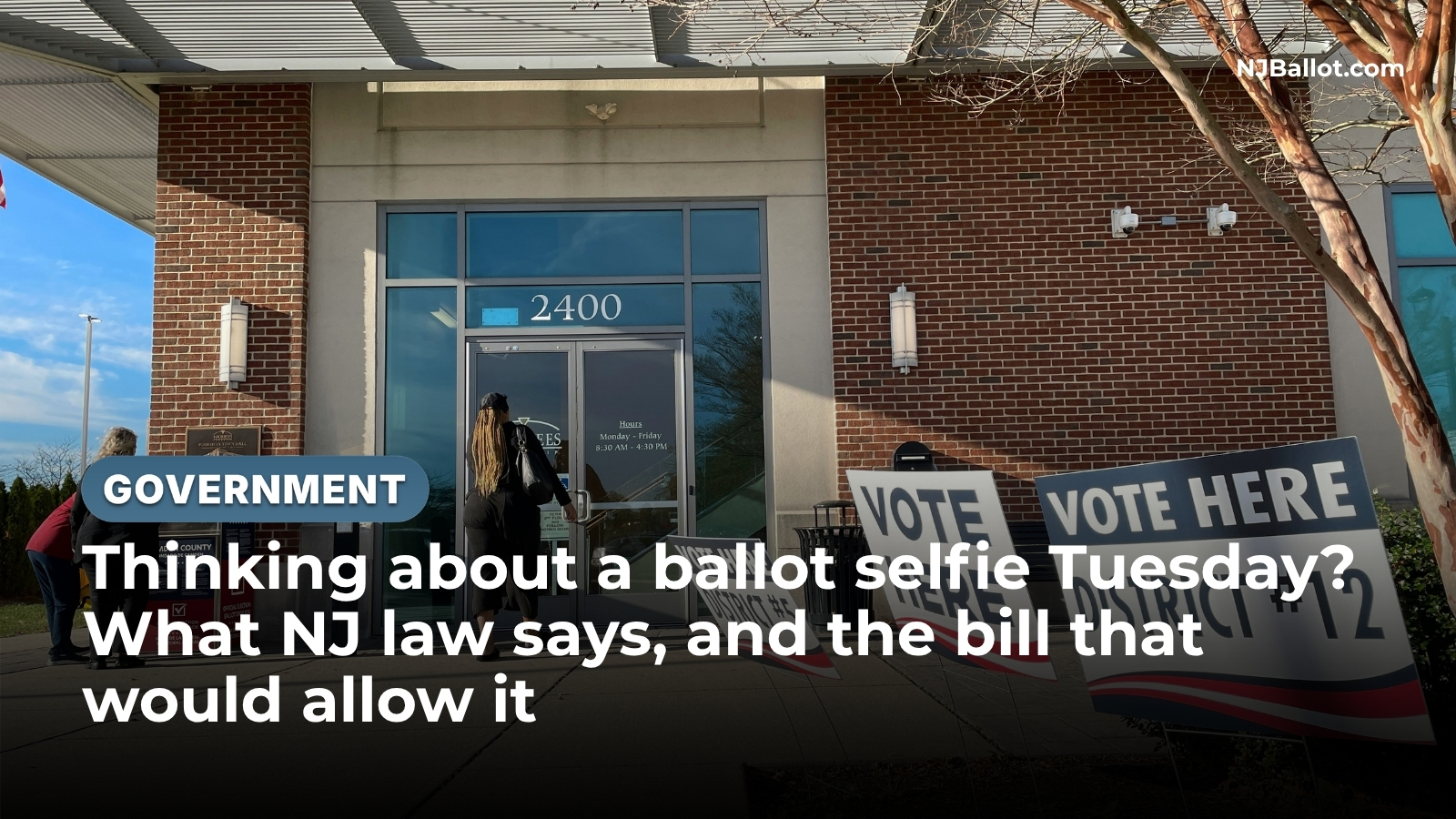

A bill in Trenton would let New Jersey voters photograph their own marked ballots and post the photos on social media, a change lawmakers have proposed in every two-year session since 2016.
Voters heading to the polls Tuesday will mark their ballots under a New Jersey law that says a voter may not "show his ballot" inside the polling room. A bill filed in January would let voters share a picture of their own completed ballot on social media.
Sen. Raj Mukherji (D, 32nd District) has sponsored a version of that bill in every two-year session since 2016, according to the New Jersey Legislature's records. He carried it in the Assembly until he moved to the Senate in 2024. This year, Assemblyman Paul Kanitra (R, 10th) carries the Assembly version.
Every version would add the same sentence to the law, word for word, the bill texts show: an exception for voters who photograph their own marked ballots and share the pictures on social media. The full Assembly passed one of the versions, 74-2, in June 2017.
State law keeps the ballot private inside the polling room
Inside the polling room, a voter may mark a ballot only in the booth and may not "show his ballot," the statute says. The section does not define that phrase.
No one may ask voters to display their ballots while they fill them out. Nor may anyone else look at a voter's ballot in a way that lets them see the choices on it, whether the voter is still marking it or has finished.
"Under current law, a voter is prohibited from showing his or her voted ballot," according to the statement attached to this year's bill. The same statement says the bill "allows voters to photograph their own voted ballots while in a voting booth."
The same section also bars anyone from loitering, campaigning or soliciting voters inside a polling place or within 100 feet of it. A county board of elections may extend the campaigning ban to 200 feet, the current text says.
Breaking any part of the section is a fourth-degree crime, the least serious of the grades of crime in the state's criminal code.
The code sets the range for that grade at a prison term of up to 18 months and a fine of up to $10,000. For someone never before convicted of an offense, the same code tells judges to impose no prison term for a crime below the second degree unless the judge finds prison necessary to protect the public.
Mail-in ballots fall under a separate law. Apart from help the law allows, it bars a mail-in voter from letting anyone else open the ballot, fill it in, look at it or otherwise break the secrecy of the vote.
The ballot-selfie bill would change only the polling-room law, not the mail-in law. Its statement describes photos taken in a voting booth.
This year's bill would add one sentence to the law
This session's versions, Mukherji's S2900 in the Senate and Kanitra's A287 in the Assembly, are identical, the Legislature's records show.
Each would add one sentence to the polling-room law. It says the section "shall not be interpreted to prohibit a voter from voluntarily taking a photograph" of his or her own voted ballot "and sharing that photograph on Internet-based social media." The change would take effect immediately, according to the bill's text.
The bill would not lift the section's other limits. It would still bar asking a voter to show a ballot or looking at someone else's ballot, and it keeps the fourth-degree penalty, the bill's text and statement show.
Lawmakers introduced both bills Jan. 13. The Senate bill went to the Senate Law and Public Safety Committee and the Assembly bill to the Assembly State and Local Government Committee, and the records show no committee vote on either since.
"If someone remembers to vote because they saw one of their friends or colleagues on social media posting a ballot selfie, we ought not to make that a crime," Mukherji, then an Assemblyman, said in 2016.
In 2017, he said nothing showed that ballot photos help anyone buy votes or pressure voters.
The same bill has been filed every session since 2016
Mukherji and other Assembly members introduced the initial bill on Sept. 19, 2016, the Legislature's records show.
The Assembly Judiciary Committee approved it 7-0 on Oct. 13, 2016. The full Assembly passed it 74-2 on June 8, 2017.
The state Senate received it June 12, 2017, and sent it to its State Government, Wagering, Tourism and Historic Preservation Committee. The bill expired there when the two-year legislative session ended in January 2018.
A sponsor who wants another try must refile the bill if both houses have not passed it by the end of the two-year session, according to the Legislature. The new version gets a different number and starts from the beginning of the process.
Mukherji refiled it for the 2018-2019 session. The new version cleared the Assembly State and Local Government Committee 5-0 on Feb. 1, 2018, and expired before a vote of the full Assembly.
Each version filed after that, through the 2024-2025 session, went to a committee and expired without a committee vote.
Federal courts outside New Jersey have split over ballot selfies
In 2016, Mukherji also questioned whether the state's law is constitutional. "At least one federal court has said that it's not. The fact that this is even on the books may not even be legal," he said at the time.
In September 2016, a federal appeals court upheld a trial court's ruling that struck down a New Hampshire law. In 2014, that state had added a ban on taking a photo of a marked ballot and sharing it, with a fine of up to $1,000. New Hampshire's goals of stopping vote buying and voter intimidation, the court said, did not support a limit on speech that broad.
"Ballot selfies have taken on a special communicative value: they both express support for a candidate and communicate that the voter has in fact given his or her vote to that candidate," the appeals court wrote in 2016.
The 2016 opinion noted that New Hampshire's secretary of state, who defended the law, had acknowledged the state had not received a single complaint about bought votes or intimidated voters since at least 1976.
In September 2017, a federal judge in Manhattan upheld New York's law, which makes it a misdemeanor to show a marked ballot to anyone in a way that discloses the voter's choices. Both the voters who sued and the state and city election boards that defended the law agreed that voters who post photos of themselves with their marked ballots on social media, where others can see them, would violate New York's law.
Senior U.S. District Judge P. Kevin Castel reasoned that vote buying and voter intimidation are "very difficult to detect," and that a ballot photo lets a buyer or someone pressuring a voter confirm how the person voted. While that check is possible, he found, laws against vote buying alone are unlikely to stop it, so a ban limited to photos taken to sell a vote would not work.
Neither ruling is binding in New Jersey.
S2900 and A287 can still move during the current two-year session. If the bill does not pass both houses before the session ends, it will expire, and a sponsor would have to file it again.
Related Articles
NJ early voting starts Saturday: What to know for the Nov. 3 election
Governor Sherrill Signs Early Voting Expansion Amid Federal Election Policy Changes
Bergen County Clerk's Settlement Ends Six-Year County Line Ballot Fight
Sources
Gregory, Phil, WHYY, "N.J. may end ban on voting booth selfies" (June 9, 2017)
Matthau, David, NJ 101.5, "Taking a selfie on Election Day in NJ could land you in jail" (Oct. 31, 2016)
New Jersey Legislature, Bill No. A1919, "Permits voter to take photograph of own voted ballot and share it on Internet-based social media" (Jan. 9, 2018)
New Jersey Legislature, Bill No. A2166, "Permits voter to take photograph of own voted ballot and share it on Internet-based social media" (Jan. 14, 2020)
New Jersey Legislature, Bill No. A2378, "Permits voter to take photograph of own voted ballot and share it on Internet-based social media" (Feb. 7, 2022)
New Jersey Legislature, Bill No. A4188, "Permits voter to take photograph of own voted ballot and share it on Internet-based social media" (Sept. 19, 2016); companion Bill No. S2713
New Jersey Legislature, Bill No. S1170, "Permits voter to take photograph of own voted ballot and share it on Internet-based social media" (Jan. 9, 2024); companion Bill No. A2499
New Jersey Legislature, Bill No. S2900, "Permits voter to take photograph of own voted ballot and share it on Internet-based social media" (Jan. 13, 2026); companion Bill No. A287
New Jersey Legislature, Frequently Asked Questions page (accessed Oct. 31, 2026)
New Jersey Legislature, legislative roster (accessed Oct. 31, 2026)
New Jersey Legislature, N.J.S.A. 19:34-7, polling room ballot and electioneering law (accessed Oct. 31, 2026)
New Jersey Legislature, N.J.S.A. 19:63-16, mail-in ballot secrecy law (accessed Oct. 31, 2026)
New Jersey Legislature, N.J.S.A. 2C:1-4, criminal code classes of offenses (accessed Nov. 1, 2026)
New Jersey Legislature, N.J.S.A. 2C:43-3, criminal code fines (accessed Oct. 31, 2026)
New Jersey Legislature, N.J.S.A. 2C:43-6, criminal code prison terms (accessed Oct. 31, 2026)
New Jersey Legislature, N.J.S.A. 2C:44-1, criminal code sentencing presumptions (accessed Oct. 31, 2026)
U.S. Code, 28 U.S.C. 41, "Number and composition of circuits" (accessed Oct. 31, 2026)
U.S. Court of Appeals for the First Circuit, Rideout v. Gardner, No. 15-2021, opinion (Sept. 28, 2016)
U.S. District Court for the Southern District of New York, Silberberg v. Board of Elections of the State of New York, No. 16-cv-8336, memorandum and order (Sept. 28, 2017)
Photo: Ernie Journeys/Unsplash