
S2260 creates new crime protecting providers and out-of-state patients; agencies lack specific guidance for implementation.
TRENTON, N.J. — New Jersey's Democratic-controlled Legislature is one floor vote away from expanding patient and provider protections already among the broadest in the country. The machinery of enforcement is only half-built.
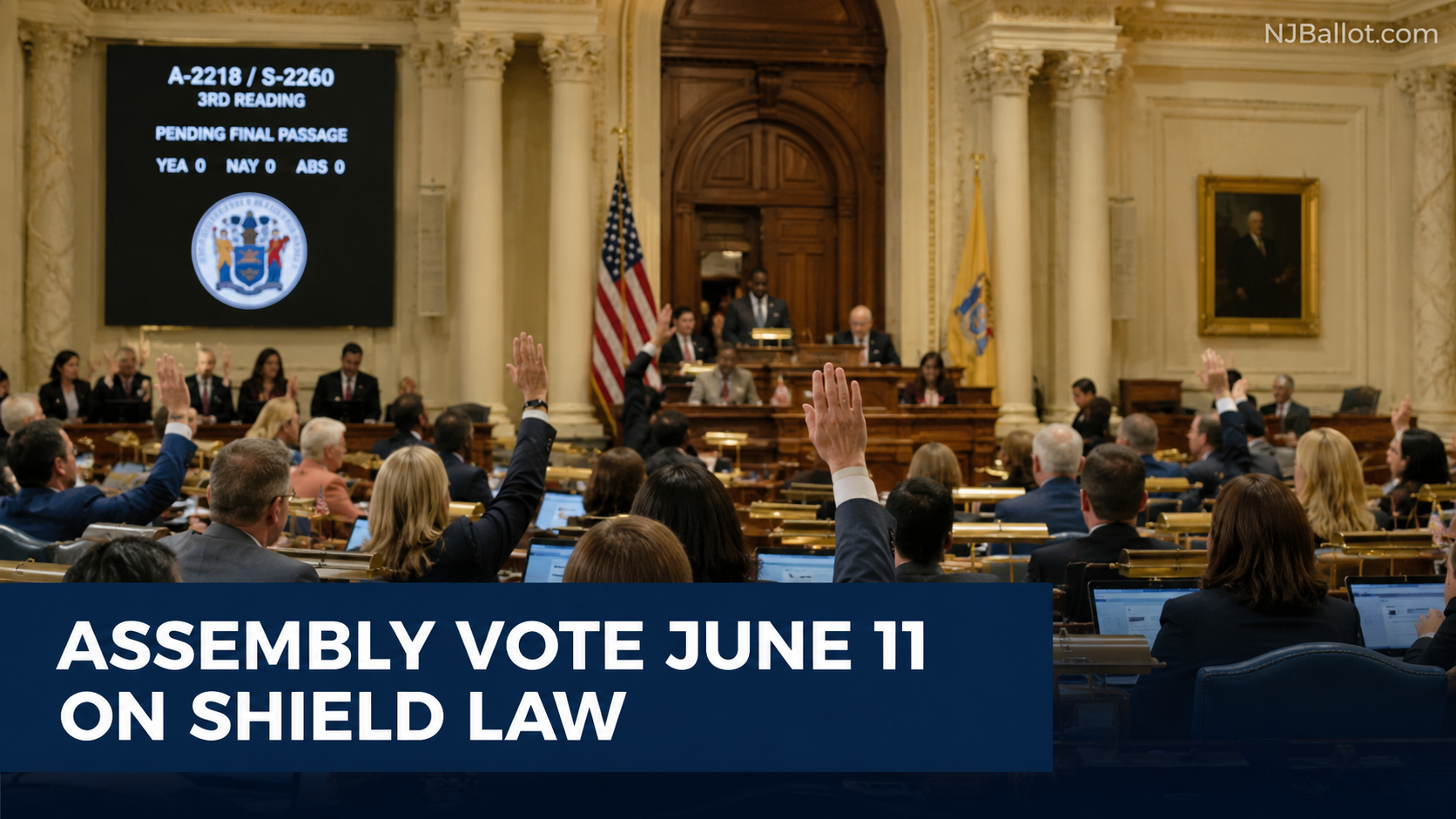
The Assembly will vote June 11 on A2218, the lower-house companion to S2260, which the Senate passed 23-12 on May 28 along party lines. Four senators missed the roll call, two from each party. One Republican abstained.
S2260 creates a new crime—interfering with reproductive health services—carrying up to ten years in prison and a $150,000 fine if someone gets hurt. It explicitly folds gender-affirming care under the "reproductive health services" umbrella and shields out-of-state patients from extradition.
A separate bill, S2257, advanced alongside S2260. S2257 bars malpractice insurers from hiking rates on providers who perform legally protected reproductive or gender-affirming care, requires zero cost-sharing for family planning and reproductive health services across commercial insurance and Medicaid, and preserves religious employer exemptions. The Assembly must pass both bills.
Governor Mikie Sherrill's office has stayed silent during the legislative process. She does not need to speak. Democrats hold a supermajority in the Assembly. Both bills are expected to reach her desk.
What happens after she signs them is where the story gets complicated.
Attorney General Jennifer Davenport assumed office inheriting a strike force her predecessor built. Matthew Platkin created the Reproductive Rights Strike Force immediately after the Dobbs decision overturned Roe v. Wade in 2022. The budget maintains a $5 million line for the Reproductive Rights Strike Force that Davenport now leads.
Platkin's office issued Directive 2025-02 last October, ordering every police department and county prosecutor in the state to classify hospitals and "any other sensitive location" as Critical Locations requiring tactical response plans for violent events. The directive does not name reproductive health clinics. It does not need to. The language is broad enough to sweep them in. Davenport now owns the directive and the strike force.
No training bulletin on the new "interference" crime has surfaced. No prosecutor has announced how she will charge it. The crime exists on paper, but the enforcement manual is blank. Davenport's office has issued no public statement on S2260 enforcement planning. Her silence leaves county prosecutors and municipal departments without direction as the vote approaches.
Republican Senator Jon Bramnick warned the bill's interference language was so broad it could criminalize prayer and speech outside clinics, not just physical obstruction. He also flagged provisions restricting state licensing board powers as legislative overreach. He voted no.
Senator Teresa Ruiz, the Essex Democrat who sponsored S2260, defended the bill as constitutional, citing Supreme Court precedent. She told colleagues she was open to amendments before the Assembly vote but did not specify language.
The opposition knows the enforcement gaps. New Jersey Right to Life issued action alerts before the Senate vote and pivoted to Assembly pressure the day after passage. Their website frames S2260 as "a shield for abortion providers, a threat to free speech." The group claim the bill repeals New Jersey's parental notification law for minors' abortions. New Jersey Right to Life's claim has no statutory basis: courts enjoined the state's parental notification law years ago, and no operative provision exists for S2260 to repeal.
The federal threat is not hypothetical. On April 29, the Supreme Court revived a federal lawsuit against the state, ruling that First Choice Women's Resource Centers, which operates five crisis pregnancy centers in New Jersey, can challenge the Attorney General's subpoena seeking donor and doctor information as a First Amendment violation. That subpoena was issued in 2023; Davenport's office has defended it since taking office in January. The Trump administration backed First Choice. The ruling previews the constitutional terrain that S2260's "interference" crime will face.
Congress is moving on a separate track. In January 2026, Representative Dave Taylor of Ohio and Senator Ashley Moody of Florida introduced the Child Interstate Abortion Notification Act, which would criminalize transporting minors across state lines for abortion without parental notification. The bill faces steep odds in the Senate but signals federal lawmakers' interest in overriding state-level protections for minors seeking abortion across state lines. If it passes, New Jersey's extradition shield would protect providers from state-level surrender but not from FBI warrants. The $5 million strike force budget Davenport now administers does not include a line item for defending New Jersey doctors in federal court.
Assemblywoman Mitchelle Drulis (D-16th) is carrying the bill in the lower house. She serves on the Assembly Health Committee and moved related reproductive health privacy legislation through that panel this session, giving her procedural experience the Assembly vote will test. Speaker announcements and attendance projections for the June 11 rally were not available as of publication.
LGBTQ+ and reproductive rights groups have scheduled a rally at the Statehouse on June 11, the same day as the Assembly voting session. They do not need to pressure many votes. They need to remind the majority party that this bill is a priority. Planned Parenthood Action Fund of New Jersey, Garden State Equality, and the Transgender Resource Center of New Jersey formed the coalition pushing the nine-bill package.
The Division of Consumer Affairs, which oversees every medical licensing board in the state, has issued two alerts in recent months on patient data protection and sensitive examinations. Neither mentions S2260. The bill would restrict those boards from disciplining providers who perform legally protected reproductive or gender-affirming care. No rulemaking has surfaced to reconcile that restriction with the boards' existing statutory duty to protect patients. The Department of Banking and Insurance, which enforces the malpractice rate protections in S2257, has published no guidance on how insurers should comply.
Agencies typically draft enforcement guidance after enactment, not before, but the lag between passage and readiness will test a strike force built for post-Dobbs abortion access defense, not for the expanded shields and new crime classification S2260 creates. All of this—the unfilled enforcement manual, the federal cross-border threat, the licensing board ambiguity, the insurance regulator silence—matters because the Legislature is moving faster than the agencies charged with enforcing its will. Senator Ruiz and her allies wrote laws that assume the state is ready to defend them. The state is not ready yet. It has until the governor signs them to catch up.
Sources
● New Jersey Monitor, "Senate passes bill to protect out-of-state abortion patients, providers," May 29, 2026.
● Rutgers University New Jersey State Policy Lab, "New Jersey Senate Passes Bill to Protect Reproductive and Gender-Affirming Healthcare," June 2, 2026.
● LegiScan, New Jersey Senate Bill 2260, 2026–2027 Regular Session.
● LegiScan, New Jersey Assembly Bill 2218, 2026–2027 Regular Session.
● LegiScan, New Jersey Senate Bill 2257, 2026–2027 Regular Session.
● New Jersey Attorney General Jennifer Davenport, official biography, njoag.gov.
● New Jersey Attorney General Matthew J. Platkin, official biography (historical), njoag.gov.
● New Jersey Attorney General, Law Enforcement Directive 2025-02, October 2025.
● New Jersey Legislature, Fiscal Year 2026 Appropriations Act, Department of Law and Public Safety.
● New Jersey Monitor, "Bipartisan bill would remove State Police from Attorney General's control," June 2025.
● New Jersey Right to Life, action alerts and website framing, May 2026.
● Guttmacher Institute, "Parental Involvement in Minors' Abortions," State Law and Policy Update, May 2026.
● Supreme Court of the United States, First Choice Women's Resource Centers v. Platkin (now State of New Jersey), April 29, 2026.
● Congressman Dave Taylor (R-OH-02), press release, Child Interstate Abortion Notification Act, January 2026.
● Garden State Equality, press release on June 11, 2026 rally and coalition advocacy.
● Planned Parenthood Action Fund of New Jersey, statement on S2260 Senate passage, May 2026.
● New Jersey Division of Consumer Affairs, alerts on patient data protection and sensitive examinations, December 2025–January 2026.
● Williams Institute, UCLA School of Law, "State Shield Laws Protecting Access to Gender-Affirming and Abortion Care," July 2025.
● NJ.com, "New Jersey Attorney General: Who is Jennifer Davenport?," January 2026.