
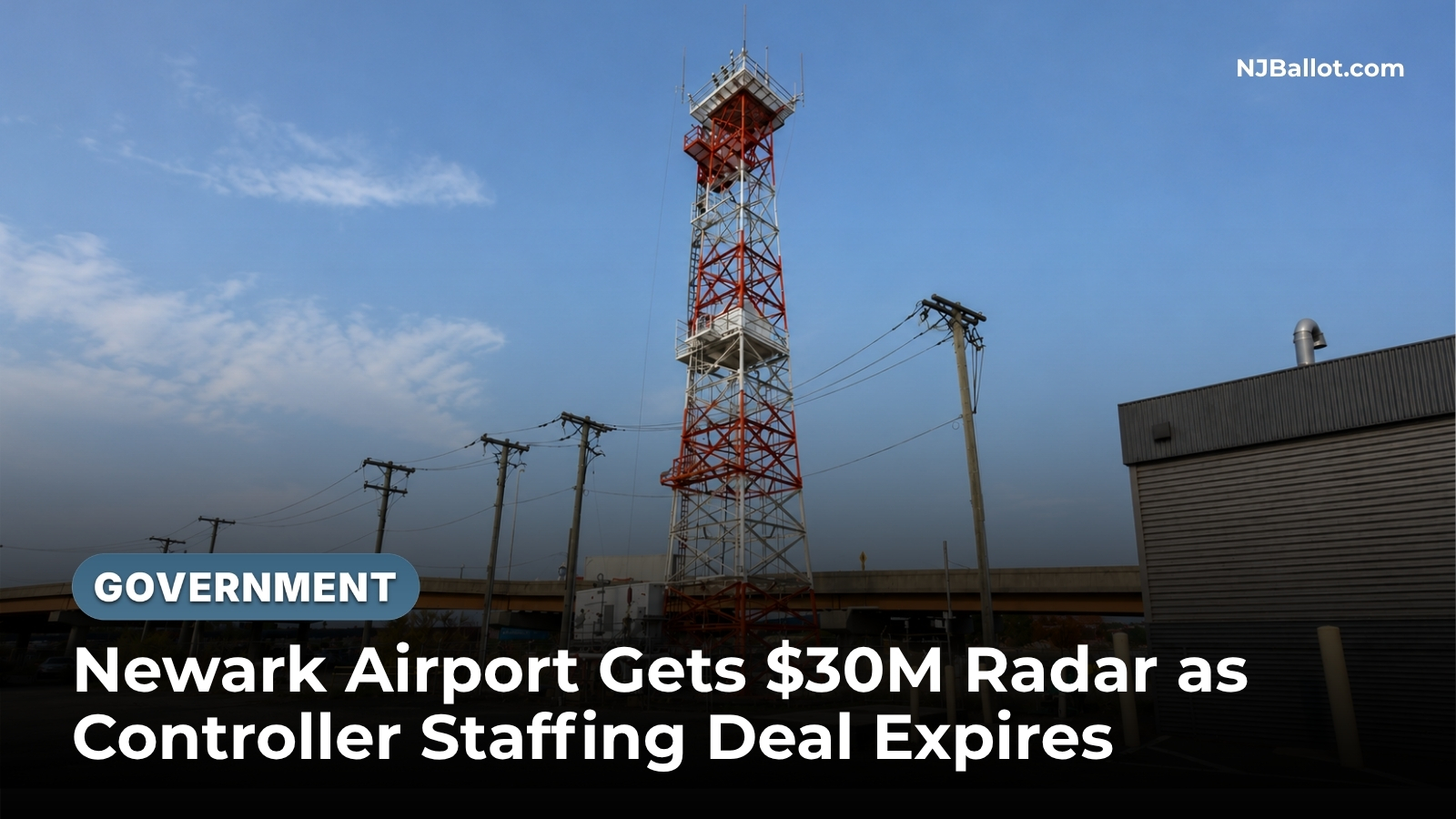

The FAA touted new surface movement technology on Aug. 11, a month after a mandatory relocation agreement expired and sent six Philadelphia TRACON staffers back to Long Island.
U.S. Transportation Secretary Sean P. Duffy stood on the tarmac at Newark Liberty International Airport on August 11 to unveil a $30 million surface radar he called a down payment on safer skies. He did not mention that a mandatory controller relocation agreement had expired the month before, sending six Philadelphia TRACON staffers back to Long Island and deepening the staffing hole the radar cannot fill.
The new gear targets runway incursions — planes or vehicles entering an active runway without clearance. It does not address the airborne failures that have put Newark under federal scrutiny since March, when an Alaska Airlines flight and a FedEx cargo plane nearly collided above the runways while both were attempting to land. Controllers ordered the Alaska pilot to go around.
Six days later an elevator gave off a burning smell that forced controllers out of the tower briefly. The U.S. Federal Aviation Administration confirmed no fire. Neither incident involved ground traffic, but both intensified scrutiny of the agency's oversight at one of the country's most crowded airports.
Duffy had already drawn attention to controller absences before the unveiling. On August 7 controllers called in sick at multiple facilities across the New York-New Jersey region, triggering staffing shortages. Duffy posted on social media that between 40 and 60 percent of controllers in the New York region had called out. He later told reporters he publicized the numbers "because I think it's important that we're transparent with the American people." He left out the lapsed agreement and the six departures.
U.S. Federal Aviation Administration Administrator Bryan Bedford stood with Duffy for the unveiling, alongside Kathryn Garcia, the Port Authority of New York and New Jersey's executive director. Bedford described the old radar in blunt terms. "This is a 30-year-old box: we can't maintain it, they don't build it, they don't supply replacement parts for it," he said.
He noted that a facility in Syracuse, New York, manufactured the new unit, calling the facility a rare onshoring win for federal aviation manufacturing and noting the agency has "brought these jobs back to the U.S., which is a key focus of the secretary and the president." Garcia said the Port Authority will eventually install the radar at LaGuardia Airport and John F. Kennedy International Airport, though she offered no timeline.
Duffy told Fox Business the Surface Movement Radar Model 4 lets controllers see ground traffic on their screens even when weather drops visibility to nothing. "It allows controllers on a dark night, or controllers in bad weather, if they can't see out of the tower and see what's happening on the tarmac, they can actually use this radar to see on their screens where everything is at – airplanes, vehicles – and again, it keeps the American public safer as we use American skies."
Six days after the unveiling the New Jersey Herald reported the details. A two-year deal signed in 2024 moved a dozen controllers from the Long Island TRACON to Philadelphia to help staff Newark's approach control. That deal lapsed in July. Half the relocated controllers went back to Long Island; the other six remained at Philadelphia, according to U.S. Federal Aviation Administration spokesman Chris Mullooly. The facility was already running at 48 percent strength last year while the agreement was still active. Mullooly would not give a current staffing figure.
The radar is one piece of a $12.5 billion nationwide modernization push. Newark's slice is $30 million across three years. At the August 11 press conference Bedford ticked off the other upgrades. The agency has converted 363 radio sites nationwide. At Newark it has swapped most of the copper telecom lines for fiber, which withstands weather that used to sever connections and knock out tower communications. Controllers have moved from paper strips to electronic tracking. The agency is also replacing more than 300 analog radios with digital units across the country.
Bedford said on August 11 that traffic across the country will double to 2 billion passenger movements over the next 20 years, and the agency needs another $10 billion to finish the job. The overhaul includes an $875 million AI contract that went to Boston-based ASI. The National Air Traffic Controllers Association (NATCA), responding to that award, told CBS New York that controllers need involvement in technology development and that humans must retain final authority over aircraft decisions.
The staffing crisis has already forced hard limits. Federal regulators have limited Newark to seventy-two flights per hour through October 30, 2027. The cap exists because approach control for Newark is based in Philadelphia, not at the airport itself. Staffing shortages there triggered the limit after equipment failures in April and May disrupted radar displays, causing controllers to lose track of aircraft during critical handoffs. Some controllers took trauma leave after the incidents.
Airlines have demanded relief from the cap, which has stranded passengers, angered carriers and disrupted schedules across the Northeast. The agency has resisted, saying the limit prevents overload. Newark relies on Philadelphia for approach control, so shortages there affect the entire region.
Philadelphia was already at 48 percent strength last year while the relocation deal was still in force. Long Island sat at roughly 60 percent. When the agreement lapsed in July, half the borrowed controllers went back to Long Island. Philadelphia lost six controllers it had been relying on to cover Newark arrivals. Bedford said the agency has brought on 4,000 controllers nationally, with 1,000 nearing certification, 1,500 still in training and 600 at the academy.
The NATCA, in a May 15, 2026 statement, contested the agency's 2026-2028 Controller Workforce Plan, calling it based on a flawed Transportation Review Board study that produced the staffing crisis. The union stated that it supports increased hiring but argued the agency should reject the study's methodology and restore accurate certified professional controller staffing targets.
The 72 flights per hour cap holds through October 2027, and the agency has not announced a replacement for the controller agreement that expired in July.
Related Articles
• United Jet Strikes Bread Truck on NJ Turnpike During Newark Landing
• Newark Liberty International Faces Back-to-Back Safety Incidents Amid Operational Strain
• After Q1 Layoffs, Q2 Opens With Another Blow: Spirit Airlines Shutdown Hits New Jersey
Sources
• ABC7NY / WABC-TV, "Alaska Airlines flight, FedEx cargo plane nearly collide at Newark airport" (March 19, 2026)
• Associated Press, "A Burning Smell Forces Newark Airport Control Tower Evacuation" (March 23, 2026)
• Tim McNicholas, CBS New York, "Newark Airport getting new safety technology to prevent runway incidents" (August 11, 2026, 6:20 PM EDT)
• Federal Aviation Administration, "Trump's Transportation Secretary Sean P. Duffy Unveils Brand-New Radar as Latest Improvement to Newark Liberty International Airport (EWR)" (August 11, 2026)
• Federal Register, "Operating Limitations at Newark Liberty International Airport" (June 23, 2026)
• Fox Business, "Major US airport getting new tech to prevent runway incidents" (August 11, 2026)
• National Air Traffic Controllers Association, "2026-2028 Controller Workforce Plan Based on Flawed Transportation Review Board Study" (May 15, 2026)
• New Jersey Herald, "Controller Relocation Agreement Expires as FAA Unveils Newark Radar" (August 17, 2026)
• U.S. Department of Transportation, "Trump's Transportation Secretary Sean P. Duffy Unveils Brand-New Radar as Latest Improvement to Newark Liberty International Airport (EWR)" (August 11, 2026)