
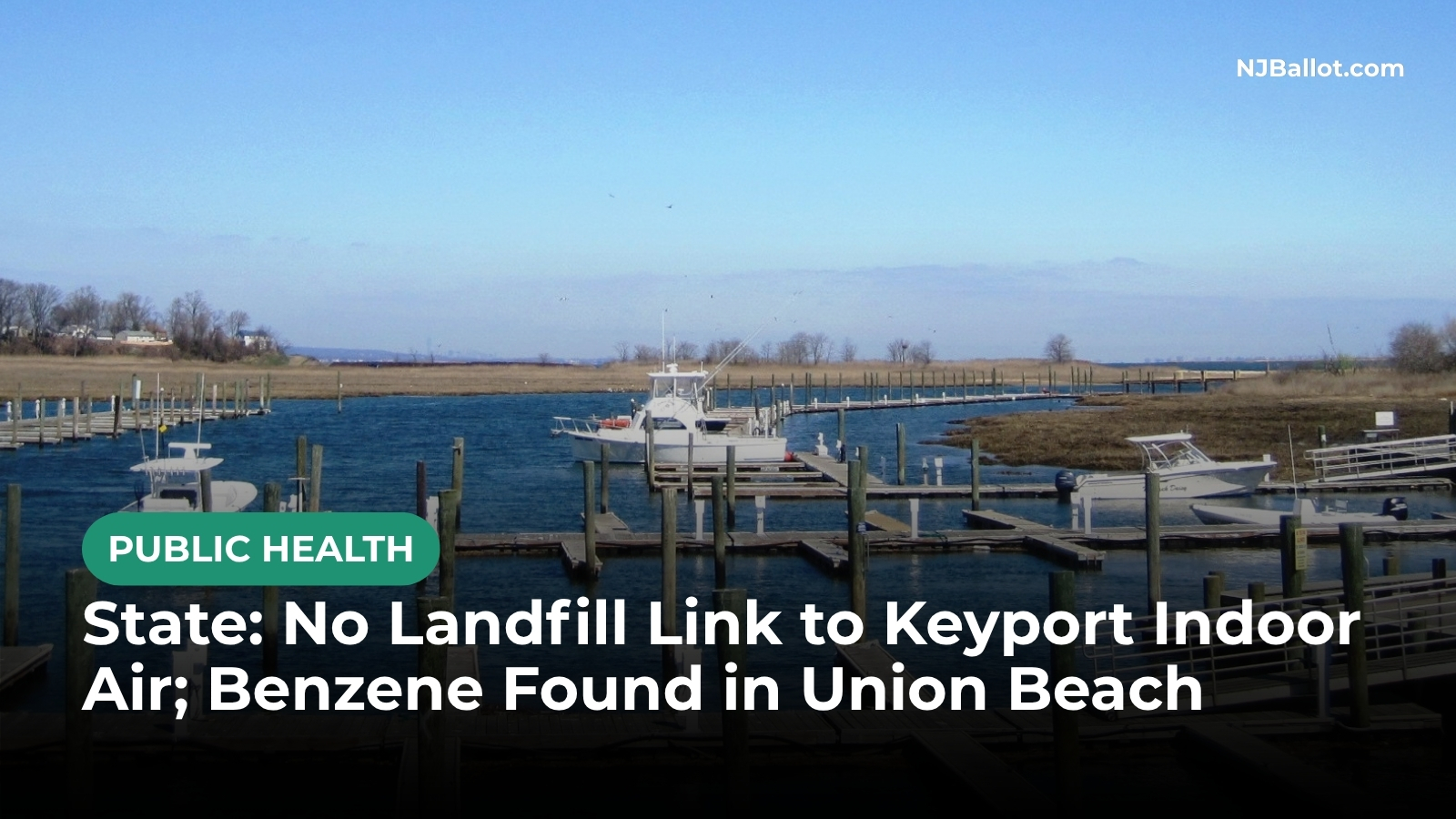

Four months after residents began logging cases, the state's first sampling results drew 250 people to Keyport High School — with more testing promised in nearby Union Beach.
Nearly 500 purple ribbons lined the lawn outside Keyport High School on the evening of September 22, 2026, one for each cancer case residents reported in the blocks around the old Aeromarine landfill.
Inside the gym, more than 250 people sat through nearly four hours of presentations and questions. The New Jersey Department of Environmental Protection brought the first results of its own sampling program: no sign, it told them, that contamination from the landfill or the wider Aeromarine site was reaching people through the air in their homes.
Keyport sits where Chingarora Creek meets Raritan Bay. The old Aeromarine landfill sits at the end of Walnut Street, picket-fenced homes on one side, nearly half a mile of bay shoreline out the back; the Union Beach sampling spots lie just across the creek in neighboring Union Beach. The state has warned against eating fish from these waters since before 1995.
The cancer-case count first reported by NJ.com stood at 41 in April, mapped mostly around First Street. NJ Spotlight News put the figure at 415 in July. By the September 22 meeting, residents said the count had passed 450; the cases are self-reported by residents to NJ.com, not verified by state health officials.
The report records lead, copper, arsenic, legacy pesticides and PFAS above state benchmarks in Chingarora Creek, the harbor and the bay, and polycyclic aromatic hydrocarbons above standards at the creek and two offshore spots. The report attributes them to stormwater and unnamed "diffuse sources." "There could be other places where contamination comes from," commissioner Ed Potosnak said at the meeting.
Four months ago the DEP planned to test only the Aeromarine property and no surrounding blocks; the plan changed two days after NJ.com ran a commissioned study that found elevated heavy metals in neighborhood soil. What followed produced the September 22 results: sampling of soil gas, the fumes that rise off contaminated soil and groundwater, and of the groundwater itself, at 15 spots in public rights of way the week of August 17. Vapor intrusion is what happens when those fumes reach the air people breathe indoors, seeping up through a foundation or a basement floor.
The sampling ran in three places: the Keyport blocks, the Union Beach blocks across the creek, and the landfill property itself.
In Keyport the results came back clean against the levels that matter for vapor intrusion. Volatile organic compounds appeared in the soil gas, none above the residential limits. Groundwater showed only low-level acetone, which the findings call "a common laboratory contaminant." "The report says the Keyport neighborhoods that were sampled need no further investigation. Those results followed the department's standard screening protocol
Union Beach had different findings: benzene at 25 micrograms per cubic meter at one spot, 41 at another, against a residential limit of 18; a third of the samples sat exactly at the limit. The Department has promised more sampling there, where the vapor-intrusion question remains open, and no further sampling in Keyport. The borough posted the state's own summary after the results came in, report attached. Its planning board meets September 30.
On the landfill itself, groundwater sampled in late May and early June exceeded quality standards for some contaminants but stayed below the vapor-intrusion limits; the report says no further groundwater investigation is needed. Nobody drinks the shallow groundwater here; Keyport's drinking water comes from public wells in confined aquifers. A consultant for the firm under contract to buy the site found benzene and vinyl chloride above state standards in June, NJ Spotlight News reported; the consultant hired by Keyport officials found no soil-gas above the vapor-intrusion limits at the industrial park.
The analysis "does not indicate that contamination from the Landfill or the Aeromarine site is reaching people," the report states, "through the pathway of concern in this area, which is breathing indoor air." On the DEP's frequently-asked-questions page, the phrasing broadens: "To date, the Department has found no evidence of an exposure pathway."
The DEP did not sample indoor air in any home; soil gas and groundwater are what its vapor-intrusion model uses to estimate indoor risk. Under the department's own guidance, indoor air sampling follows soil-gas readings above screening levels, and Keyport had none. Bill Wolfe, a former DEP staffer turned agency critic, says the guidance itself is the problem: "DEP has not found a pathway because they have not sampled for it."
Asked whether water could carry contamination from the site to the people, the department points to its flow analysis: the water moves from the neighborhoods toward the industrial park, then toward Chingarora Creek and the bay. A DEP official at the meeting pressed the point: the sampled spots are "adjacent to the industrial facility," and "groundwater flows in the opposite direction," per CBS. The residents' answer is the flooding: storms and tides push water back through streets and yards, they told NJ Spotlight News in July.
Sal Liguori, a leukemia patient whose son died of cancer in 2022, asked at the September 22 meeting, according to CBS News New York: "People have cancer. People have autoimmune disease. These people have reported stuff. They're not in danger?" Scott Smith, an independent scientist that residents brought in, tested nearby properties: some showed little or no concerning readings, but others, including Liguori's, showed elevated carcinogens, per CBS. More testing, he said, must come first.
Adam Poling, diagnosed with osteosarcoma at 15 and featured in NJ.com's series on the cluster, asked at the meeting for a Geiger-counter check of his neighborhood; the testing had found cobalt, he noted, and some isotopes are radioactive. "Yes, we can certainly look into that," a department official answered, per NJ.com. After the meeting Poling told NJ.com residents needed "a micro look at it," something "much closer, more human."
A New Jersey Department of Health official told the room, according to NJ.com's account of the meeting: "I hear you and I understand you – I've read the NJ.com stories ..." The health department says its assessment must wait: it must first determine whether the data shows a pathway, then examine cancer cases along it, while the DEP has testing yet to finish.
The DEP's sampling showed lead above state standards at five stream sites, copper at four, and arsenic elevated at numerous locations, along with legacy pesticides and benzo(a)pyrene, a known carcinogen. They found polycyclic aromatic hydrocarbons above standards at Chingarora Creek, at First Street and at two offshore spots. The review did not find PCBs, the industrial compounds documented at the site in 2010 and now banned, NJ.com reported.
PFAS, the "forever chemicals," exceeded groundwater benchmarks at six stream sites, a comparison made for information only since the state has no surface-water standard yet. Dioxin testing, added at the residents' investigator's urging, found none.
"Water is a source of carcinogens. There is a pathway," Mary Beth Terry, a professor of epidemiology and environmental health at Columbia's Mailman School of Public Health, told NJ.com in its earlier coverage, before the latest test results. Mark Annis, a licensed site remediation professional, said in August the site can shed contaminants through the water: "They rise to the surface, become airborne with breaking wave action and are driven inland with onshore winds." "I heard no mention of this inhalation pathway" in the state's presentations, he said. Alexis Mraz, an assistant professor at The College of New Jersey, has told NJ.com the neighborhood flooding could spread contamination.
The site's future runs through the courts, the council and the EPA
The owner of the landfill, Bayridge Realty Corporation, did not respond to requests for comment, CBS News New York reported on September 23. On August 6 the DEP cut its 2025 penalty assessment against the owner from $891,000 to $864,000, a recalculation rather than a payment, leaving $1,196,000 outstanding across four assessments consolidated before the state Office of Administrative Law. A status conference is set for September 30.
Pacer Partners, the firm under contract to buy the site, wants the Keyport council to amend the 2005 redevelopment plan that envisioned 310 housing units there, a use the DEP says the site cannot support, according to NJ.com. Pacer argues redevelopment is "the only viable path to complete the site's closure in a timely manner." Cleanup and testing alone will run tens of millions, the firm says. At least one environmental group is skeptical of the model. "Why are we allowing this landfill to keep leaching into the community when there is no remediation plan in sight?" asked Greg Remaud, executive director of NY/NJ Baykeeper, a group that has watched the site for more than two decades. Residents have filed a petition of more than 1,000 signatures asking the United States Environmental Protection Agency to evaluate Aeromarine for the Superfund list.
For all the penalties, plans and petitions, John Schneider, a Keyport resident and local historian, said the meeting showed how hard it is to separate the science from the human cost. "That pain is real," he told NJ.com, "even when the science cannot yet provide the answer they are looking for."
Related Articles
Keyport Cancer Cluster Update: 370 Cases, $1.2M Unpaid Fines, 47 Years of Inaction
Keyport Cancer Cluster: 41 Cases, $900K in Unpaid Fines, and a 40-Year Enforcement Gap
Sources
Borough of Union Beach, "DEP shares investigation results" news item (September 2026)
CBS News New York, "N.J. DEP shares test results from former landfill in Keyport as residents voice cancer concerns" (September 23, 2026)
Monmouth County Board of Elections, 2026 General Election notice (September 2026)
Mueller, Amanda, NJ.com, "Feared cancer cluster update: State finds toxins near homes, says they didn't come from old dump" (September 25, 2026)
Mueller, Amanda, NJ.com, "Neighborhood is 'hot spot' of toxins, new study reveals" (August 7, 2026)
New Jersey Department of Environmental Protection, Keyport Investigation Summary Report (September 22, 2026)
New Jersey Department of Environmental Protection, "Keyport Landfill" site page, updated (September 2026)
New Jersey Department of Environmental Protection, "Keyport Landfill FAQs" (retrieved September 29, 2026)
New Jersey Department of Environmental Protection and New Jersey Department of Health, "Update on Keyport Sanitary Landfill at Aeromarine Industrial Park" (April 30, 2026)
NJ Spotlight News, "Chemicals persistent in cancer-riddled area near Keyport landfill" (July 30, 2026)
Northeast Public Media LLC, NJBallot, "Keyport Cancer Cases Surge to Nearly 200 as DEP Penalties Sit Unpaid — 47 Years After State Ordered Closure" (May 17, 2026)
Oglesby, Amanda, Asbury Park Press, "Experts share Keyport landfill findings after months of investigations" (August 14, 2026)
Pacer Partners, "Former Aeromarine Terminal & Keyport Landfill — Keyport Cleanup" (retrieved September 29, 2026)
Two River Times, "Keyport wants DEP to address residents' concerns about landfill" (May 2, 2026)
Two River Times, "Keyport landfill fight hits 6 months" (May 30, 2026)
Wolfe, Bill, Wolfenotes, "'To Date' DEP Has Been Grossly Negligent In Regulatory Oversight Of Toxic Site In Cancer Cluster Keyport, NJ" (July 30, 2026)
Photo: "Matawan Creek mouth" (2016) by Mr. Matté, via Wikimedia Commons, licensed CC BY 4.0. Cropped and color-adjusted.