
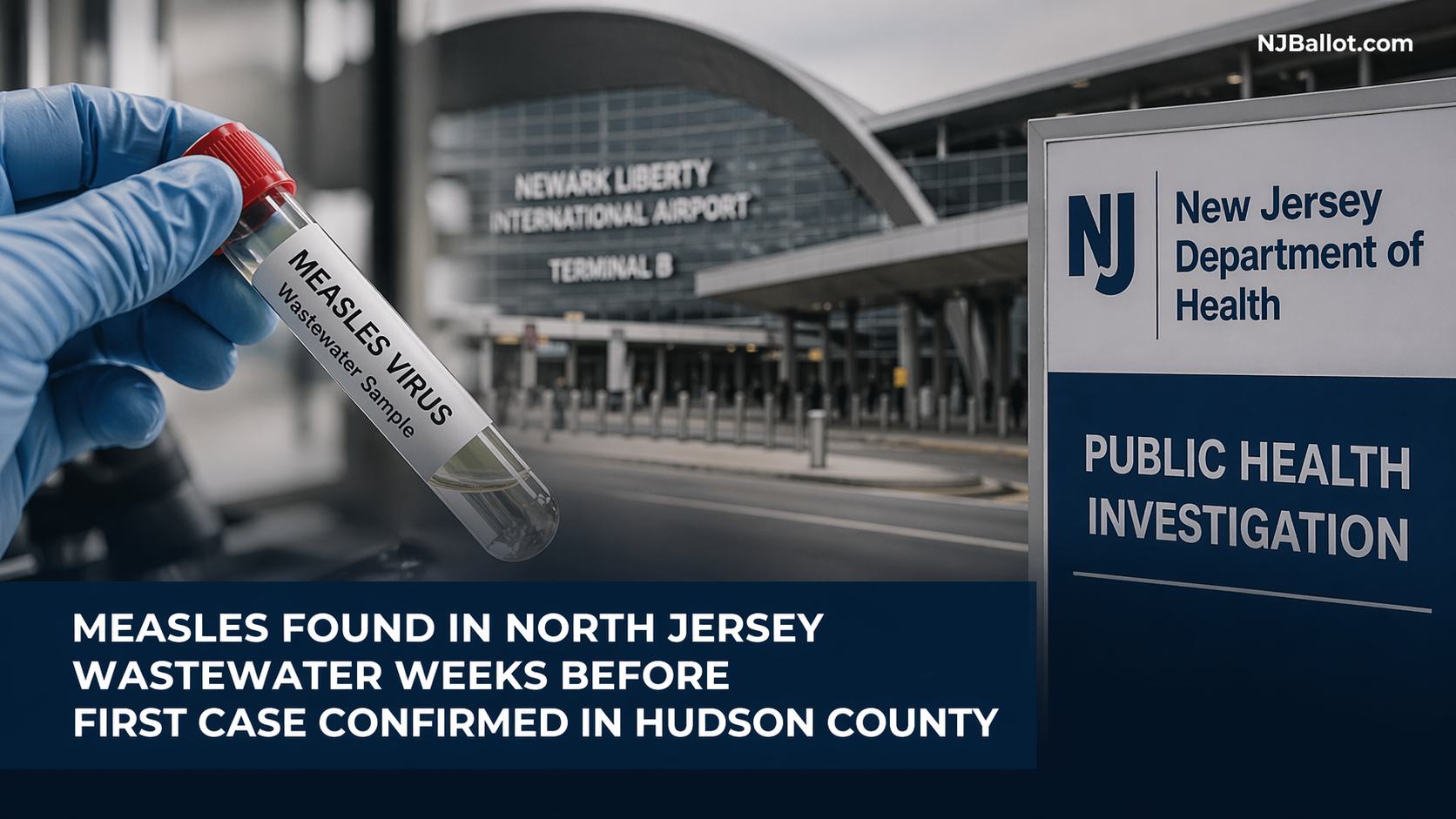

Hudson County—State health officials detected measles in North Jersey wastewater weeks before a confirmed case surfaced in Hudson County. That gap is now raising questions about how early warning systems translate into real-world response.
On April 14, a Hudson County resident passed through Terminal B at Newark Liberty International Airport. Three days later, the individual visited the pediatric emergency department at Hackensack University Medical Center in Bergen County between 11:15 PM on April 17 and 3:15 AM on April 18.
On April 22, the New Jersey Department of Health confirmed the state's first measles case of 2026.
Health officials say the individual, who had recently traveled internationally, remained infectious during both visits. Anyone present at those locations during the exposure windows who is not fully vaccinated should monitor for symptoms including fever, cough, runny nose, red eyes and rash.
Monitoring deadlines are May 5 for airport exposure and May 8 for hospital exposure, with symptoms possibly appearing as late as May 11.
A 33-Day Gap
The warning came earlier.
On March 20, a wastewater sample collected from an Essex County treatment facility serving parts of Bergen, Passaic, Hudson, Union and Essex counties tested positive for measles virus. The New Jersey Department of Health reported the detection on March 26. A follow-up sample days later tested negative. No clinical cases appeared at the time.
Wastewater surveillance is designed to detect viral presence before confirmed diagnoses. That signal alone does not trigger the same response protocols as a confirmed infection.
Under New Jersey administrative code (NJAC 8:57-1), formal reporting requirements activate once a suspected or confirmed clinical case is identified. Public health response is largely tied to clinical illness, not early environmental detection.
The 33-day gap between sample collection on March 20 and diagnosis on April 22 reflects a structural reality. Early warning systems can identify risk, but response protocols activate only after a confirmed case enters the reporting chain.
Hudson County's vaccination profile is stronger than some parts of the state. But it is not immune to risk. State data shows that 3.0% of students in Hudson County have religious exemptions from vaccination, compared to a statewide average of 5.0% and a record of 10.5% in Ocean County.
Overall measles vaccination coverage is slipping. Kindergarten MMR vaccination rates in New Jersey have declined from about 96% in 2019-2020 to 92.8% in 2024-2025. That is below the 95% threshold typically associated with herd immunity.
For Hudson County residents, the exposure locations matter, and they span county lines. Though located in Essex County, Terminal B functions as the primary aviation gateway for county residents, with direct PATH, NJ Transit and rideshare connections. The Hackensack visit brought the exposure into Bergen County. The exposure window, an early weekday morning, overlaps with peak commuter hours.
That means the risk did not stay isolated. It moved through one of the region's busiest transit corridors.
Measles Cases Also Rising Nationally
The New Jersey case comes amid a broader rise in measles activity across the country. According to the Centers for Disease Control and Prevention, the U.S. had recorded 1,748 measles cases as of April 16, 2026, approaching the 2,288 cases reported during all of 2025.
The CDC reports that 94% of cases this year are associated with outbreaks, with 19 outbreaks identified nationwide so far in 2026. New Jersey reported 11 cases in 2025 and 7 in 2024.
Response Gap Raises Local Capacity Questions
Once officials confirm a case, New Jersey's response system activates. Hospitals report to county health departments, which coordinate with the state.
But the strength of that response depends on local capacity. New Jersey ranks 38th nationally in per-capita public health spending, according to America's Health Rankings data cited by the Johns Hopkins International Vaccine Access Center. That ranking can influence how quickly contact tracing, vaccination outreach and public communication scale up after a confirmed case.
The federally funded Vaccines for Children program provides free MMR vaccines to eligible families through enrolled providers statewide, including local health departments in the region. For unvaccinated individuals without evidence of immunity, the MMR vaccine can reduce the risk of infection if they receive it within 72 hours of exposure, according to CDC guidance.
But access depends on clinic hours, staffing and awareness. Those resources can vary across municipalities.
What Happens Next
NJDOH says it is working with the airport and hospital to identify and notify individuals who may have been exposed. As of April 22, the department has not confirmed additional cases linked to the exposures.
Health officials advise anyone who may have been exposed and is not fully vaccinated to contact a healthcare provider immediately.
The case confirmation came on the same day as state budget testimony on immunization funding. On April 22, Health Commissioner Raynard Washington testified before the Assembly Budget Committee on Governor Mikie Sherrill's proposal to add 4 million for immunization funding.
Assemblyman Brian Rumpf, whose district includes Ocean County, questioned whether the increase would address the exemption rates in his district.
Assemblywoman Ellen Park asked whether the money would reach underfunded local health departments.
A wastewater sample collected on March 20 detected the virus. NJDOH issued a public advisory on March 26. The gap between that environmental signal and the April 22 clinical case confirmation highlights a structural question about protocol design, one that surfaced during legislative budget testimony on the same day the case was confirmed.
Sources
• New Jersey Department of Health, "Measles Advisory — Exposure Information" (April 22, 2026)
• New Jersey Department of Health, "Wastewater Surveillance Detects Measles Virus" (March 26, 2026)
• Centers for Disease Control and Prevention, "Measles Case Counts" (April 16, 2026)
• Centers for Disease Control and Prevention, "Vaccines for Children Program" (2026)
• Centers for Disease Control and Prevention, "Measles Vaccination" (March 3, 2026)
• America's Health Rankings / Johns Hopkins International Vaccine Access Center, "New Jersey: Per-Capita Public Health Spending" (2025)
• Dana DiFilippo, New Jersey Monitor, "Health Commissioner Testifies on Immunization Funding" (April 22, 2026)