
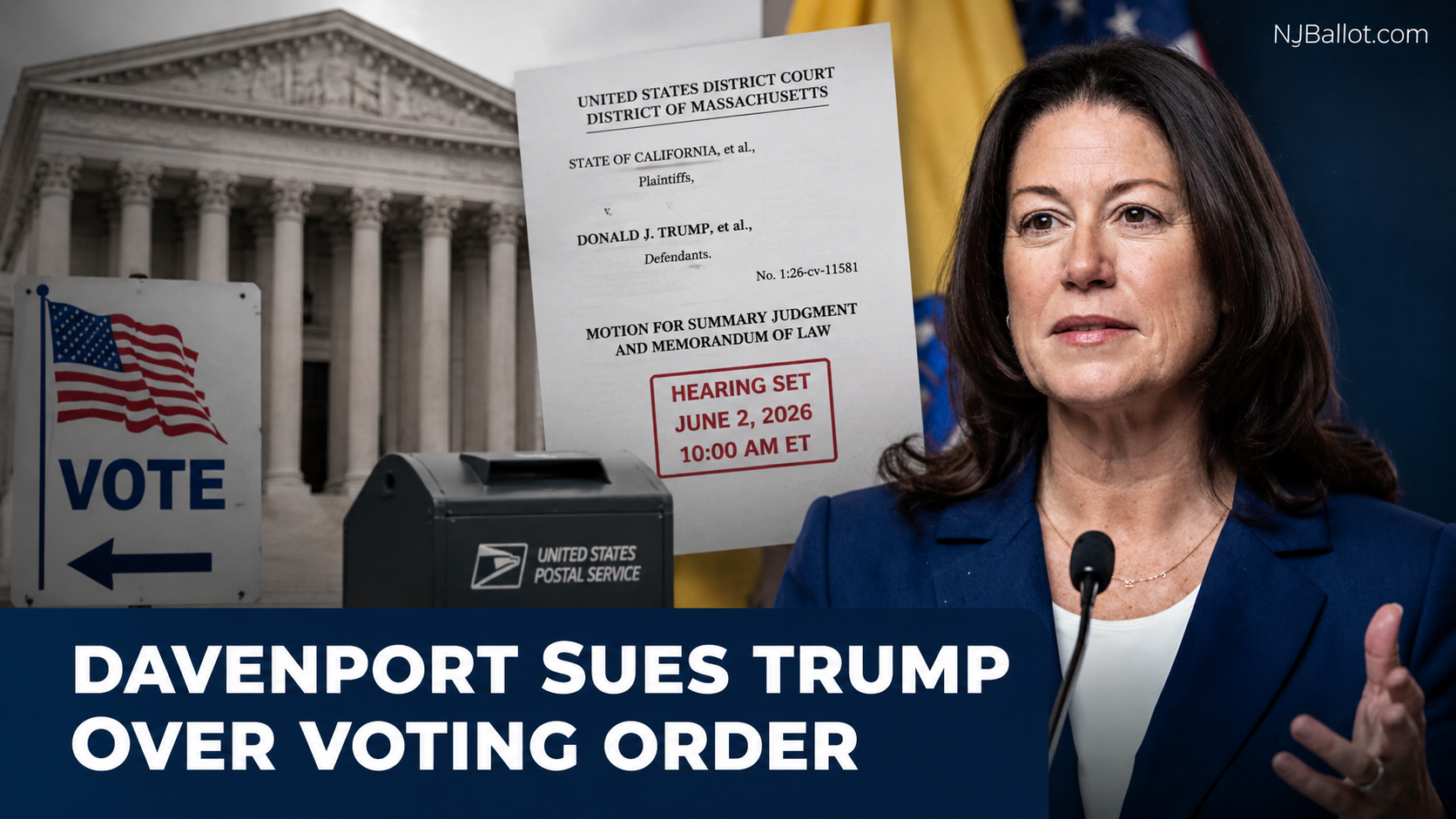

The Attorney General deploys poll monitors and attorneys while court weighs permanent injunction against White House voter-order that would restrict mail-in voting if enforced.
TRENTON, N.J. — New Jersey Attorney General Jennifer Davenport announced a statewide voter protection deployment on May 21, dispatching attorneys, civil rights monitors and cyber threat trackers to polling places as early voting began on Monday. The same day voters cast the first primary ballots, Davenport will argue in federal court to permanently block a Trump administration order that would restrict mail-in voting if enforced.
"Every eligible voter in New Jersey has the right to cast their ballot freely, fairly and without intimidation," Davenport said in a statement. "My office is committed to protecting that right."
Davenport reactivated the Voter Protection Initiative, a protocol her predecessor Matthew Platkin used in 2023 and 2025, according to state records. The Division of Law established a 24/7 attorney hotline for county election officials. The Office of Public Integrity and Accountability opened channels for voter intimidation and fraud claims. The New Jersey Cybersecurity and Communications Integration Cell began monitoring digital and physical threats. The Division on Civil Rights stood up its BIAS portal at 1-800-277-BIAS for discrimination reports.
The announcement arrived eight days before the June 2 primary and 47 days after Davenport joined 23 other attorneys general and Pennsylvania Governor Josh Shapiro in suing President Donald Trump over Executive Order 14399.
That order, signed March 31, directs the Department of Homeland Security to compile citizenship lists using Social Security Administration and immigration databases. It instructs the Postal Service to refuse ballot delivery to voters not on the federal list. It also threatens criminal prosecution and funding cuts against state election officials who resist. The order faces active litigation and has not been enforced against New Jersey voters.
New Jersey relies heavily on vote-by-mail. State records show more than 20 to 30 percent of New Jerseyans vote by mail in general elections. The primary draws lower turnout, but uses the same infrastructure. A disruption to USPS ballot handling or a federal demand for voter database access would hit the state hard.
The lawsuit, filed in U.S. District Court for the District of Massachusetts as case 1:26-cv-11581, moved fast. The coalition filed a motion for summary judgment on April 24 seeking a permanent injunction. The court ordered the Trump Administration to respond by May 7. As of May 25, the administration had not publicly filed a response, according to court records from sister state attorneys general.
The court scheduled a hearing for June 2 at 10:00 AM, the same day New Jersey voters head to the polls.
Davenport did not invent the machinery she is deploying. Platkin announced an identical Voter Protection Initiative before the June 2023 primary and the November 2025 general election. The 2025 announcement added a Division on Civil Rights hotline at 1-833-NJDCR4U, according to state archives. Davenport's May 21 announcement used the same structure, the same agencies and nearly the same language.
What changed is the federal backdrop. Platkin operated the initiative during routine election cycles. Davenport runs it while actively litigating against the White House. The dual posture—state poll protection plus federal courtroom confrontation—creates a timeline where state and federal election tracks converge on a single day.
A 2025 state law expanded the electioneering protective zone around polling places from 100 feet to up to 200 feet at county board discretion. The statute requires counties that adopt the wider zone to post "clear and conspicuous notice." Davenport's announcement cited the expansion as a safeguard.
No county board of elections has posted notice of adopting the 200-foot zone on its public-facing election webpage as of May 25, according to a survey of county websites. Voters cannot determine before arriving whether their polling place carries a 100-foot or 200-foot buffer. The statute gives county boards discretion and does not require them to report the choice to the state or to post notice online.
The Division of Elections, housed in the Secretary of State's office, lists county contact information but does not aggregate zone adoption data. The Office of the Attorney General does not track which counties use the wider zone. State law mandates availability. Counties decide implementation. No entity monitors compliance.
Davenport also "reissued" Law Enforcement Guidance on the Role of Law Enforcement in Election Activities to every local police department and county prosecutor. The document on the attorney general's website carries a February 18, 2022 date: the original Platkin version. It prohibits on-duty or uniformed officers from serving as poll workers or challengers. It also bars officers from entering polling places unless poll workers or county superintendents call for help. The guidance further requires departments to notify the Secretary of State before deploying officers near election sites.
No local police department, county sheriff or county prosecutor has issued a public statement acknowledging receipt of the reissued guidance, according to a survey of law enforcement websites and press release archives. The OAG does not publish a confirmation list. The guidance travels as a routing memo with no visible downstream accountability.
The legislature has introduced bills that would amend the statute. Assembly Bill A194 and Senate Bill S2241 would loosen restrictions on police presence at polling places and drop boxes. Neither bill has advanced to a committee vote. The Office of the Attorney General has not testified or commented publicly on the pending legislation. The 2022 guidance remains operative while lawmakers draft bills to expand police access.
The 2025 zone expansion remains invisible on county websites. The 2026 primary proceeds in eight days.
Federal pressure runs on a parallel track. Representative Nellie Pou (D, NJ-09) led a nine-member state delegation in a letter to USPS Postmaster General Louis DeJoy on April 6, demanding the Postal Service reject the Trump executive order. Senators Cory Booker and Andy Kim signed, along with seven House members including Representative Josh Gottheimer and Governor Mikie Sherrill. The letter cited USPS's own regulatory language: "Postal Service does not administer elections." The Postal Service has not publicly responded.
The delegation letter and the attorney general lawsuit are operationally separate but rhetorically aligned. Both frame the Trump order as federal overreach into state election administration. Both cite separation of powers. Both lean on USPS neutrality as the firewall. The lawsuit seeks judicial nullification, while the letter seeks institutional resistance. Neither has produced a visible federal retreat so far. Federal courts blocked similar Trump order provisions in January 2026.
Davenport's safeguards announcement does not mention the congressional pressure, the pending police-presence bills, the invisible zone adoption or the four-year-old guidance document. It presents the Voter Protection Initiative as a standalone state response. State poll monitors deploy, federal lawyers argue, and county bureaucrats decide buffer distances in silence. Local chiefs file memos no one tracks. Legislators draft bills the attorney general ignores.
The voter sees only the hotline number and the BIAS portal. The rest is infrastructure they cannot directly inspect.
Early voting runs through May 31. Mail-in ballot applications must reach county clerks by today, May 26, for delivery or by June 1 at 3:00 PM for in-person pickup. Election Day is June 2; polls open 6:00 AM to 8:00 PM. The federal hearing in Massachusetts starts at 10:00 AM.
Sources
· NJ Office of the Attorney General, "Attorney General Davenport Announces Safeguards to Protect the Right to Vote During the 2026 Primary Election" (May 21, 2026).
· NJ Office of the Attorney General, "AG Davenport Sues Trump Administration Over Unlawful Executive Order Attempting to Exert Federal Control Over Elections" (April 3, 2026).
· NJ Office of the Attorney General, Election Protection Resources, accessed May 25, 2026.
· California Office of the Attorney General, "Attorney General Bonta Leads Coalition of 24 States in Filing Motion for Summary Judgment to Block Trump's Unlawful Executive Order on Elections" (April 24, 2026).
· Massachusetts Office of the Attorney General, "AG Campbell Leads Coalition of 24 States in Filing Motion for Summary Judgment to Block Trump's Unlawful Executive Order on Elections" (April 24, 2026).
· U.S. District Court for the District of Massachusetts, Case 1:26-cv-11581, State of California v. Trump, active docket.
· Representative Nellie Pou, "Pou Leads NJ Delegation Letter to USPS Postmaster General" (April 6, 2026).
· New Jersey Monitor, "Civil rights groups, NJ Democrats condemn Trump mail ballot order as 'power grab'" (April 2, 2026).
· WRNJ Radio, "New Jersey attorney general announces voter protection measures ahead of 2026 primary election" (May 22, 2026).
· NJ Office of the Attorney General, "Attorney General Platkin Announces Safeguards to Protect the Right to Vote During the 2025 General Election" (October 24, 2025).
· NJ Office of the Attorney General, "Attorney General Platkin Announces Safeguards to Protect the Right to Vote During the 2023 Primary Election" (June 5, 2023).
· NJ Office of the Attorney General, "Law Enforcement Guidance on the Role of Law Enforcement in Election Activities" (February 18, 2022).
· New Jersey Legislature, Assembly Bill A194, 2026-2027 session.
· New Jersey Legislature, Senate Bill S2241, 2026-2027 session.
· NJ School Boards Association, "Election Interference Law Handbook" (October 31, 2025).